
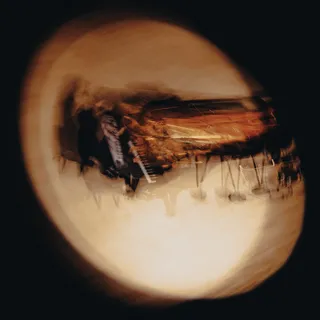
To listen to Cameron Winter perform is to tune into the same transcendental radio that perked up its ears when Bob Dylan and Van Morrison played their first guitar chords. It is to enter into a tradition where songs are never pinned down, and where they are inseparable from the enigmatic performers who rearrange them each concert with a peculiar kinetic awareness that could belong only to them. When listening to such artists, we get the sense that they are out of place in this world, that they should be traveling performers in an America that exists only in myth.
While some might be skeptical of placing Winter on such a pedestal, this live album is a self-conscious attempt to do just that. Besides the cover art’s parallels with Dylan’s 1963 album recorded on the same stage (black background, spotlight on the performer), the fact that the companion film by Paul Thomas Anderson is being released through Janus Films, the Penguin Classics of movie distribution, sends us a clear message: I belong among the greats.
If we choose to accept that claim, we find that Winter’s uniqueness lies not so much in his songwriting itself, since like his forefathers he writes in an infinite Ginsbergian incantation, but rather in the way he carries through this aesthetic vision. Specifically, his marriage of Van Morrison’s lurching and spiraling vocal style with his own idiosyncratic piano playing, a wonderful mixture of Glassian minimalism, impressionist arpeggios, and soulful pounding-of-the-keys. The result is a sound with a peculiar power to evoke bells, churches, gold sermons, waves, and everything heavenly under-the-sun; a sound which can turn slightly embarrassing rambles like
Nina knows the reason, and she's seen into the mouth of
What it is to be a mountain, and she's seen all the good pigeon-like
People shot down and bones be kicked to powder
By the insane wild horses
into the most celestial thing you’ve ever heard. This isn’t to discount Winter’s lyrical talents but simply to note that, like many other poetic songwriters, his words are instruments of hypnosis and not necessarily literary production.
We might even go further and say that the songs, great as they are, aren’t really the main attraction (Winter debuts three new ones here, the best being the heartbreaking “If You Turn Back Now”). The real joy of this record lies in entering a brilliant bardic mind as he discovers how those songs can transform. Take Winter’s choice in the second verse of “Drinking Age,” after “table by the door” and “wallet on the ground” to slam the piano keys, as if to bring us face-to-face with the concreteness of these objects, and then, after “bag of rubber bands,” to pull us up into the room’s atmosphere with a wonderful arpeggiated swell, like a rush of air. Or that sublime vocal three and a half minutes into “$0,” where with one jazzy inflection the moon turns from an object of awe to a reminder of some forsaken lover.
In these moments of wonder we spy the paradises that Winter’s been seeking on his crazy pirate’s quest. I kept finding myself completely awestruck, not only as someone listening in but as if I was actually an audience member in Carnegie Hall, sharing in the silences and roars, interruptions and whoops; all of which articulated my feelings more accurately than any superlative-filled review can. Frankly, listening to the live album I felt as if I was witnessing a miracle in the flesh, and that particular witnessing-quality is a great virtue of the mixing here.
So is all this to say that Cameron Winter is God? Of course not—though I can see it written on a subway wall. But he is the first musician to give us Zoomers any taste of the transcendent, the first one to show us that the sublime is a real possibility, and for a generation so deep in the quagmire of inattention and superficiality that it can’t conceive of the next minute, nevermind eternity, that’s a real gift.