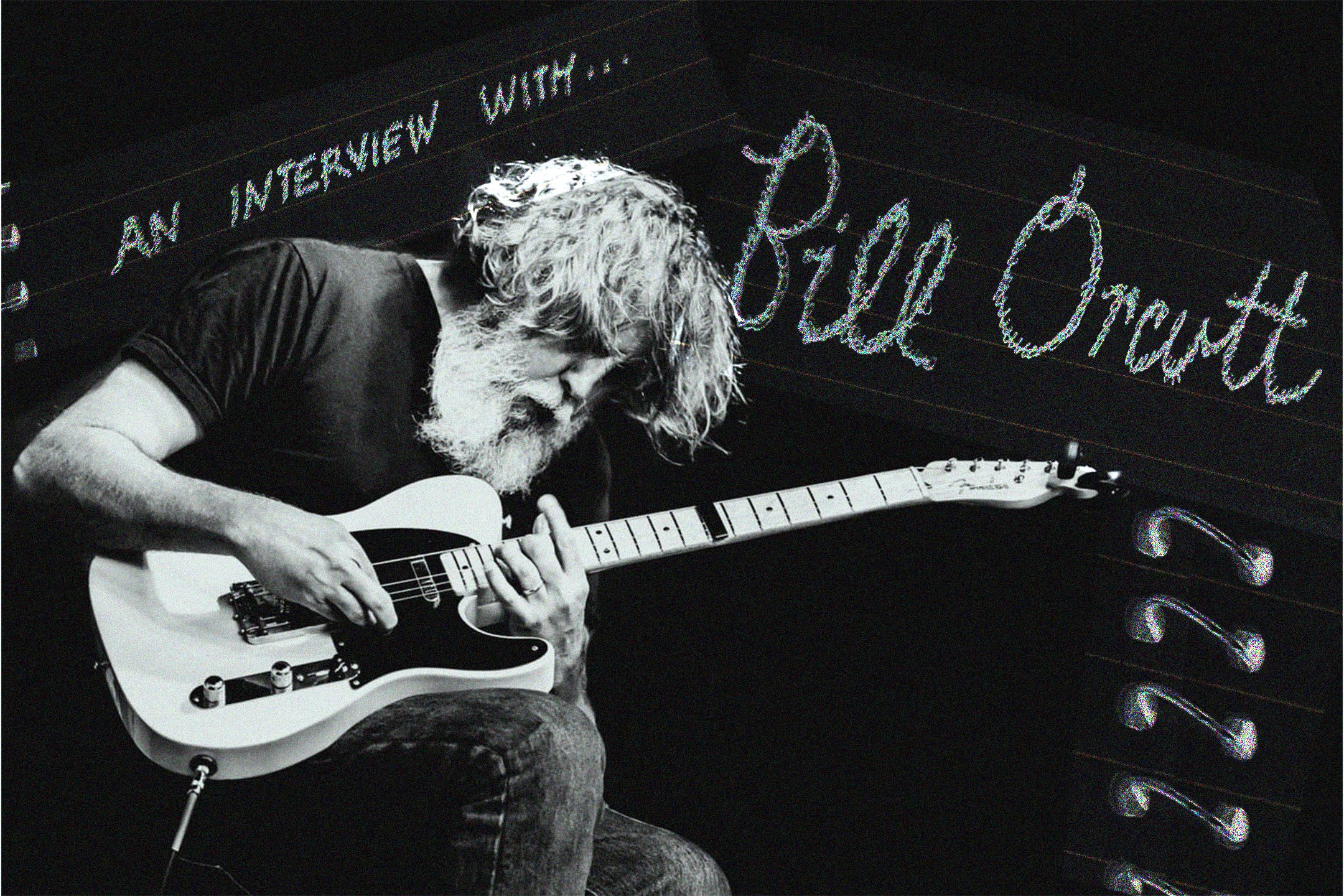
From Miami to San Francisco, from noise rock to blues, Bill Orcutt is a chameleon whose only giveaway is his trusty four-string guitar. He has traversed the breadth of musical genres since he began playing in bands in the mid-80s, and his latest project, The Four Louies, is only one of dozens of genre-nonconforming solo releases. After the dissolution of Harry Pussy in 1997, Orcutt took a decade-long hiatus. But since his return to music in 2009, he’s proved that he will never exhaust the guitar’s potential.
The Four Louies is an experimental rearrangement of two wildly different pieces of music: Richard Berry’s 1957 radio hit “Louie Louie” and Steve Reich’s 1970 avant-garde composition Four Organs. Orcutt finds a through-line between the R&B and minimalist works, manipulating their common key, and dressing it all with the drone of Reich’s organs. The first half of the composition is an enemies to lovers tale between the guitar and Chris Corsano’s drums, but this tumult is soon to be lost in the sea of organ that subdues the second. Performed live, Orcutt and his ensemble run to the horizon, and the longer they play towards no end, heads wobbling, the more the sound becomes noise; Orcutt has always accentuated this distinction. It’s something that could have only been made by a born nerd.
Following two nights at Roulette NYC, and ahead of Philadelphia’s show, Orcutt answers questions from coding, to college, to the creative process on the road.
Graphic by Emma Maurer
How are you feeling after the shows this weekend? And in preparation for the Philly show tonight?
Tired, we’re on the way to Philly right now. I’m in the car with a bunch of people.
You had a really special ensemble playing The Four Louies with you. How did this extremely talented gang of musicians come together for these shows?
That’s right. Well, I knew them. For the New Yorkers, just mostly people that I already knew and have already played with, so Alan and Mari and Chris Corsano on drums.
How did you know that they were right for this project?
I like them, and I know they’re good musicians, and they wanted to do it. That was kind of enough. Chris was already coming down from Chicago, and I love playing with Chris. They were just the right people in the right place. I played with Alan. I put out one of Alan’s records.
About The Four Louies itself: this project rearranges two pieces from very different parts of the music spectrum. How did you find a through-line between the Berry song and the Reich composition, and what is your process like for brainstorming rearrangements in particular? As opposed to original or improvised music…
I don’t know where the original idea came from, I remember I wanted to do a Cracked record, and I had various ideas. Out of nowhere, this idea popped into my head, and I realized they’re in the same key. A lot of the prominent instrumentation is the Farfisa, these cheap electric organs of the 60s.
That drone sound?
Yeah, that’s the organ.
I want to ask you about Cracked because I know nothing about coding. What are the biggest mental barriers you encounter when you’re composing or creating anything, from your coding software to even poetry?
It’s weird. It’s the same as any other creative process. It’s just a tool that’s between you and the end result. You have an idea, then you’re trying to make it real. It’s an instrument in a sense. And coding is different because you’re typing, but at some point it becomes thinking with your fingers; it’s writing. And you’re getting immediate feedback. So you build this thing with words, with code, then you’re hearing the results, and you’re modifying it so that it’s more like what you were imagining.
So you would say it’s closer to writing than playing an instrument.
It’s not really typing. It’s a form of expression.
I read somewhere that you once described music not really as ideas that come to life, but rather self expression. And, someone once told me that they hated the term “self expression,” because it kind of encompasses everything that we are and everything we do. So I was wondering how you feel about this perspective, and if you think coding is in fact a form of self expression.
I mean, it is a form of self expression, unless you’re doing it for work, in which case you’re expressing somebody else’s ideas. But if you’re doing it for yourself, then yeah, it is self expression. And, your friend is probably right that that phrase could apply to anything as humans; what we’re doing all the time is self expression. So I don’t necessarily disagree, but there are people who think that art exists in a realm outside of expression; that is a perspective that’s not mine, so I think that was probably what I was reacting against.
I learned that you used to paint in high school, so is the painter in you, or anything that you’ve learned as a painter, important to your music?
I don’t know. I think, like a lot of kids, I was just lonely and fucked up and it comes out as some kind of art. For me, at that time, I did a lot of painting. I don’t know if I learned anything from it, and when I got to college, I came back and destroyed all those paintings. They were just a way of dealing with whatever I had to deal with.
How did you go about destroying them?
I think I just broke them up with canvas stretchers and they went into the trash. I didn’t burn them. It wasn’t that dramatic.
Do you feel like, looking back, you were as fucked up as you thought you were?
Like a lot of teenagers, I was sad, that’s all. I didn’t know how to fix it. But I think that’s just the condition of being that age.
Speaking of that age, what subcultures were you a part of in Miami that were formative in helping you find sounds that inspired you? What did you think was always really cool?
I don’t think I was part of any subculture. I was just a nerd who read a lot of books. It’s kind of the nature of that subculture that you don’t have any friends. But that was all I did, and when I started playing music, I was working a lot from reading reviews. I had a couple of friends who were into similar music. I don’t know if we qualified as a subculture, but we listened to punk and jazz, so buying those records was definitely formative.
I thought you said you didn’t have friends.
Yeah, you’re right. I had a couple of friends. Tim Powell was one of my friends in junior high and high school. He and I were just about the only people who liked punk in my school. We listened to the Ramones together.
Well, you supposedly weren’t really interested in music until your parents gave you guitar and gave you a turntable. So is that where you started?
The guitar really didn’t make me interested in music. They got me a guitar because they thought that musical instruction would be good for me. It wasn’t until I got a turntable and made friends with Tim that he showed me some good record stores and I opened a door into the whole world.
Did you care about what your parents thought was good for you?
I don’t think so.
Was reading your first love before music?
Yes, I wanted to go to art school. But, I was the first one in my family to go to college, so my parents weren’t going to throw away a perfectly good college education on art school. So I had to figure something out. My first major was architecture, and I was not good at architecture, and it was nothing like art. So I wound up being an English major, because that was the only other thing.
I saw this little blog bubble on Bandcamp under your self titled project that describes your newer releases as “increasingly ear friendly.” How did this make you feel?
I think it was an accurate description of that record, because some of those early records are very deconstructed and more challenging to listen to. That record is a little bit smoother, not as choppy, not as fractured. I don’t particularly like difficult or dissonant music. I’m open to whatever. And once you’re done with it, it goes into the world and doesn’t really belong to you anymore. It’s for other people to figure out what it is.
You’ve written a lot of music with and for all sorts of people, you’re almost unstoppable at making music. Some ego maniacs will resist creating new things out of this fear that quantity necessarily sacrifices quality. So do you care? Or think about this quality-quantity binary?
That’s a good question. I don’t know. I don’t necessarily worry, “Is it good?” I always feel like, if I have an idea, and then after six months I’m still into it, then it may not be good, but it’s me, it’s an expression. It’s coming out of me and it’s valid for me. So if I can figure out how to turn it into sound, then I’m going to do it. The more times you go to bat, the more likely you’re gonna strike out. But who cares? Who cares?
“Just do it” is very much the mindset of improv. What attracts you to improv, and if you think that you can get good at it if you don’t have some sort of natural sauce?
I’ve just suited my own track. And, I never went to music school. So there’s a whole lot of stuff I don’t know and have no direct experience about. So I’ve kind of always done things for myself.
Do you think that applies to everything that you create?
Yeah, I guess mostly what I do is music.
Are you trying to pursue coding or English or anything like that in the future?
I don’t really. The only time I ever work with coding is when I’m working on a creative project. I have enough between my own music and releasing other people’s records. Music is what I do now, for better or worse.
Yeah, your record label. What inspired that?
It just kind of happened. The first record was kind of done by accident, because I had seen somebody and I really liked the music, and I told someone if I love it, I would release it… never really intending that that would get out. And then somebody kind of told that information to the artist. Said, “Oh, Bill would release your record.” And he came to me, he said, “Oh, I heard that you want to put out my record.” So I did it, and that was the first one.
Do you feel like being on the more managerial, operative side of the music business gives you a different perspective on what making art means today, and does it make it feel more bleak? More optimistic? I’m curious.
I don’t really think of it as bleak. I just think the world is not in a good place. But you know, people are. People keep making stuff. Because that’s what we do. So, I just try to make records that people are going to like that I like. That’s number one. Yeah, that’s the only focus I have.
I was introduced to your music by someone who was 18 years old in Phoenix, Arizona, and I don’t know if you quite imagine the people who listen to your music across America, these young people in weird places. But, I guess, what would you say to them? Do you ever think about that?
No, I don’t think I really necessarily visualize exactly who the audience is. I’m thinking about myself. And, I’m glad that there are people who enjoy it. When I encounter them in the world, I’m happy to chat, but it’s too vast. It’s too hard to get your head around all the ways that people are going to take it and what it might mean to them. So I just tend to focus on, is it making me happy? How does it feel for me when I’m playing it, when I’m listening? It’s wonderful, people will come and tell me, “You know, I listened to your record in the 90s and it changed my life,” or “it’s helped me through a difficult time” and it’s lovely to hear. But I don’t know what to do with it, really.
Do you feel like people can really make music for others?
Everybody else has got to find their own path. For me, I’m just trying to make myself happy, which is hard. That’s the challenge, and then, if it makes other people happy, you’re really there. But, I wouldn’t describe my motivators to make music for other people. It’s hard enough to make music for me.
I find it funny you use the word “path,” because actually, in another interview, you described learning to make music like traveling down a path. And I was going to ask you not what that path looked like, but felt ike.
I feel like the path, having done it now for a while… Well, you could say something stupid like… the path is much longer. We’re now coming up on 100 records on my label. It’s kind of like you’re telling a story. And it’s not just, as they say, blue sky, you have all this baggage that you’re dragging along behind you. And it’s not really constraining, but it gives you a context that you’re working out of. So, how does it feel? It’s an interesting question, like, what’s ahead? I’m still motivated by the things that I was maybe 10 years ago, which is just finding new places to put the guitar. I enjoy playing, and try not to make the same record over and over again. So I feel like I keep trying to find new contexts and new people to play with, and different ways of featuring what it is I do.
The guitar, I’m glad you mentioned it. About the four string guitar, you’ve done all these different things, you’ve kept making new-sounding records with different people, but you’ve stayed so close to this four string guitar and this atonal sound. So I was wondering what draws you to it?
The four-string thing just happened by accident. It wasn’t like people always looked for some explanation, like it was the results of years of careful research (laughter). It was just a thing that I started doing only because a friend of mine, I showed him some songs I wrote and he said, “Oh, those are cool. We should do a band and I’ll play drums.” Had I not shown him those songs, had he not said, “Hey, let’s play them together,” I’m sure it would have gone away. Like so many things in my life, it’s just such a random set of circumstances that produced a result.
But do you really think that you could have found this partner in another instrument?
No, I don’t think so at all. It’s all completely random. Playing The Four Louies, I was like, I would love to do this live. I actually sent a copy of the record to William Winant, and I said “I really want to do this live. What do you think?” He’s like, “That sounds great. Let’s do it.” I booked the shows, but I didn’t have a band or anything, and somehow that wasn’t concerning me. At some point people were sweating me, like, what are you doing? So at the show in San Francisco, there was this band on the bill, Gumby’s Junk. Never heard of them. I looked at a bunch of their videos, and I was like, wow, these kids can play. They’re great, why don’t I get them in the band? They were into it, and they introduced me to this kid, Eli, who wound up doing a transcription of the record and made a score. But I never would have met Eli if Gumby’s Junk had not been on the bill. It’s so strange how random circumstances can produce a perfect output. I can’t actually remember what the question was.