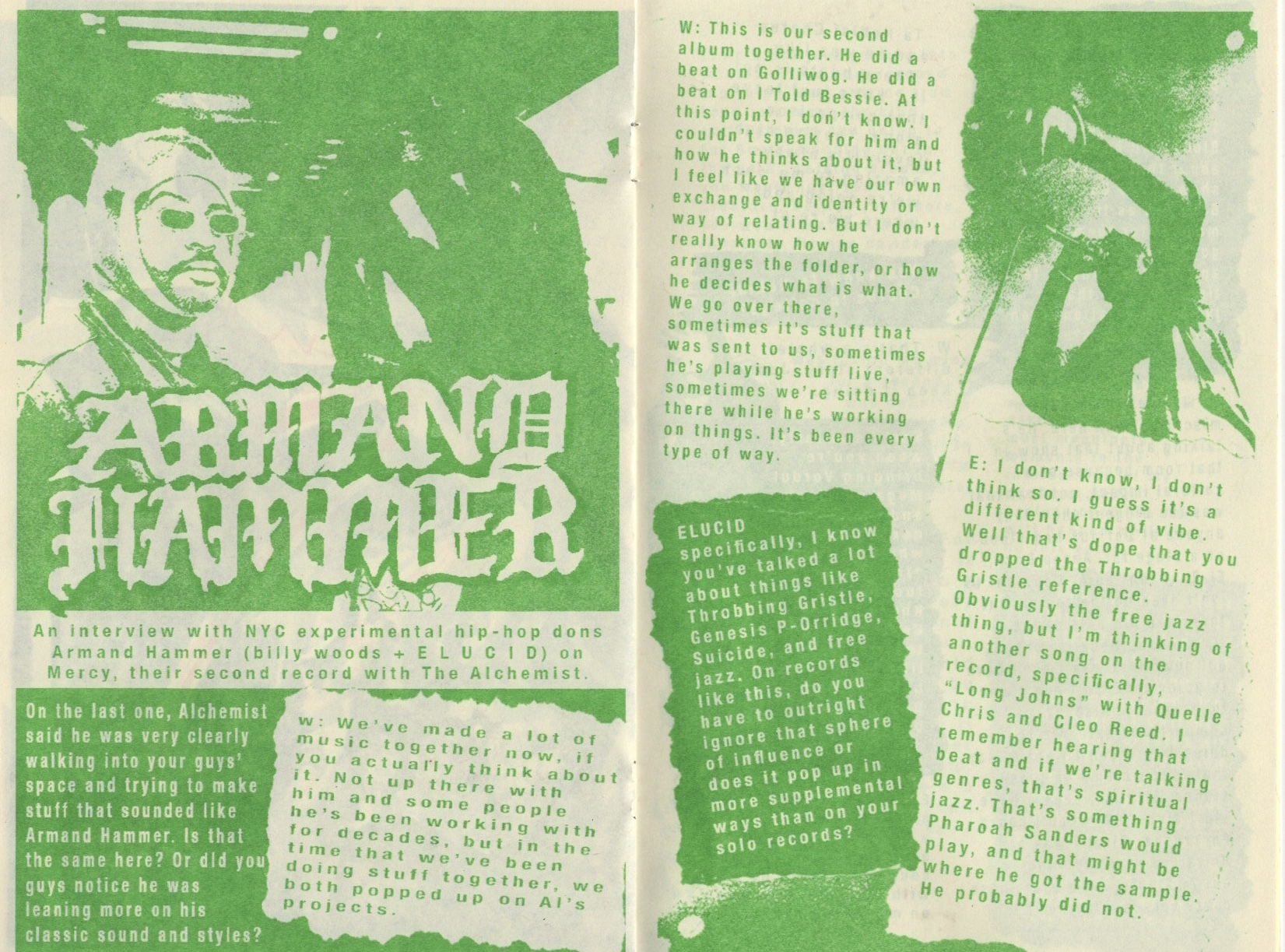
Author’s note: This interview was conducted around the release of Armand Hammer’s album Mercy and was published exclusively in print in the fall of 2025. We distributed the zine (risograph printed and handmade by STATIC staff) locally, mostly to friends and frequent readers. To celebrate the surprise release of the duo’s new record Snakes & Ladders, we’ve decided to publish the interview in its entirety online. The interview was conducted by Benny Sun, the magazine’s previous managing editor.
What were your guys’ go-to consoles or games? What did you guys grow up with?
E L U C I D: Street Fighter 2 was the first game I played on Super Nintendo. Then maybe like NBA Jam. Probably a close second.
billy woods: Street Fighter 2 was definitely memorable on Super Nintendo, but this is the console war days and I was a Genesis kid. I always had to wait a long time to get any type of video game system. My mom was not tryna do it. When the Super Nintendo came out, I played it at other people’s houses, but by the time I was able to get one, Genesis was kind of poppin’, and I just got a Genesis. I think it came with Altered Beasts for free? And I was like “I don’t fuck with this.” Altered Beasts was in the arcades, where the graphics seemed so crazy. But that was one of those free games where you beat it the same day that you got it.
Actually talking about the record now, what was the timeline of this new record? I know Haram took a while, how was it linking up with The Alchemist again?
w: Ironically, I guess I would say that almost the exact same thing happened. I think Al had been very clear that he was like, “Let’s link up and do it,” and the funny thing was we started working on it, and at that point I was doing anything. I had nothing else going on. I had already done Maps and I was just waiting to do this. We started working on it and got some things done, and then at a certain point ELUCID was getting into his solo album, REVELATOR, that came out last year. He was kind of like, “I’m gonna have to put a pause on this. I need to stay in the space of my new record.” As hard as it is to believe, at that time, when we first started doing this, Al didn’t have a lot going on. He had a lot of things on the whiteboard, but some of them he hadn’t started yet. Chaz was just working on his album. I didn’t have anything to work on, so that’s actually how I ended up making…I had ideas of doing the Golliwog album, but had no clear plans to do so. But all of a sudden, I was the only one not doing anything. So I went and did that album because of that. We reconvened and got back into it again, did the other 60% of the record or something. What do you think, [ELUCID]?
E: I forgot some of those details in there. But that’s true to life.
w: Because you’re an artist’s artist. You’re like, “I’m painting rooms purple right now. I can’t paint a black room.” That’s not the case with me. I’m just like, well whatever!
E: There was a contractual thing where I had to finish the record by this particular time too. Both things are true. I feel like we did a couple things early. I can’t remember, did we do “Super Nintendo” the night before we went to Australia or New Zealand? I feel like that’s where we started off. I feel like we started off and “Super Nintendo was one of the first batch of songs we recorded. Is that true?
w: “Super Nintendo” was early. But I know if it was that early. It was definitely early. We did a bunch of recording early on, in LA and then in New York, then we paused. When we came back, there was actually a good amount of songs that were actually culled. Some good songs that were sent to other locations. When we came back, we were like, “We’ve done 15, or 12, I don’t know how many we had, songs. Here’s the core seven we’re going to build on for the rest of the record.” Other records floated off that are still sitting out there that are good records. Or totally different things happened once we came back. “Long Johns” was a different type of song before.
Was it ever gonna be Haram 2, or at least titled that? Or was it straight away something different entirely?
w: Hell no. C’mon. And sorry: that’s not disrespectful to anyone else, I like thinking out new names. It doesn’t matter, if the music is good, call it whatever you want. But for me that’s one of the really fun parts, is thinking of names and directions. I wouldn’t turn down the opportunity to do that, that’s how I should say it.
On the last one, Alchemist said he was very clearly walking into your guys’ space and trying to make stuff that sounded like Armand Hammer. Is that the same here? Or dId you guys notice he was leaning more on his classic sound and styles?
w: We’ve made a lot of music together now, if you actually think about it. Not up there with him and some people he’s been working with for decades, but in the time that we’ve been doing stuff together, we both popped up on Al’s projects. This is our second album together. He did a beat on Golliwog. He did a beat on I Told Bessie. At this point, I don’t know. I couldn’t speak for him and how he thinks about it, but I feel like we have our own exchange and identity or way of relating. But I don’t really know how he arranges the folder, or how he decides what is what. We go over there, sometimes it’s stuff that was sent to us, sometimes he’s playing stuff live, sometimes we’re sitting there while he’s working on things. It’s been every type of way.
E: But I’ve always appreciated that sentiment. I remember when I heard him say that. But it’s always a thoughtful drop, when he’s sending us beats or whatever he’s playing for us in the room. When I hear it, sometimes I do not hear some of Al’s collaborators. So many dope rappers he works with, I feel like they may not have chosen this particular beat. They may not have rhymed in this particular time, or how the drums are falling in the beat. They may not have chosen the things that I’m attracted to. Maybe woods can speak on that.
w: When he sends a pack of beats, that’s a different energy. He’s going through and cultivating those and thinking these are the ones. If we’re in the studio and it’s 2 a.m., and ELUCID is half asleep on the couch and I’m rolling another one, like, “play some more shit!” I don’t think it’s cultivated in the same way. I obviously don’t have any idea, like he’s the mad scientist. I don’t know what folders he’s pulling from or how he’s deciding, but sometimes he’s on the analog machine, just turning dials, playing beats, it’s 3 a.m. So that’s a different story. When he’s sending an email with a pack of beats, I feel like he’s really thought them out and picked them out for specific reasons and vibes. He’ll be like, “We need to paint in this color. We need something that’s this color.” I remember with “Super Nintendo,” he was like, “This color we got, this really works. I want you guys to listen to that one.
ELUCID specifically, I know you’ve talked a lot about things like Throbbing Gristle, Genesis P-Orridge, Suicide, and free jazz. On records like this, do you have to outright ignore that sphere of influence or does it pop up in more supplemental ways than on your solo records?
E: I don’t know, I don’t think so. I guess it’s a different kind of vibe. Well that’s dope that you dropped the Throbbing Gristle reference. Obviously the free jazz thing, but I’m thinking of another song on the record, specifically, “Long Johns” with Quelle Chris and Cleo Reed. I remember hearing that beat and if we’re talking genres, that’s spiritual jazz. That’s something Pharoah Sanders would play, and that might be where he got the sample. He probably did not.
w: NIcholas Craven on your head for saying that!
E: Hahaha why? What would he say?
w: You said the possible name of a sample.
E: True. He’s the king of samples.
w: “Long Johns” was definitely one that you picked out early, like this is happening.
E: Al has a really good record collection. My uncle was a DJ, I’m from that thing. Being in someone’s record crates and them being a very tasteful sort of DJ with a real ear for the ideas they want to make through other people’s music, he knows that. That’s what I really connect with, man. He just makes dope shit. It’s very nostalgic for me.
Do the both of you work at the overlap of your tastes? Or are you guys trying to talk the fringes that one or the other might not know about.
W: I don’t think about that.
E: We both can rhyme over so many different types of beats. I’m more picky. Oftentimes, he’ll let me lead the direction in songs, and then he’ll do what he wants to do, and we’ll do that song. But I think I might take the lead there.
W: There was a lot in this where, of the packs we were sent together, we’re picking the same thing. And honestly, some of the ones where we didn’t feel 100% about the same beat ended up being good songs that are not on the album currently. Like I said, due to the two stages of working and everything, we ended up with a good amount of tracks, and some of them found other locales or will. Part of that was some of them were ones where I like the beat more than anyone else, or once we’re putting the album together, it might be like, “Oh, this doesn’t really fit.” Or if it fits, it has to fit here and ELUCID and Al prefer a different song. There were different versions of things. “Long Johns” was different. Quelle Chris wasn’t on it. Cleo Reed, who’s amazing, wasn’t on it. In the original version, I had a verse that was good, I just feel like the current version of the song is better.
When you’re calling up guests on the record, you have this really tight circle around you, how are you deciding who to call? Is it a scheduling thing, or is it that you have a strong vision for Siifu on this one, or Cleo Reed’s voice on the record.
E: The first thing for me and people that I’ve brought into the fold, it’s always that I gotta love what you do as an artist. It’s gotta make me feel a particular way. I really gotta connect with it. It’s been a spontaneous sort of thing. I don’t know these people, but I’ll just reach out in whatever way possible. Social media has fostered some of these relationships. I go see you live, then it connects, then I just ask. People, they want to do something, we made it work. I think that’s where it starts.
W: I think our approach is different with some of that. ELUCID always works very organically. Sometimes for me it’ll be something I’ve really thought about, and sometimes the opportunity is there. A good example is I felt like I wanted Earl to rap on this album. Talked to him early and that was one of the last songs we did in L.A., all together, writing in the studio at the same time, late night. Recorded the back and forth and everything in the booth. The Siifu thing was, “You would probably sound good on this beat.” Siifu always has some scheme he’s cooking up. He’s gonna do something, whether he’s gonna release it or not.
Cleo Reed is somebody who I did a show with years ago. I tried to collaborate with her on Golliwog and some of the timing and schemes didn’t work out. We were already talking, and it was like, “What about this?” She said, “I got this song, you do that I’ll do this,” it was real simple. Just someone who I thought their music was really different, really crazy. Silka, ELUCID already had a working relationship with them and that was real easy. Kapwani is also one of the features.
Quelle, we were on the road together earlier in the year. He’s just somebody who and just somebody, when you’re around, talking and playing music, discussing lots of things. We sent him something to choose, and he, of course, was like, “I could do both of these,” and that can go either way. This time it went really well, it was automatic, real easy. He says he has a joint for us.
E: Ooh…
I remember a few years ago I talked to Blockhead and he said that he got two hours with Danny Brown in the studio and just churned those two verses out, the one on Maps and his record.
W: I got those hours. We did it at Steel Tipped Dove’s. Blockhead was somewhere in the West Village swirling a cocktail in his hand as he stared out of the floor-to-ceiling windows of his condo, hands unsullied.
Not that I was there for it, but I think a lot about how people talk about the scale of the underground shifting so aggressively. Blockhead kept talking about that ‘07 Def Jux show at the Bowery Ballroom as this real big moment for them. But you guys are playing to rooms and festival crowds ten times that. Is that a jarring escalation, even across 20 years?
W: Well let’s not make a miscomparison here. He’s talking about that show in that room because of a cultural impact, not that that was the biggest show that anyone at Def Jux had stood on a stage for. Aesop Rock, El-P, at that point Cannibal Ox isn’t even on the roster, but these are big acts at the time. Aesop Rock is a huge act now, he doesn’t even have to go on tour. So I don’t want to make any false comparisons here. We’re doing fine. I don’t want to say that they weren’t on those stages. El-P has been a huge start since ‘97, when I heard Funcrusher Plus, I was at Howard University bugging out in a dorm room over these crazy verses, playing it for Ta Nehisi Coates and he was like, “These beats is not it.” Let’s just leave that comparison alone. They’re high level. It’s always amazing to me what we’re doing and where we’re at.
You knew Ta Nehisi Coates in college?
W: That’s a whole different story. Just keep it going.
Sorta similarly, when you’re bringing Vordul Mega on stage and standing next to him while he raps “Iron Galaxy” at fucking Knockdown Center, what’s that feeling like for both of you? Does surreal begin to describe it?
E: For me, absolutely, as a fan. I met him that afternoon, I saw him at sound check and he was with Creature, who was on my record REVELATOR. As a kid just getting into whatever this underground rap thing was, coming from Long Island on the LIRR, cutting class and going to Fat Beats, hanging out in the park, walking around, you would just see Creature. He was just there, you would just see him randomly. He had no idea who I was or whatever, but I knew Creature through open mics and shows. So seeing Vordul on stage, I was losing my mind for a second. It was definitely real energetic, real ill to see him up there.
W: For me, it was a very emotional moment. I wouldn’t be making music if I never met him. He’s a person I feel very close to and it was a powerful, meaningful moment for me in innumerable ways. The first time I heard those lyrics was acapella in my living room on 151st Street in Harlem. I was like, “I never heard anybody rap like this.” He was like, “El-P’s gonna make the beats,” I was like, “You’re tripping. That’s never gonna happen.” He was like a teenager in high school, by then he was 17. Words can’t describe one of the most meaningful moments in the intersection of my personal and professional life that will happen while I’m on this earth.
On the other hand, I spoke to DJ Haram recently and she said she introduces you guys to a lot of the women she works with. She outright told me she thinks Backwoodz should have a lot more female rappers. Is that something you guys are both cognisant of, especially the younger crop and things like that?
E: I think that’s important. I think that’s important to share and I feel like we’ve made some attempts at that for sure, with recording or live shows. We’re not operating in a vacuum. We have a lineage. We’re part of a larger system that supports people younger than us that share a vision. I remember the first time I thought about this was when I heard AKAI SOLO. He just made me feel a way, like yo I understand exactly what you kickin’ right now. I feel you completely. AKAI SOLO is much younger than me. I know there’s kids even younger than him. It’s important to me.
W: For my part, I appreciate that there’s always people round to give me all types of angles to think about things from. In the moment, people like Haram and ELUCID who are way more plugged in than me, I appreciate, in the moment, when I find myself in the midst of those sorts of things happening. At times, I try to be more intentional about seeking it out and making it happen. It’d be a mistake to say, oh, that’s my super duper number one priority, but I’m reminded of it by the type of people that I’m around, and I try to appreciate when I’m in moments when you’re like, oh, this is kind of crazy. And definitely, as a person out in the world and as an artist, meeting, not even necessarily artists I work with, but people out in the world, where they’re like, oh, this shit is really changing my life or changing my way of thinking about art. There’s people who were that for me. Then ten years later, I was finally doing my thing and it reflects part of that.
When I’m talking about something like that, El-P records? That shit changed my- I was like, this shit is crazy man. It was crazy. We were in that dorm room listening to that record so much. When the RZA dropped that second Bobby Didgtal record that nobody listened to. If I linked up with him, I’d be like, yo, that was so important to be as an MC. There was this song, “Must Be Bobby” that [producer] James Bond had on vinyl, he had the single. I cannot tell you how many mediocre rhymes I wrote to that instrumental. When you talk about putting in 10,000 hours, that instrumental was in the joint. We would just sit there and record. I didn’t come up when there were recording systems, so I was just recording to a cassette tape through Bond’s little monitor, just so I could figure out rapping. There’s all sorts of things, and writers whether it was somebody like Baldwin or bell hooks or McCarthy or whoever, Stephen King, things that sparked my imagination and took me somewhere else. Sometimes you meet people who are young and a 17 year old is like, this shit is what I think about and changed the way I think about art. Some point down the line, some of those people are gonna be like, this is part of what took me to where I ended up going with whatever I was doing. That’s gonna be crazy to experience.
One of the coolest things when I really started following you guys was the amount of people who are super dedicated; I’m thinking of Caltrops Press, who creates all those really detailed zines. Has that ever been on your mind, knowing that there’s people really pouring over every interpretation of every line of every choice made on these records, down to the skin and bones?
W: To me, if anything, sometimes I listen to a project and I’m like, “Why didn’t I do X? Why didn’t I go with this line.” I do that so much myself that I don’t really think too much about what others…Ocassionally of course sometimes you write something and you’re like, “Is that going to be interpreted in a way that I don’t want it to be?” And then you have to decide whether it’s, fucking, I don’t care, or let me switch it up.
Conversely, a lot of your fans are very young, very online, they’re white and kind of stupid. They’ll loop you both into weird discourses and things like that. Is that annoying, flat out?
W: The thing to me from doing shows, and I literally just got off the road, it’s a lot of different people. When you’re actually out there dealing with people in person, it’s just a wide spectrum of people. There are people older than me who come up…there’s a guy from Brookyln who, really, was giving me retired cop energy, a little bit. Not in a bad way! Just where, if he ended up being a homicide investigator who’d retired for a while and now lived in Belgium, I would’ve believe. Or like a union, some sort of construction union. He knew all about the music, mad respectful, friendly, and went about his business. And then there’ll be like a teenage first generation African immigrant but born somewhere in Europe, like, “Man, this shit is super important to me,” or “I’m Zimbabwean, I grew up there and knowing you’re from Zimbabwe,” to people bringing actual children, to the people that you’re talking about. I feel like it’s not productive for me to spend a whole bunch of time figuring out the dynamics. I’m gonna see you outside, and if you’re just a person who posts things on the internet, I try not to take it too seriously one way or another. You end up in a lot of silly games for no reason. “Your fans are all white.” No they’re not! If I had the spare time man, I would really do it. But I really don’t.
There’s a line that really stood out to me [on “Scandanavia], the idea that woods would [‘burn this whole thing down and go back to hustling for my dinner’]. You’ve also talked about the idea of artistic immortality, especially with people like Baldwin, McCarthy, bell hooks, or Throbbing Gristle. Legacy is a weird thing to talk about, but you guys are dozens of records in. What does aging gracefully in rap music look like to you guys?
W: First off, and I’ll let him answer this; his opening line in that song refutes my premise all together. He says “he might, but I ain’t going back.”
E: Legacy? It’s a distraction from creating and being right now in the moment, trying to make shit. I try not to think about these things. I know these things outlast me. They will outlast our children, who will hopefully tell the story. Hopefully I’m a good character in the story when they grow up. These things outlast us, cool. Now what? I’m still trying to say what now means.