
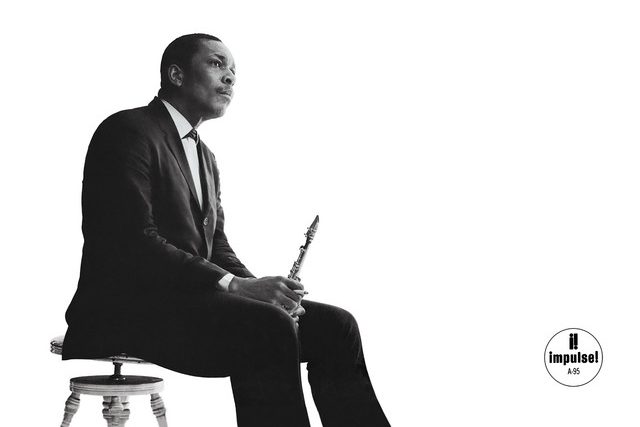
There is a story Alice Coltrane told of her husband John, who once descended from the staircase of their house holding the music “like Moses coming down from the mountain,” said Alice, for what would eventually become A Love Supreme. The record, famously, marks an artistic highpoint for John Coltrane, a rare instance where an artist’s vision of finality properly manifests not only in their own catalog, but within their entire genre as well. But the ascribed narrative means that, too often, Coltrane’s work in the few years ensuing are overlooked in favor of his more beloved priors. As the first and most consequential record released in the last chapter of his life, Ascension is a seminal masterwork that functionally normalized entire new sects of jazz and avant-garde music whose reputation as an aesthetic disaster has long-deserved amendment.
Beneath all of A Love Supreme’s radical and perceptive compositions, there was a very obviously beautiful jazz record. Coltrane’s playing was exuberant and daring, though not quite as encompassing as the “sheets of sound” approach many retroactively ascribed to the style he had begun exploring in the years prior . Even when it dipped into rougher territory – a squawking low-note here, some heavy hitting from Elvin Jones there – there was no cause to label it as anything but beautiful. But after he achieved what he perceived to be his final aesthetic destination, he found himself in a time of artistic tumult. When newcomers like Albert Ayler, Archie Shepp, and Pharoah Sanders began recontextualizing the way a saxophone could be wielded, the New Thing became an outlet for John Coltrane’s ambitions.
When Coltrane’s quartet, plus Archie Shepp, took the stage at Soldier Field in 1965, just months after the release of A Love Supreme, he presented what sounded like a totally overhauled vision of himself and many went home rather than endure the cacophony. A taste of this can be heard on Sun Ship, which was recorded about a week after the Soldier Field gig without Shepp. The tempered calm of A Love Supreme is nowhere to be found, Coltrane is pushing the limits of his instrument at nearly every moment, and Tyner, in particular, generates a wall of sound that plays a cornerstone to the rest of the quartet’s restlessness.
Ascension only furthered that cacophony. Recorded in early 1965, Coltrane turned four into 11: alongside Shepp, Coltrane added Sanders, Freddie Hubbard, Dewey Johnson, Marlon Brown, John Tchicai, and Art Davis for two trumpets, five saxophonists, two bassists, a pianist and a drummer. Unlike Ornette Coleman’s seminal Free Jazz, where two quartets performed freely and indistinguishably together, the ensemble on Ascension does get time to individually shine across a series of solos. These segments, momentary relief from the chaos, range from revolutionary performances that dare redefine an instrument to just-okay holdovers that pass the time well enough. Coltrane’s solo obviously shines as the record’s crowning achievement, but Shepp puts up a performance on par and hearing Freddie Hubbard in this loose context is an almost equally enlightening experience. The record ends on its two weakest solos though: McCoy Tyner’s playing never matches the extravagance of his ensemble and the double bass duet by Davis and Garrison are too muddy to make much of an impact.
Ascension thrives when the ensemble plays as a total unit moving full speed ahead. Here, the music feels apocalyptic, as if it’s a musical manifestation of the heavens of Revelations. Coltrane’s playing stands out especially during these moments, squealing and squeaking like a rusty door hinge, or a belabored man taking his last breaths. The juxtaposition of the old guard and new faces creates an anachronistic air around the entire record. As Shepp and Sanders sputter through their parts, Elvin Jones lays down some modal chords that could easily have been found on an earlier Coltrane record like Giant Steps. The friction between the two schools of thoughts creates a wonderful chaos that feels like witnessing a struggle between heaven and hell.
It’s fascinating purveying the reaction Ascension elicits, then and now. People seemed impressed at both ends: those who heard it as a culmination of new trends in jazz, as a confusing jumble of hyperbolic performances and meandering noodling, and everything in between. In his book Coltrane: The Story of a Sound, Ben Ratliff describes Ascension as “not a success in particular,” while Eric Nisenson describes the record as an “audacious failure” in his awkwardly titled book Ascension: John Coltrane and His Quest.
These characterizations feel like something of a misplacement of the record, its purpose, and its impact. To say it was an aesthetic disaster is one personal thing, but to describe it as having failed its mission feels ahistoric. The record was a success insofar as the barriers it broke down between the amorphous, unconsidered New Thing and the traditional jazz establishment. Chicago’s AACM has essentially spent its entire history breaking apart Ascension and putting it back together, as has much of European’s free jazz history. The record became the connective tissue for an entire half-century of daring music. Texture suddenly became feasible propulsion. Glenn Branca’s own Ascension became a crucial blueprint for any sort of noisy rock that followed it; the frantic hammering of Sonic Youth’s Steve Shelley sounds eerily like that of Elvin Jones’ solos. With the title of his book, even Nisenson seems to acknowledge that, to some extent, Ascension marked the final destination for Coltrane’s snaking artistic journey.