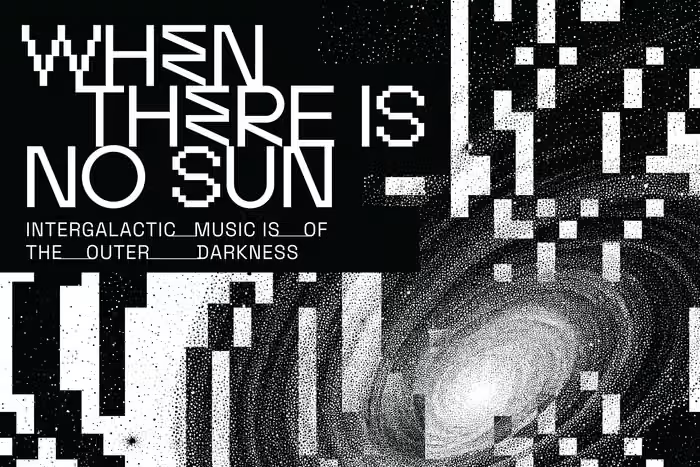
NYC and Istanbul based label OMNI enlisted Berlin minimal techno producer/DJ Ricardo Villalobos to the experiment of bringing Sun Ra’s cosmic philosophy to life in sound. The compilation of 12 tracks from seven producers grounds samples of drawling trumpets and tinkling woodwind riffs into a carefully structured arc of stripped back dance beats that pull rhythm from across the board, including techno, drum and base and house. When There Is No Sun asks a group of powerhouse dance music producers to reimagine a visionary jazz musician’s poetry. The result feels more apt for a library bookshelf than the dance floor, even if it reaches for both.
Where the compilation shines is Villalobos’ curation. His comfort in hours-long, tunneling DJ sets makes itself known in the compilation’s architectural journey. Underground Resistance seats the journey in the poetry with the compilation’s opening sample from the spoken word recording of Sun Ra’s poetry My Words Are Music. Underground Resistance’s commitment to techno that foregrounds the power that music has in building radical imagination grounds the opening of the compilation into the intellectual roots that underscore Villalobos’ curatorial efforts. As curator, Villalobos has taken on the steep task of articulating an Afro-futurist philosophy rooted in Sun Ra’s belief that he was originally from Saturn; by dedicating the opening spotlight to these lines and calling on the legacy prowess of a radical Detroit techno collective, he underlines the intellectual roots of this compilation. Sonorous and steeped in certitude, the voice of Saul Williams assures listeners in the opening lines that “When angels speak, they speak of cosmic waves of sound. Wavelength infinity.” It’s hard to not feel the impact of a voice so resonant and steeped in sonic strength. Chugging behind the sparse poetry lies a high-hat led drum beat, setting the compilation into a steady forward motion not dissimilar to a Kraftwerk-esque motorik beat.
Experimental favorite SHE Spells Dooms carries on the stride that UR set in motion, but pulls more from the recordings of Sun Ra’s celestially inspired orchestra Arkestra to interrupt the uniformity of the four-to-the-floor chug that blends the tracks together. It’s lush to listen to; dissonant piano glissandos, rich saxophone that cuts through a stripped back electronic backing. But a lack of changing rhythm structures begins to move me towards distraction, rather than the meditative state that Sun Ra sought to open listeners to through the Arkestra. A key function of the Arkestra was to build soundscapes that encouraged listeners to self-reflect, meditate, and ultimately nudge listeners to open themselves up to their own imagination, demonstrative of his belief that sound allowed for individuals to imagine, and ultimately bring to fruition, a radical future free of the oppression of constraints such as race and gender. Distraction in the form of boredom is antithetical to that mission and right as distraction starts to settle, Villalobos brings in a remix from the Belfast legend, Calibre, cutting through with the potent energy of liquid funk drum and bass the producer is known for.
Calibre’s remix is an explosive, rewarding, and somewhat refreshing change of pace in a heady compilation that might lose the casual listener. Explosive, fast breakbeats give way into samples of an accordion that breathes an air of humanity next to electronic drums; a contrast that widens the gap between machine and human. The space between these sonic realms is bridged partially with piano riffs that cut across the divide through a tight, near staccato individual notes, where resonance is supplemented by the bass electronic base rather than sampled piano. But the explosive power of Calibre depends on its positioning within the compilation as a whole, reliant on juxtaposition with restrained minimal beat rather than full-throttle sonic overload.
The following tracks by Villalobos, Istanbul’s Baris K, UK acid legend A Guy Called Gerald, and Chicago house icon Chez Damier move between minimal techno, piano infused house, deep house, ambient and jazz. Calibre is marked as an energetic crux before tracks stretch out towards the ten minute mark, tracks steadily rumbling forward in hopes of the listener being moved into introspection. Villalobos is doing what he is so legendary for; imposing exceptionally clear structure into a sonic composition. But that structure becomes the compilation’s own pitfall, largely indebted to the relationship between structure and the poetry that runs through the compilation.
In the indecipherable scrambling of the poetry, an art so deeply entangled with its form, the messages of the poems start to disintegrate (or at least, lose conceptual wholeness). Especially in the pursuit of articulating such a complicated ideology, putting the task of untangling poetic meaning onto a listener is a weighty task. By the time the poetry reaches the listener, it has undergone at least two shifts of form; from written to original vocal recording, then from original recording to this compilation. Villalobos’ curation becomes its own poetic effort, one that might overshadow the original messaging to a listener unfamiliar with the source material. By no means is it an undue task, and to a listener who cares to sit and sort through the layers the compilation serves as an exciting jumping point into the world of Sun Ra.
Somewhere in Villalobos’ chase of architectural feeling, and the sonic continuity that can require, the individual tracks have lost some of their dance floor appeal. Tracks such as ”I have forgotten feat. Tara Middleton,” Villalobos’ 10-minute remix, might certainly find home on a minimal techno dance floor, but would simultaneously lose their conceptual backing which the compilation form affords. This is an experimental compilation rich with jumping points into a deeply theoretical philosophy, but it begins to fall apart when you remove individual elements from the scaffolding Villalobos has created.
Despite the dance-floor legends that produce this compilation, most of these tracks are not for a dance floor and that’s ok. The beauty of this compilation lies in its self-awareness and commitment to the form of a compilation. The holistic architecture that makes it successful in the sonification of Sun Ra’s philosophy is simultaneously an architecture that individual tracks do not carry alone, and shouldn’t be expected to. Villalobos has built a listening experience for those with the patience and willingness to untangle poetry that has shifted form and perhaps cannot survive another shift.