
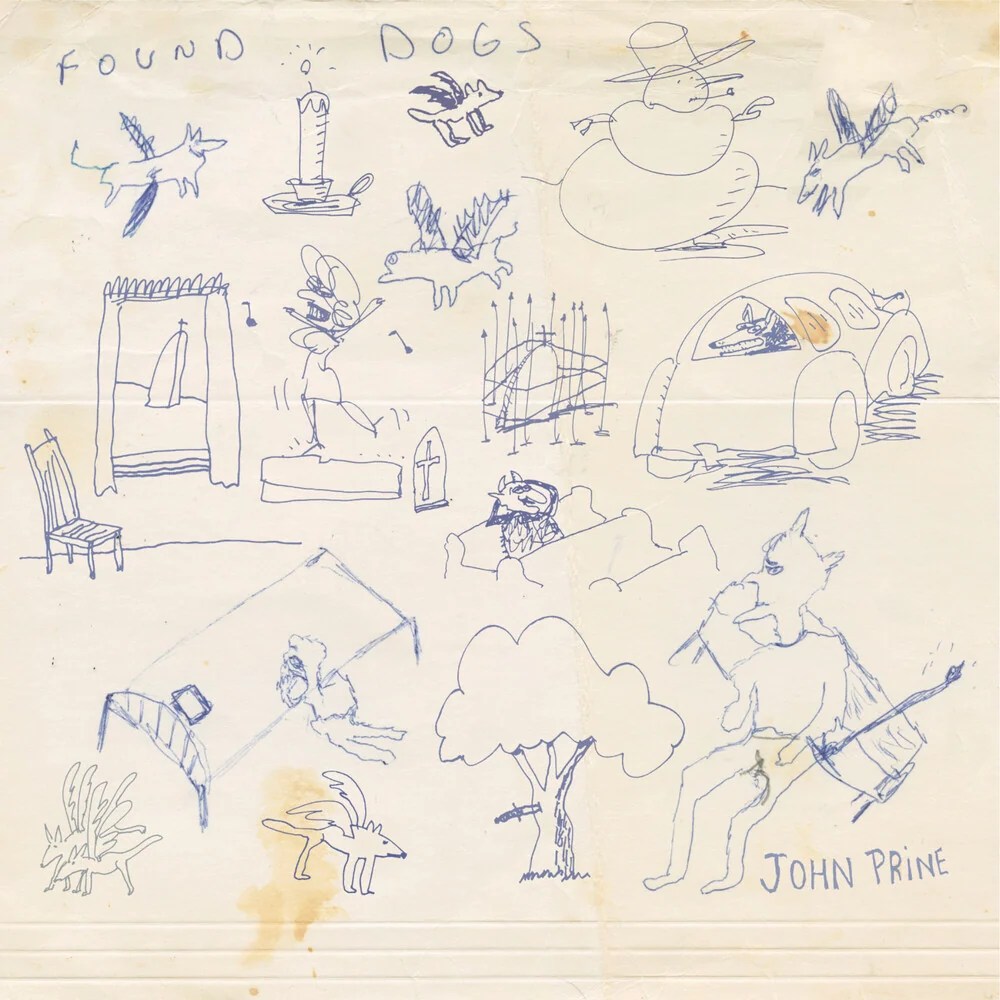
In one respect, titling a record of archival John Prine tracks Found Dogs almost feels like a dour joke, the kind you could ironically find in the Mailman’s own songs. Prine, though long acknowledged as a titan of American lyrics, only hit peak national popularity shortly before his death in 2020—his final record debuted in a top-five position on the Billboard 200. Now, a day before what would have been his 80th birthday, his estate released a companion record to the 1994 album Lost Dogs+Mixed Blessings, combining alternate recordings from the original record with rediscovered tracks composed around the same time.
Though Prine arguably never got his proper flowers while alive, I doubt he cared. Discovered by the music critic Roger Ebert while playing a small gig in Chicago, Prine’s first set lists were mostly comprised of ditties he wrote on his mail route; even after earning high praise from figures like Kris Kristofferson and Bob Dylan for his 1971 self-titled LP, he never veered away from the remarkable brand of folksiness that propelled him from his life as a Vietnam veteran and blue-collar worker into the upper echelons of the American musical world.
In that universe, figures like Dylan and Springsteen exemplify a particular strain of the American songwriting tradition, one that sometimes veers into prescriptive, self-righteous territory. Prine’s brand of lyricism, by contrast, compels listeners with plainspoken, quippy wisdom. Consider these lyrics from a track off Lost Dogs: “The scientific nature of the ordinary man/Is to go on out, and do the best you can.” The Mailman rarely comes off as preachy, or even full of doom and dread—he tells it like it is.
That plainspoken tendency of Prine’s shines through on any material he produced, including Found Dogs. At no point does the record impress itself upon the listener the way its predecessor does. Being a compilation of largely ditched tracks, it really had no chance of doing so in the first place. That said, it necessarily carries classic Prine-isms with it, evoking a nostalgia for the now-passed songwriter’s later-in-life insight into the world.
Beyond that, a particularly acute listener can gain perspective as to the development of a keystone record within the Mailman’s discography. Demos like “Lake Marie” and “Ain’t Hurtin Nobody,” provide a refreshing take for a seasoned listener of Prine’s, though they hardly mark improvements from the more cogent versions on the original LP. Still, the combination of the singer’s vocals, balancing between gravelling and lighthearted, with the sweet strums of an acoustic guitar form a bare, beautiful soundscape one can very easily get lost in.
Though the demos hold merit, the highlights of the record come through in the newly unveiled tracks. “World Without Love” stands out in particular, the sweet sentiment at its core coalescing into a simple, affecting narrative. Prine gets at a seemingly sweeping, universal notion of love’s necessity with a few to-the-point brushstrokes, readily displaying his cards by the end of the first verse: “I had her and I lost her/Then she came back again/’Cause we can’t live in a world without love.” Those lyrics may seem like a story you’ve heard time and time again, almost bordering on a truism, but the magic of Prine’s songwriting reassures you: such a tale can be just as valid and insightful as the first time you heard it.
Maybe that’s what keeps Found Dogs from ever feeling like a hacky money-grab, as so many posthumous projects do. Prine’s insistence on keeping things grounded through each lyric—zeroing in on the kind of narrative that has two feet planted in the real world—allows even his scrapped tracks some presence. In this way, the same unrealized praise that Prine enjoyers may lament as a missing piece from his legacy could insulate him from the machinations that would taint a project like this one. With greater fame, perhaps there would be an impetus to force Prine into a box, to confine him to the sense of self he occupied in his productive heyday. Really, though, I’m not sure these considerations should be taken into account when attempting to pin down the songwriter’s ethos. Even after his death, he’d probably want us to just listen to the tunes.