
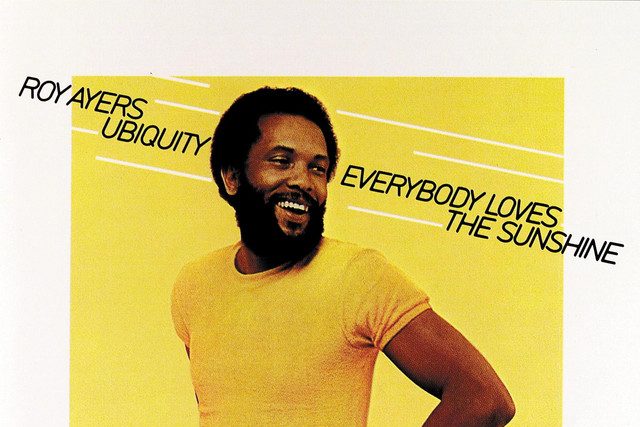
There’s a moment during Roy Ayers’ NPR Tiny Desk where the legendary singer-vibraphonist takes pause over the microphone, a wry smile rising on his face. You can see him scan his entranced audience, who hang on each note of “Everybody Loves the Sunshine,” the title track off his band’s 1976 record. Still grinning, he launches into one of the tune’s repeated couplets: “do what I do when I do what I’m doing/in the sunshine.” Ayers, perhaps the only man who could sing such a line with enough zeal to make sense of it, passed away in 2025, seven years after NPR hosted the aforementioned set. Even as his voice began to show signs of wear, his music continued to compel even the most keen-eared of audiences, exemplifying the kind of staying power his artistry possesses.
Case in point: his band’s most famous album remains squarely relevant even as it turns 50 this May, enduring in large part due to its influential sound defined by disparate, melded sounds and a nigh-incomparable level of passion. Everybody Loves the Sunshine epitomizes the free-flowing, inexplicable artistry of its lead member. Yet, for all of its spontaneity and range, it somehow coalesces into a thematically and sonically cogent record— the defining work of the 1970s soul-infused jazz-funk niche.
While Roy Ayers Ubiquity clearly revolved around its lead singer, the group by no means functioned as a one man show. Over the course of recording Everybody Loves the Sunshine, it sported seven listed members, along with a litany of engineers and other creatives. Among Ubiquity’s more prominent bandmates were the female vocalist Debbie “Chicas” Darby, whose vocals provided a counterweight for—and even occasionally supplanted—the lead singer’s, and Philip Woo, a pianist and eventual full-time member of the outfit who Ayers literally pulled out of the crowd in Seattle. Ayers incorporated the diverse sound and influence of the group into his musical process, even choosing the name “Ubiquity” for the band because “ubiquity means a state of being everywhere at once,” a gesture to his desire for his sound to expand out of any potential confines and find new ears.
Armed with a capable, eclectic group, Ayers made an explicit effort to record the album overnight after performances, believing that musicians’ lingering fatigue allowed them to play more freely. His lack of regard for the more planned-out aspects of the record process proved a vital choice— the songs feel alive, punctuated by the strain of the talents within them. For instance, Chicas gives a particularly rousing effort on “It Ain’t Your Sign, It’s Your Mind,” belting over a synthetic bassline and layered percussion. Such a soundscape proves characteristic to the record, which at any time could feature the wail of a harmonica, the gravelly thump of synthetically produced bass, or the warmth of Ayer’s manic vibraphone playing, all giving way to vocals carried by the various singers’ incredible fervor.
“It Ain’t Your Sign” itself leads a string of three songs that display the wide splay of tone present on the album. “People And The World” precedes it, with lyrics like “can’t you see we need each other?/can’t you see we need some unity?” forming the core of the track’s message. Ayers and Chicas riff alongside each other, a repeated tendency of Sunshine that lends an extra sonic dimension in most places, but here goes so far as to underwrite the purpose of the lyrics. Considering “People And The World” and its clear-cut message honing in on the joy of shared community, one can imagine the two singers’ repetition (and the robust backing vocals behind them) almost beckoning the listener to join in.
Finishing this brilliant string of three, “Everybody Loves the Sunshine” itself offers a much more light-hearted alternative to the urgency of the previous two tracks. Ayers floats over the squeal of a string synthesizer, supported by the drop-in of piano notes and backup singers underscoring catchy, now-iconic lyrics. True to the spirit of the song, the idea for it came naturally, with Ayers stating that he “just got this phrase in [his] head” before recording at Electric Lady Studios in New York. The recognizability of the song parallels its role in illuminating what makes Sunshine so singularly brilliant— its sweeping, potent positivity, tied in with Ayers’ notion that the shared joy found in the music can carry the listener home.
As such, it figures that the record serves as the rare work that merits extended consideration both as a seminal album in its own right and as a jumping-off point for generations of Black musicians. Sonically, it contains many of the instrumental forebearers of modern genres. “The Third Eye” features a drumline that would not feel out of place on an Erykah Badu record. In fact, Questlove nicknamed Ayers the “King of Neo-Soul” for his contributions to the genre. That inter-artist connection played out in real life— during the twilight years of Ayers’ career, he collaborated with Badu herself, and allowed samples to be taken from his work fairly liberally.
Ubiquity’s frontman maintained this career-defining commitment to the development and furthering of an open and welcoming community, with Black artists at its center, all of which turned his musical project into a much more impactful, far-reaching venture. Outside of Sunshine, he titled his greatest hits compilation “Destination Motherland” in reference to Africa, and toured with Pan-African activist and artist Fela Kuti. Both point to his dedication to opening spaces for Black expression, a more incisive understanding of the general community-forging pledge carried within Sunshine.
Ayers’ last performance occurred a mere three years ago, capping off a consistently active career that spanned almost the entire length of Everybody Loves the Sunshine’s first half-century in the public consciousness; yet it’s easy to imagine how the next fifty years of the record’s existence will deepen its impact. Through Sunshine, and buoyed by the assembled talent of the musicians behind Ubiquity, Ayers exists within music history as both the progenitor of a musical movement and the driving force behind a singularly free-flowing, remarkably cohesive work. The record speaks for itself, though Ayers, rather simply, qualified it best: “Pure vibes.”