The heart of the anti-capitalist Roman empire lies in Forte Prenestino, a military fort erected in the 1880s to defend Italian unification, abandoned and then later turned into a community center. For over ten years, Forte Prenestino annually hosts the largest arts festival in Europe: Crack’d. For three days, and two sunrise-nights, artists of Europe fill the entire graffitied castle to the brim with anti-capitalist and anti-fascist zines, posters, books. I was fortuitously in Rome for two out of Crackd’s three days.
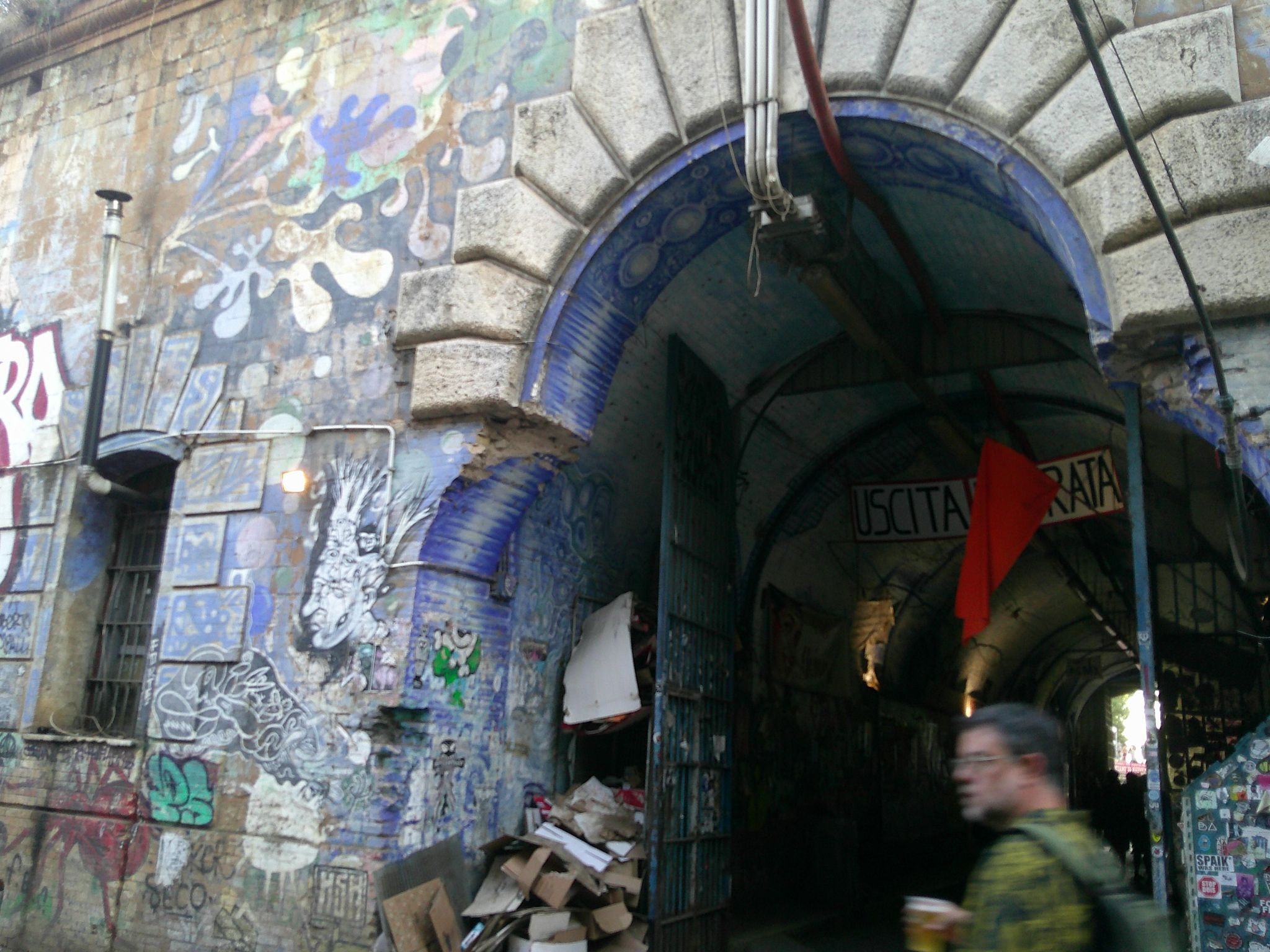
The fort immediately flaunts its grandiosity upon entering. A 30 foot tunnel welcomes you—so steep and fortified one is grateful fate landed it into radical hands. Humdrum of community rebellion buzzes through its graffitied walls. Tattooed folks with mullet helmets and matte dreadlocks – an indicative sign that this is European radicalism and not American – flicker in and out of the scene. I was stupefied at first to see white people flaunt dreadlocks with such confidence, used to the discourse of cultural appropriation that is frequent within U.S leftist spaces. The entrance fee is ten euros, each cent being equally divided among the hundreds of artists that overflow. The space is bustling, so tight one has to stand stiffly against the wall as if hiding from a centennial for proper flow.
The comrades I met generously spoke English whenever I talked to them. This meant I could wholly purview their radical collectivization through art, music, and occupation. I asked BendaNeraFumetti, a collective of four artists, if this was the biggest year Crack’d has seen. Behind them displayed the drawings they would sell. Ballpoint sketches of ghastly spectrals with pen lines shifting in thickness and intensity so as to make wispy, un-whole marks on the piece. They had laminated bookmarks of bodies that shifted into lilacs and amorphized into deer corpses. All of these pieces intentionally felt unclear, with a hazy definition of shape, color, and being.
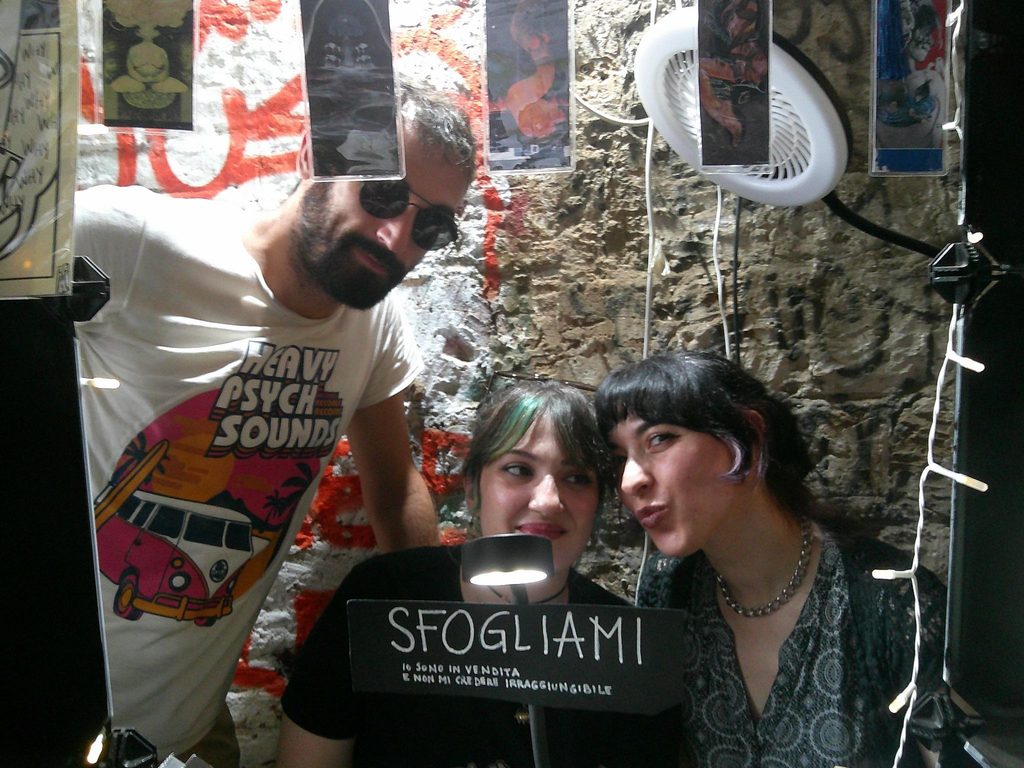
Hearing I was Californian, they gave a rundown of their art and the festival.“I’ve been going to Crack’d since the first festival 12 years ago. 2018 was the biggest year. Both the inside and the outside were so packed that you couldn’t even walk through it. I had to leave early because I wasn’t even able to look at the artists, or even dance. Usually, if you apply to be a vendor you’re accepted. This year it was first come first serve.” Talking with them more, they revealed that the festival had changed slightly since its nascency. “You see the vibe. It is all leftists, no? But the artists nowadays, they want to raise the prices. This is supposed to be affordable! I keep myself distant from everyone. There can be drama, conflict.”
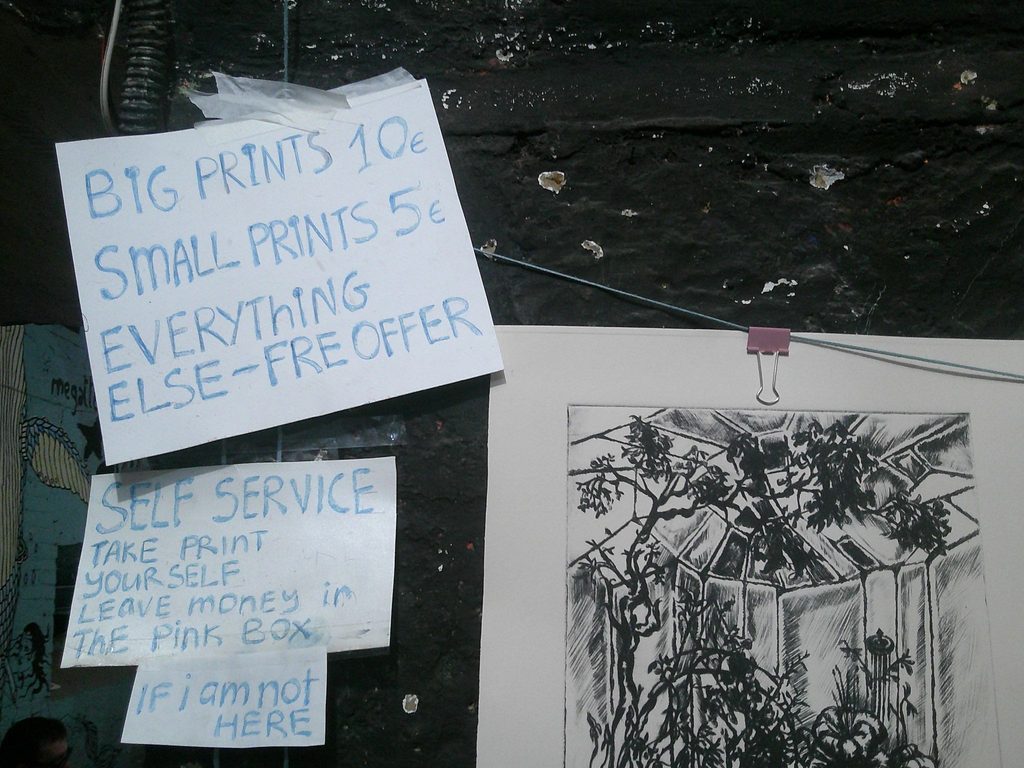
As I made my way further in, floating between the colored walls and eccentric art, I glimpsed some truth. Littered around were scattered 30 euro posters, and 15 euro stickers. An ostentatious price for these anti-capitalist slummers.
I conversated with them a few minutes after my mouth shut from all its gawking. Upon entering, there was an opportunity to walk forward through the stretching hall and reach the outdoor, inner bailey, or enter through an archway, about 10 steps in, on either side of the hall. People flowed in and out of these, and so enticed I was to see the fuss and leave the outdoors for later. The archway beckoned me to a slowly descending curved staircase that led into a corridor, a catacomb-like maze of tunnels which, in even intervals, opened up to larger spaces. Graffiti covered every inch of the stone walls, so much so that its natural gray peaked out only in small key-hole pockets of space. Italian slogans, ghoulish faces and initials were all the eye could see on the structure itself. Within, and lacing both the corridors and the spaces were vendors standing toe to toe. There were so many people and artists that I felt I was looking at an ant hill as it came alive for feeding time.
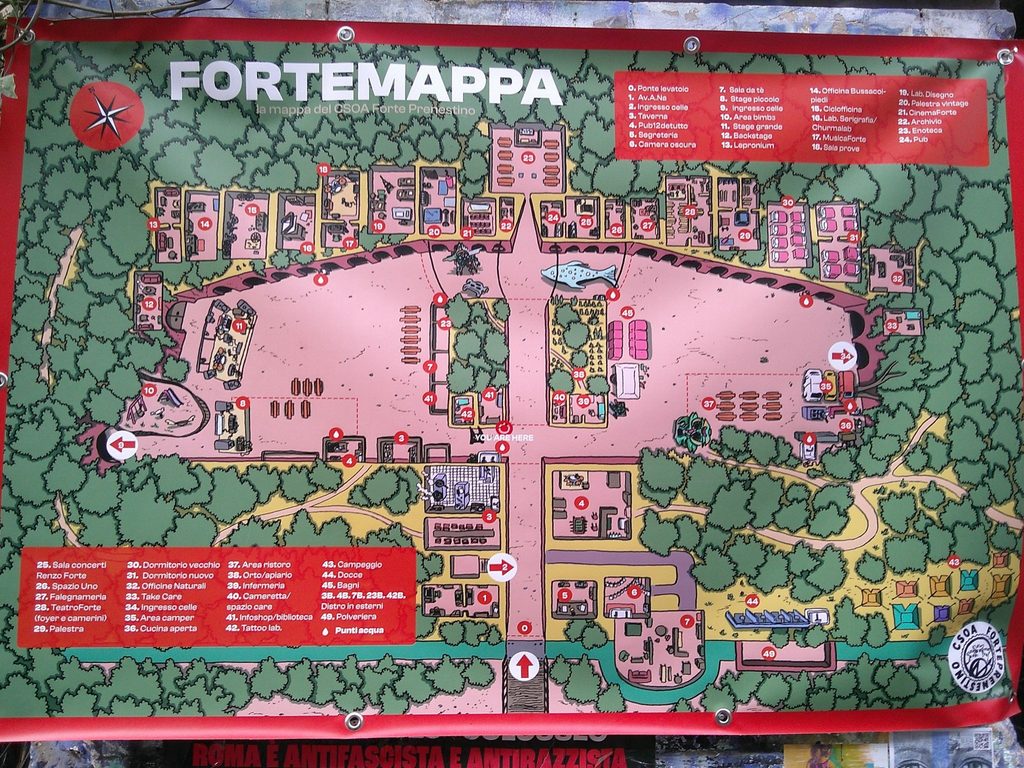
Built in the slum-stereotyped suburb Centocelle, Forte Prenestino was abandoned until May 1, 1986 when radical squatters entered, cleaned all waste, and turned the expansive Forte Prenestino into a living, self-perpetuating community home and creative center. Since then, it has been a consistent host to theatrical performances, educational seminars, practice rooms, homes, and everything the people need to gather, think, create, and rest. It was a kaleidoscope of life, dreams, aspirations and most of all, belief!
Forte Prenestino is referred to as a Occupied Self Management Social Center (CSOA). Although this idea is fairly foreign to U.S soil, it has been a common social stratagem for collectivization and social centers within the radical network of Italy, popping up in Milan, Rome, Bologna, and other parts of the country. Typically, CSOA’s arise out of a social need for community forces, political disruption, and collective actions. Despite the cemented network of CSOA around Italy, it does not mean Forte Prenestino’s is not susceptible to closure. These leftist social centers are afforded existence only through the effort of collective, radical masses and their dedication to creating these self-perpetuating spaces. Despite community management, Prenestino has managed to keep their fees affordable. Would the artists follow?
Sporadically promoted were free art prints of beautifully sketched flowers in a field, or free stickers of absurdist bugs with skulls for eyes. Many of the vendors sold their pieces for ten euros maximum. Their art was existential, nihilistic, a coeval twist of non-human entities into one.
My eye caught on a zine about the corpses of fascist criminals, encased with the grim, close-up body shots of those whose violence boomeranged back for 15 euro a piece. The artist, Pedro, had come from Spain to sell his work for the first time. Beneath the title read, You don’t argue with fascism, you destroy it. Pedro spoke, “There’s too much toleration of anti-violence movements. Violence has historically been used to smother fascism and defend against its terror. We can not shy away from it now, when Nazi and far-right groups have the powers of parapolice unions, the paramilitary, and neo-Nazi battalions in Eastern Europe.” The radicals within Prenestino weren’t perverse towards death, but embraced and embodied it. Much of the art displayed, even if not conspicuously political, provoked a sense of bodily alienation parallel to Marx’s pronouncement of the capitalist body’s estrangement. Many were grim, death-focused, while others were overtly leftist with stamped slogans writing, “Kill Fascism!.” To make a leap, it felt that fascism had compelled the Prenestino leftists to pursue a future not averse to responsive violence. The entire mass, 300 plus bodies, were unioned in their ideas against current modes of production and governmental institutions. It was as if the Crack’d festival was a time of respite, of communion with like-minded individuals in which art, life, music, and joy could be celebrated with kindred spirits.
After more wondrous traversing through the tunnels and artist, the fort opened up to a deceptively gigantic lower ward, in which I ran into a group of Italians covered head to toe in tattoos and heavy, gothic makeup. Gessica, the tattoo artist of the group, reminisced,
“Egh, I don’t even know how I found this place. You just know, if you grow up here, if you believe in anti-capitalism, in anti-fascism. You find it.”
Still, how has it avoided closure?
“You see above the trees? Higher on the hill?” they pointed to a shadowed mound with opaque tent-like shapes an acre above us. “That’s where people live here, permanently. People move in and out. Right now, the artists are staying there. But I’ve been coming here since I was a teenager. I learned English here. Only recently have the fascist cops started threatening us. We just have to be careful.”
I felt the wavering fear of closure when the festival was coming to a close. I had only been able to catch a single musician: Tanzanian rapper Antivirus whose energy consumed the entire scenic space. Her speed and tenacity were at 200bpm with the help of her also Tanzanian DJ Travella. Travella’s sounds were produced in the frantic fold of Singeli, a proletariat genre found in their home town of Dar Es Salaam. Occasionally, Antivirus would turn around and twerk whilst the entire crowd chirruped in cheers.
The heterogeneous music of Crack’d began at eight pm everyday. Largely, the performers produced electronically based sounds with motifs flitting from DJ Salve’ psychedelic EDM exorcising the poisonous molotov of capitalist society, to traditional vinyl DJ’s performing with anthropocene inspired visual art projected. Mostly fitting under the electronica cache, the artists chosen for the festival pine for the reprieve from traditional DJ mixing. This was experimental. The ideology of the Crack’d festival was inextricable to the diverse, cross-cultural, and radically subversive music created from pluralistic beats of the world. As proclaimed in their program: “Crack! has been exploring music scenes developing outside of mainstream cultural circuits, exploring artistic practices that transform sound into a tool for expression, resistance, and social interaction.”
I find that many festivals in the U.S exist beneath a consumerist gleam which alludes to collectivity while curating a space somewhat antithetical to its supposed ideals. As in, people carry Israeli flags and grope girls despite such festivals sloganing the community. No space is perfect, and especially spaces that forefront radical ideas. Crack! might not be completely clean, but it was reassuring to be in an artist’s space so consumed by belief that the entire event and all its activities, performances, and arts, were saturated in parallel, anti-capitalist ideals. It felt as if the frame matched the picture.
Conquered and sweaty, I sat on the outdoor benches with a few teal haired Italians, watching the vendors close shop slowly. I asked them what they thought about Forte Prenestino. Like most other attendees I had conversed with, they were continuous and loyal attendees. The most passionate and communicative was Baba, an artist and Stephen king lover with proficient English. Mid-discussion, we were interrupted by an organizer who informed us that if we did not wear artist wristbands, we must immediately exit.
At this, Baba, ascended in outrage. “The classification of artist versus non-artist is promoting the very hierarchy that the Prenestino leftists are supposed to be opposed to! There shouldn’t be a class distinction!”
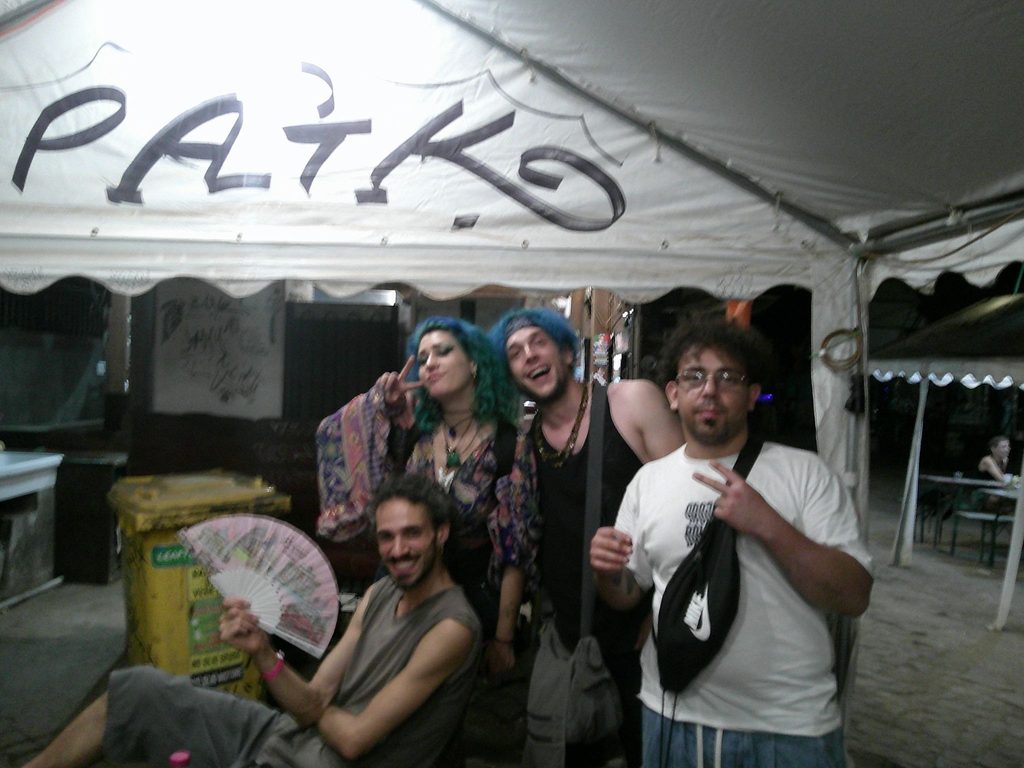
Later, I asked about the incident to one of her companions, Adriana, “It makes sense that they have to be strict about the after-party, because they have to be careful. But still, this is supposed to be a free collective, and it doesn’t make sense to separate us. I’m an artist even if I don’t wear a wristband. I’m an artist! They never used to do this before.”
Both lead to the bigger question of security versus radical agency. How does one balance the protection of autonomous social centers within a flat hierarchy? Evidently, Crack’d took caution. Yet it is understandable that long-time festival goers and de-wristbanded artists would be upset that delineation is created through a small yellow wristband attached to a prescribed identity. I can not fault Prenestino, as communal spaces like these must be hinged open and close to allow for allotted radicalism without destruction. Containing craziness means levity when necessary.
Still, tension between autonomy and CSOA continuation has been maneuvering through the CSOA’s of Italy. A disparate few are steadily moving towards legalization despite inter-community conflict regarding the restrictions these contracts impose upon otherwise communal agency. With parafascist regimes rising up in Europe and the U.S, it is more important than ever to maintain the autonomy of the CSOA. Can this type of radical convergence sustain itself illegally?
The tension between these centers makes me believe that the idyllic inspiration I felt from such cemented belief would most likely be broken down if I were a constant member. Yet it also made me feel that much more gratitude for the 20 year long festival never wavering to hold communion for thrashing, raw musicians and visceral, tenacious art. Art, music, dance, and joy are the immutable ingredients of liberation. Crack’d is conspicuously aware of this fact.
Unfortunately, property rights are not so easily let up in the U.S. It is less likely that such a massive radical communion could happen in New York, where even D.I.Y punk shows are shut down in the span of an hour or two. The closest New York has gotten is DIY venue Silent Barn, which opened in 2012 as a three story community space paralleling Prenestino’s diverse range of events. In 2018, it closed down for the same reasons most independent spaces do: too much ambition and too little money. After being evicted in 2012 for their “quasi-legal” state, Silent Barn had full ownership of the property and ran a fully legal business. It makes one wonder what the state of the DIY community could be if they were allowed to run similarly to the outspoken squatter rights of Italy. It also reminds me that DIY comes with its own burdens of responsibility and tension that I was not privy to as a temporary visitor.
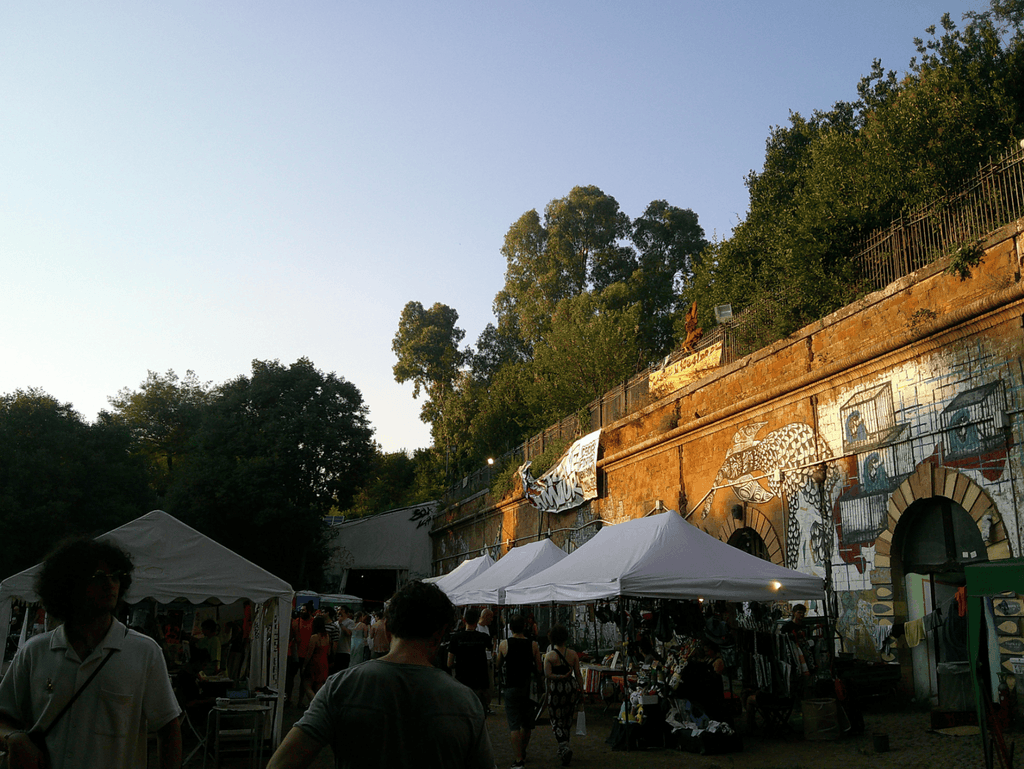
Outside of the politics of Forte Prenestino as a CSOA, and the hankering problems that come with independent collectivity, Crack’d remains an impassioned display of radical collectivity. Its refusal to submit to the government, and its steadfast contrivance of three days of anti-capitalist culture took me into a new form of thought; one filled with death, passion, blood and being.
As fellow Californian and attendee Benjamin reminds, “It was like entering a wasteland. An abandoned ruin. Where people’s dreams mattered more than their lives outside the fort.” Whether or not it’s healthy or progressive to subsist by a dream, I can not decide.