
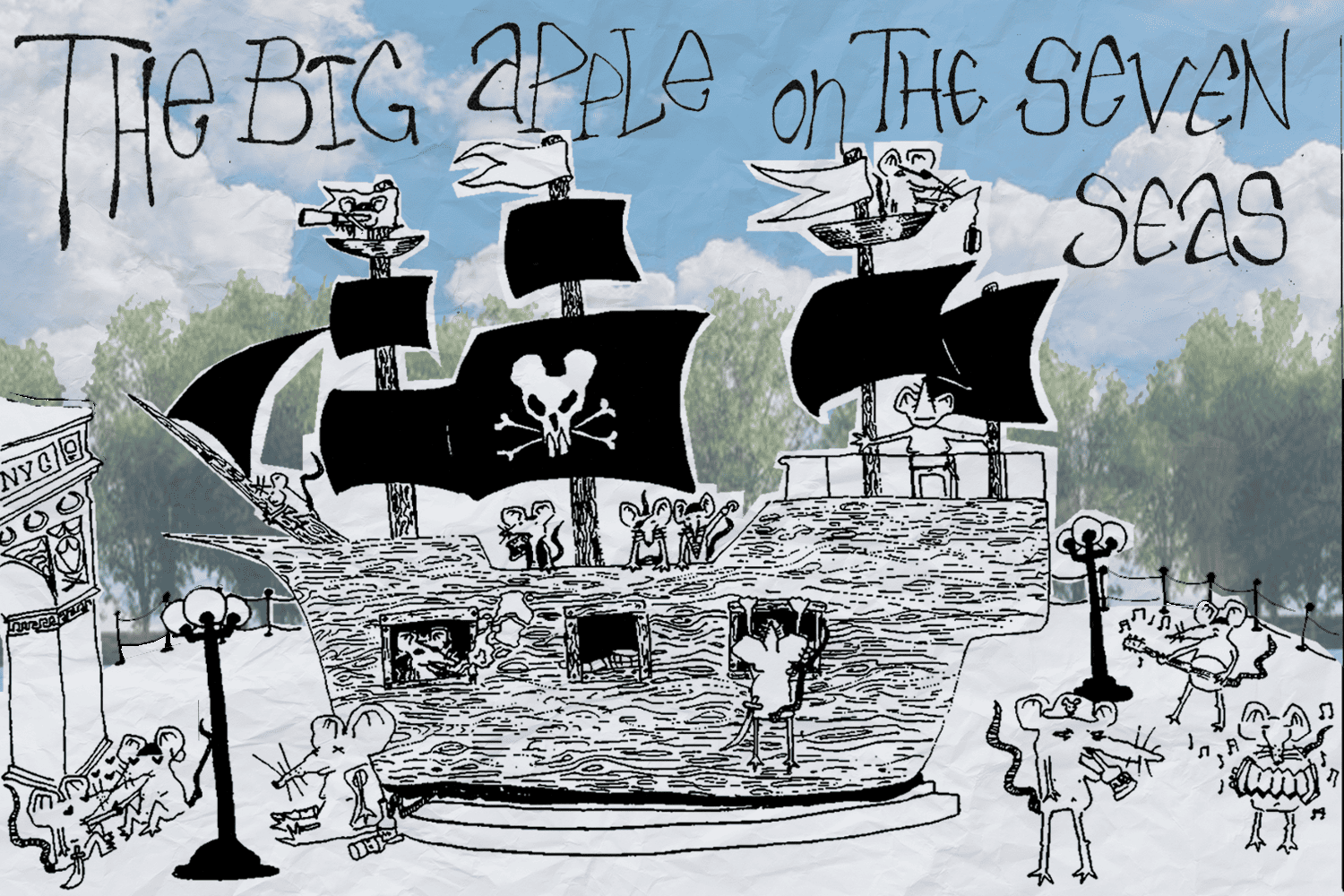
Graphic by Xanthe Massey
A line of people, inconspicuously dressed except for the occasional guitar case, file up the gangplank of the nearly 131-foot long wrought iron tall ship, the 1885 Wavertree. On the gently rolling deck above the East River, everyone seats themselves amongst a circle of folding chairs placed under white canvas canopies, where returning attendees chat like old friends and new arrivals slowly fill the empty seats.
Although the ship’s huge mast and tangle of ropes obscure Manhattan’s skyscrapers from view, the sounds of helicopters over the river, cars rushing toward the Brooklyn Bridge and the booming bass of amplified pop music from Pier 17’s nearby rooftop send several amused (and annoyed) looks reverberating through the growing crowd.
It’s early October, and folk music enthusiasts from around New York City are meeting for a monthly gathering of sea shanty and maritime music at the South Street Seaport Museum, filling lower Manhattan’s historic Schermerhorn Row with a chorus of a capella sailors’ work songs. Although these chants have been sung on merchant and whaling ships since before the mid-15th century, today will be a rather modern take on tradition.
“This will be part good singing and part good listening,” group lead Lindsey Smith, a classically-trained singer with The Folk Music Society of New York, says good-humoredly. She then launches into the first halyard shanty, a spirited call-and-response tune sailors belted while coordinating the difficult rope-pulling required to raise heavy sails.
As the wind whips around the ship and the group starts chanting a work song about sugar, tea and rum, some singers begin to mimic the hard labor the music was first used to ease the pain of. They pull one arm over the other with heaves and hos, as if they and their imaginary, poorly-staffed crew (hired by the bare minimum to save a shipowner some money), were hoisting heavy ship cargo. It could be in honor of what these songs were made for, but perhaps what’s more telling is how none of the seasoned members—the old navymen—join in on the charade.
“I heard that song on Spongebob, actually,” confessed John, one of the younger members of the shanty singers. “It’s one of those songs they have instrumental in the background, you know what I mean? I was looking it up like, who’s song is that?”
So yes, you could worry that it’s the few youthful souls, clutching tea-stained artifacts of an age they never saw, who may be disrespecting shanty histories. But, if those who’ve grown up in the heyday of ahistorical, entertainment-based cash-grabs are also the ones that run the risk of falsifying the afternoon, of turning it into a facade of what sea shanties once meant to sailors, then perhaps it’s worth weighing how any sentiment of what a shanty “truly” is or was has been lost in the vast market of today.
Consider the Assassin’s Creed Wiki Fandom, which can quickly inform you of the game’s full, numbered shanty list in order of when each song appears on the so-called “Shanty Wheel” (which includes over 50 chants). The game added shanties in 2013, but a July update now allows players to pick and save specific tracks to play in-game. Think also of the TikTok rendition of “The Wellerman Song,” a New Zealand shanty from the 1800s re-posted with autotune and reverb in late 2020. So the question will be asked: is this afternoon on the East River just #ShantyTok all over again?
Any revivalist might understand these shanty-singers’ struggle, how trying to dig an old musical style out of the archives can end up rife with inauthenticities (think 2010s stomp-and-holler, hello Mumford & Sons), but this is no stadium tour, and the theatrics take on a different character. Hidden by the ship’s sturdily built five-foot-tall rails, no confused tourist vacationing on the pier below can see or hear the revelry — performances are free, purely for the not-quite 50 people in attendance, and if need be said, there are no phones in sight. Certainly, I’d rather the youth get directed here than elsewhere.
As the chorus moves through their repertoire of 19th-century chants, nearly everybody young and old either sings purely from memory or picks up new lyrics on the fly from the singers around them. This feat is impressive anywhere. However, with the fading importance of maritime tradition from mainstream consciousness, a shanty-singing in 2026 might not have been possible if not for the development of modern recording technologies.
A large part of why these songs are able to reach a much wider audience today is due to the so-called “halcyon days” of the first English Folk Song Revival, a period in the early 1900s when original folk songs were recorded on wax cylinders for the first time. What are now loosely called “shanties,” an English term for a musical tradition found around the world, were mostly written on ships while crews were in the midst of hard times — away from home, laboring on the high seas for months with little pay. The practice heralds as far back as the mid-1400s, but peaked during the industrializing era of the mid-1800s, especially along shiproutes from New York to Britain.
Consider the ways shanties have moved through the centuries, with each age offering a newly fascinated audience. The songs have undoubtedly been changed, especially so in the process of documenting and recording the inherently transitory artform. Even the oldest member of this shanty group has probably been influenced by the biases of those who were able to do the original documenting, so perhaps the question shouldn’t be how “authentic” the group is able to be, but how their specific appropriation of shanties fits into the broader pattern of these songs’ long history.
Indeed, as much as the ensuing two hours made me wonder about cultural perceptions of a “shanty,” for the singers it was more about enjoying time spent with some of their most kindred spirits . Everyone offered a song and played the role of lead caller, children joined in and newcomers were taught the lyrics of well-rehearsed tunes, many of which ended up being composed by members of the group. Not true seafarers, sure, yet navigating rough waters just like sailors of old— some of the best moments occurred when singers departed from renditions of ancient songs to instead draw from their own histories.
The wistful tune “Ellis Island” by Jan Christensen, a beloved member of the society who passed in 2017, began with the solo call “As I walk around the streets all the same / I heard some people say,” then moved to the group, who sang about the difficulty of leaving home to be in a foreign country, searching for work and social cohesion: “Oh they all look funny and they don’t speak English / They’re taking my jobs away,” they lament, finishing with, “And if you make it through the day / they will send your card away and say / welcome to the land of the free.”
As it grew clear that the group possessed their own history to build from, it began to feel almost coincidental how shanties were the folk medium that brought these not-quite mariners together. Because really, the afternoon was about making music happen in unison, a practice which in any century is about being able to coordinate with the cues of your people, your band, your choir. Even though the group only had to act out hard labor while they sang, they still found synchronicity in shanties. What this might prove is that these modern people are working hard, even if shanties have become their time of respite. The fact is shanties are still being used to lament some of the most difficult contradictions of modern, working life.
Disparate toils can become shared ones when tuned into music— and the idea of protesting in song is by no means obsolete. Think of Jesse Welles’ overtly political folk release from this June, Masks Off, where songs like “Join Ice” (“If you’re in need of a gig that’ll make you feel big / come with me and put some folks in detention”) evoke Dylan’s great 1963 “Masters of War” and its attack on the institutionalized war machine: “I just want you to know / I can see through your masks.” As this folk music tradition happens in real time at the monthly shanty sing, songs like Christensen’s continually cement their importance in the lives of the small group that always returns. These are real stories told by and for a community of people — and perhaps their message isn’t one that needs Columbia Records to tell the world it’s worth hearing.
Still, even the most highly distributed folk music relies on the very same history of call-and-response chants that these shanty sings do. Shanties are sailors’ contribution to a longstanding tradition practiced by laborers throughout history, from slaves in the American South to industrial laborers in the early 20th century. One of the most significant yet forgotten bits of this group’s own shanty history rests in their location on the East River. The waterfront was once a bustling center of global trade as New York grew into the United States’ largest port city by 1797. Since the commercial shipping industry has been pushed from the peninsula, the space is now a tourist attraction. In a time and place when most New Yorkers nearly always have two feet on solid concrete, the revival of sea chants on such a major waterway exists as a nod to how the city came to be.
Being hosted by the South Seaport Museum certainly ties the group in some way to their far-removed origins, but still, they’re located just out of sight of Ellis Island and Lady Liberty’s watchful eye. Being both in and out of a purely historical view means unconventional melodies were by no means discouraged. Sure, there was a rendition of the 1850s children’s nursery rhyme “Row, Row, Row Your Boat,” but there was also a spirited parody of Led Zeppelin’s 1970 “Immigrant Song” complete with a kazoo-led chorus, which received especially loud cheers.
“I’m more of a contemporary,” admitted Carlos, the Led Zeppelin performer and a longtime member of the shanty group. In his free time, he works on blending old sea chants with maritime-themed tracks. His vast repertoire of reworked songs, all handwritten in a 3-ring binder, includes a version of Enya’s 1988 “Orinoco Flow” and The Police’s “Message In A Bottle.” The choir of voices and two or three guitars, plus the aforementioned kazoo, introduces newer elements of a shared culture that even today’s young people are still very much a part of. Nearly everyone in the group has had the old radio hits drilled into their heads over the years, and they still come to hear Carlos’ versions with open ears.
“I see young people come,” said Carlos. “They’re welcome to have [here], because after all, when generations go by, you know, when us old people die, we need newer younger ones filling in.”
As the torch is continually passed from old to young, this sort of revival is more about finding and holding onto the elements of traditional folk music creation that even modernity cannot adulterate. After the event’s end, everyone stuck around for as long as they could, making plans to meet in Brooklyn for a night of pub songs and revelry. And as the group said their goodbyes and left to their corners of the city, they called out to each other in excitement for their next meeting on the first Sunday of November. Back on the Wavertree again, there may be some new songs. There will certainly be some old ones.