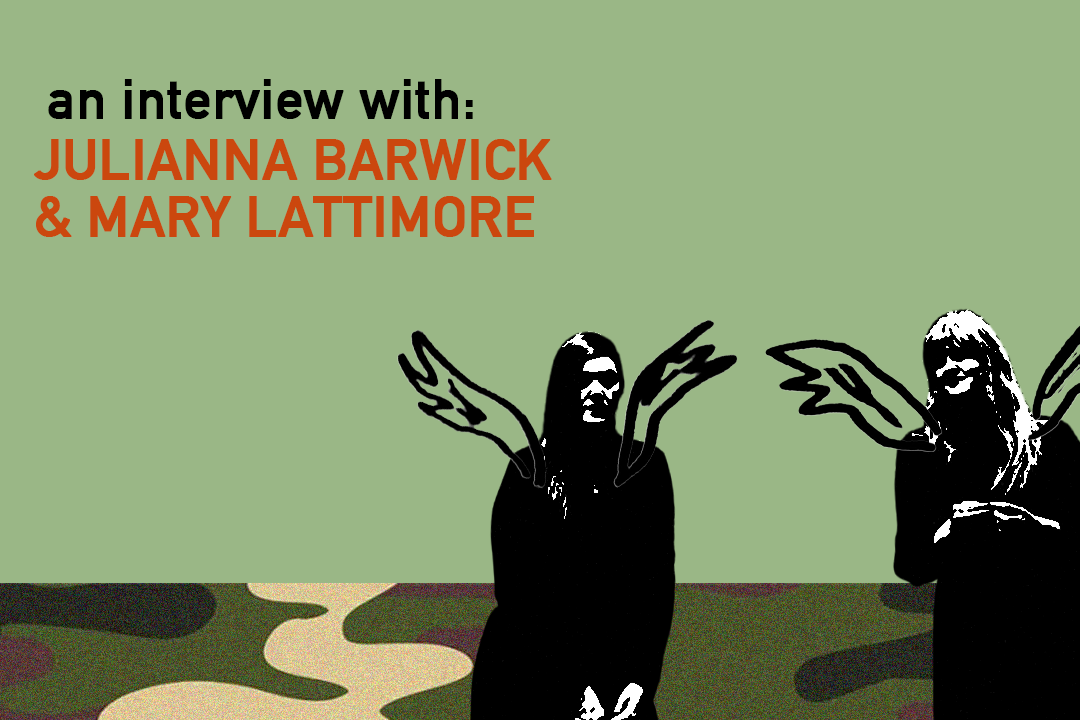
There’s a palpable lived-in atmosphere under the cavernous roof of the Knockdown Center, both from the countless artists who have performed there, its past life producing glass, and the “knock-down” doorframe that serves as its namesake today. Much like the antique quality of the venue’s past, Julianna Barwick & Mary Lattimore’s collaborative album Tragic Magic sees the two breathing new life into analog synths and centuries-old instruments from the Musée de la Musique in Paris, taking their storied pasts and channeling it into an intricate yet personal tribute to collaboration.
As longtime collaborators and Los Angeles residents alike, Julianna and Mary recorded Tragic Magic in the wake of the Palisades wildfires in 2025, with much of the album centering around the two navigating memory and grief beyond words. Just as Lattimore’s delicate flourishes on the harp complement Barwick’s ethereal vocal melodies, her shimmering melodies are also deepened by Barwick’s atmospheric synths. That continuous ebb and flow is central to Tragic Magic’s showcase of their combined styles. Other collaborative moments, like a cover of Vangelis’ “Rachel’s Song” and the Roger Eno-composed “Temple of the Winds” only add to the album’s spellbinding emotion further emphasize the destination of those reflections on tragedy – finding joy in one another’s art.
This interview has been condensed and edited for clarity.
I’d like to start out with a question for Mary – you’ve mentioned that you’ve played the harp since you were 11. I’m interested in asking what drew you to it in terms of musical qualities and how has that changed over the course of your musical career?
Mary: Well, I was drawn to this instrument partly because I was forced to play this instrument as a child. My mother is a harpist. “Forced” is a negative word, but I would say encouraged to play this instrument as a child. I started classical training at age 11, and it wasn’t until 2005 when I really started trying to merge the music I listened to with the music that I played, so I wasn’t playing classical music as much anymore. That’s my background with the harp. I really love the sound and the possibilities that the harp has, a lot of different colors and different sounds and tones.
For Julianna, much of your music focuses on the overlap between vocal textures and the use of electronic loops, synths and the like. What kind of overlap or relationship between those two main musical elements do you usually look for in your music? Are you using both of them in conjunction to build atmosphere, or is it emphasizing one side using the other’s specific sounds?
Julianna: I’d say that the sound that I liked to hear since I was a child was singing in very reverberant spaces, like parking garages or big auditoriums. I sang a lot in choirs in elementary school and at church with the congregation, so I was singing all the time in these places before happening upon looping techniques about 20 years ago. Employing effects pedals artificially creates that choral sound in a reverberant space by using electricity and machines, I can make the sound that I like to hear and like to make. When I’m using different tones and timbres of my voice, it can sometimes be really airy and light, and other times kind of brassy, as well as bass notes that push as low as I can go before it doesn’t go anymore. Basically, I’m just kind of using my voice and those machines as a big palette to paint with.
Who are some of your greatest musical influences in general, and are there any artists you specifically looked to during the making of Tragic Magic?
Julianna: Growing up, I loved hearing my mom sing. She has a beautiful voice, and if she wasn’t singing in church, she was just singing at home nonstop, and I find myself doing that constantly. As a child, I was very much drawn to soundtracks, so we would watch a movie at home, and I would go to the library and check out the vinyl record, play it on my Fisher-Price player and teach it to myself on the piano. So I’m heavily, heavily influenced by vocalists and soundtracks and scores.
Mary: For me, Brian [Eno] is such a big influence. When we were making “Tragic Magic,” we used his Oblique Strategies cards, where you pick a card, and it gives you a small, abstract guideline. We would pick a card each day like “use an unacceptable color,” for getting little hints about structure or just something to think about while making the music. I loved his music for a really long time, and so it was such an honor to have Roger write us a piece too. They’re just such an amazing duo of brothers and musicians. I really love The Cure. They’re my favorite band in the world, and I feel like their influence has really affected my music and trying to convey different emotions and sadnesses.
Both of you have worked with a wide variety of artists including members of The Cure, Jeff Ziegler and Kurt Vile for Mary and the likes of Jonsí and Helado Negro for Julianna. When it comes to your own collaborations, what would you say are the defining aspects or the main goals for working with one another, and how has that process developed during the making of Tragic Magic?
Mary: A big part of the goal is just to have fun and to see how our personal styles blend together in a conversation. It’s social as well as musical.For this project, we made this record in the Museum of Musical Instruments in Paris, and we were given access to these really crazy historic instruments. So a big part of this was to just go to Paris, appreciate the experience to the max, and to really show the qualities of these historic instruments that never get played.
Julianna: I completely agree. Individually we both use loops a lot, and there’s an element of surprise there – you’re looping and layering sounds and then you have something that you never could’ve composed ahead of time. Over the years, we’ve played shows together where we’ve done our individual sets and then we’ve jammed at the end. Like Mary said, it’s so fun to have that kind of communication without having to say anything, and it just flows beautifully. We had already toured together, guested on each other’s records, DJed together and all that, and everyone who liked our music was saying, “You guys should make a record together.” So this was a once-in-a-lifetime opportunity, and we were really excited about working together and experimenting in the moment with these wildly precious instruments in Paris.
I saw a handful of interviews and press releases for the album that used the term “musical telepathy” about your dynamic with one another, so I think that’s a very succinct way of putting it.
Julianna: Yeah, we also just scored a film together called Threshold. It’s a documentary about the Olympic cross country skier Jessie Diggins, and it’s out on Peacock right now. If anybody wants to check it out, that’s our first collaborative film score.
The making of Tragic Magic was rooted in events like the LA wildfires last January, while also drawing from those shared experiences in Paris that you mentioned. What was it like to balance those emotional aspects of grief or catharsis with the feeling of intimacy that comes from the two of you working on music together?
Julianna: Well, it definitely contributed to the vibe of the record, because Mary and I both live in LA, so we each were bringing our own personal experiences with the fires – especially the day they happened. We brought that into our session, where our city and friends that we know that lost everything were very, very heavy on our minds. So I would say that that kind of grief is definitely a player in at least some of the songs on the record, because we were feeling it. We were in Paris two weeks after the fires happened, so it was very fresh and still very horrific in our hometown.
Mary: I think the way music is made is just by taking everything as an influence – it’s taking little bits of this and very organically, whether it’s being in Paris, like the art exhibits or the friendship or a conflict, as well as the sadness that you’ve experienced. The record is like this, capturing this moment in time with all of those emotions and a sense of beauty in a special package. It just kind of naturally reflects on that time in my view.
The two of you recorded the album across nine days at the Philharmonie de Paris, which is already a far cry from somewhere like the rehearsal stage where [Julianna’s] The Magic Place was recorded. But then it’s like, how did the experience of working with these historic instruments and recording spaces in Paris, influence your performances at the time?
Julianna: The whole experience was very novel. We were very reverent towards the opportunity to work with these precious instruments. They’re usually on display at the Musée de la Musique and were prepared for us to use, so that really lent to us playing these instruments and giving them an opportunity to do what they were made to do. So it was just a moment of respecting these instruments and the excitement of the opportunity to access them and play them and make something together with our record.
Mary: We had our friend Trevor [Spencer] engineer and help us with the record; he was the one that mic’d everything and had the expertise to figure out what was needed as far as the technical stuff went, which was very helpful. The rooms that we recorded in were quite simple, but they were in the basement of the Philharmonie, which was a very beautiful, futuristic-looking architectural gem in this park. So even though the rooms weren’t fancy or anything, it felt good to be a working part of the Philharmonie.
On that note of reverence working with these external materials, I wanted to ask about your cover of Vangelis on “Rachel’s Song,” as well as rendering Roger Eno’s composition on “Temple of the Winds.” Was there any additional ethos you wanted to preserve like a specific tone or any aspects of those instrumentals you wanted to emphasize, and how did that influence those songs in a different way from your collaborations?
Mary: Roger’s song was written for us specifically, and it was the first time it’s ever been recorded and played. We met him in Melbourne when we were playing there for the Melbourne Recital Hall, and we had lunch with him and got to know him a little bit. He wrote us this piece on staff paper with a pencil in a park, with no instruments at all, and then he presented us with the piece at the concert later on. We were just waiting for an opportunity to present this piece he wrote, and it made total sense that it would be on this record.
We decided to use this harp from 1740, which I felt was a perfect choice for a song called “Temple of the Winds” – it had this very metallic sound that fit so well with this song, and Julianna told me “I made my voice sound like the wind, can you tell?” That’s the story of that song – it wasn’t like we had ever heard it before or that we had to imitate anything. It was written for us, that was the first time it was ever played, and I think it really sounds perfect.
Julianna: With “Rachel’s Song,” Mary told me a few years ago “I would love to hear your voice on this song, that would be so cool.” And so the next time we knew we were going to play a show together, we worked it out to play live. It was just wonderful, because Mary’s harp sounds so good and in the original song, there’s a very Gotham-esque, rainy atmosphere. When we were in our recording session, our friend Rachel told us that LA was getting its first rain since the fires, and Mary said “Try and go out and record it, send it to us,” so she recorded it and sent it to us. That’s the rain you hear on that song on the record – it’s the first rain that Los Angeles got after those fires. Once again, there’s a little of our experiences, our hometown and our emotions just trickling into moments like that.
Ahead of your shows in the East Coast and Europe over the next few months, what excites you the most about translating your music to live performances, either on your own or together for Tragic Magic?
Julianna: Mary and I just got done with our first kind of run for this record with a little West Coast tour, and it’s just always been a great time playing shows together. Individually, we’re solo musicians doing our own thing, and miraculously, we still work perfectly together when we’re playing shows and on tour together and driving for 10, 12 hours a day. We love what we do, and because of our history and our friendship, it makes it really exciting. It’s always exciting to get on stage and see how this one specific show is going to go, because they’re all a little different.
It’s exciting to see how it’s going to go, and we’ve been loving playing these songs live. It’s really fun, and it’s been a real stretch for both of us because we’re used to looping and relying only on ourselves. We love that, but there’s lots of washes of reverb and things like that, and with this record it’s like stretching a new muscle where it’s more stripped-down, and there’s still going to be reverb. But in my case, I’m not used to singing song-songs with word-words. It’s been a really interesting collaboration that’s definitely influenced by the opportunity and the space and the instruments that we used.
Mary: I’m looking forward to it a lot too, and I feel like, Juliana, you agree with me probably, is that, when you first start playing the new songs and you’re looking at notes, you have a little cheat sheet for the chords and pedal settings for what happens in the song on sheets of paper. But the more you play the songs, the deeper you get with them, and the more you get to know the songs and their arcs, the freer you can be within that.
I’m really looking forward to getting to know these songs really well, so that we can really give them some freedom by looking less at the notes and connecting with people too. I mean, that’s a big reason why we do this, so we can just talk to people in these different places and really feel how different parts of the world feel. It makes the world a little bit smaller, in a good way, just getting to interact with other people on this planet.
Specifically regarding OUTLINE, would you say that there’s a bit of internal pressure about performing with such a disparate collection of artists like Geordie Greep and Delroy Edwards playing his first set with a live band, or do you feel like it’s more of an opportunity that complements what you’re trying to achieve with your music?
Mary: I opened for Geordie and his new band in September, and I’ll say that just by being at the merch table after that set, I felt like these people that listen to Geordie are music-heads. They all knew his influences. You could hear a pin drop during my set. Nobody said a word, and you could even hear somebody washing their hands in the bathroom across the huge room. I felt like the audience was so respectful and open-minded to a solo harp on a stage, so I really feel like this is an opportunity for us to play for a new audience, and it’s really fun to be smashed in between these different bands. It’s almost like a collage – whoever programmed this has a cool brain.
Julianna: I think Mary and I individually make music that’s hard to categorize, so we’ve played with all kinds of musicians over the years, and it works because we’re not sort of limited to one genre and can step in and out of places. So it’s really cool to be on a very varied lineup, and we’re gonna really enjoy it.
When it comes to your live performances and Tragic Magic, is there an emotional impression you want to make for these new audiences or other people who have never heard of your work?
Julianna: I don’t think Mary and I are ever thinking about what kind of reaction we want per se, but we’re really looking forward to reaching people with our music, because a lot of our emotion and our heart went into it, and so far we’ve gotten a lot of feedback in that capacity, which is really good to hear. We played LA on Valentine’s Day, and we heard from some people afterwards who really appreciated the lyrics to “Melted Moon,” for instance. So it’s wonderful to have that kind of connectivity, but people can react the way that they want to react.
Mary: I definitely feel like whenever I play, whether it be solo or or with the project, bringing the harp to a new audience is something that I have in the back of my mind a lot ever since I started playing music. I hear from people like, “Oh, I’ve never seen a harp in person before,” and so that’s part of my thoughts for OUTLINE or anything else. It’s like maybe I’m showing people a harp for the first time, or maybe they’re seeing this played for the first time in their life. And that’s pretty cool, too.
To close out the interview, do either of you have any additional remarks or advice for the readers at STATIC?
Julianna: Just keep making stuff. I feel like these days, you can kind of follow your nose and figure out your own voice pretty easily – the way I got started was GarageBand on my computer, so I just took a workshop, got a pedal and read the manual. So yeah, just follow your nose, find your voice. Try to follow the light and not get too sad, because the world is pretty depressing right now.
Mary: Yeah, art can be a very good way to channel emotions, so it’s just a wonderful outlet.