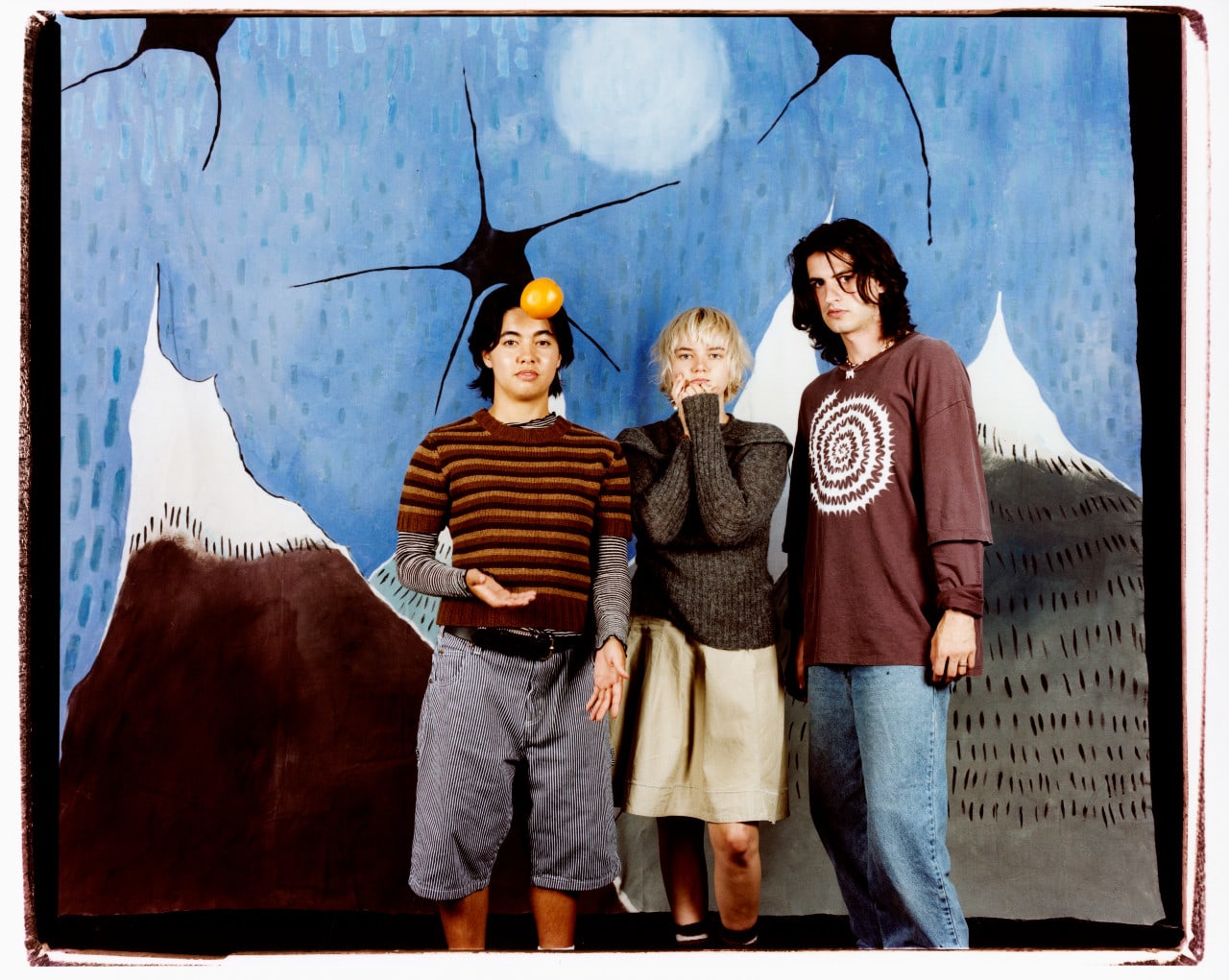
mary in the junkyard is the definition of DIY. From the grassroots South London scene to touring the world with Wet Leg, this young eccentric rock trio blossomed through giving alternative music an entirely new meaning with their addictive atypicality. Weaving entire worlds into their work via characters and props ranging from yetis to beetroots, the band’s devotion to their craft and raw authenticity shines for all to see. Prior to their New York benefit shows with Dove Ellis, Clari Freeman-Taylor (vocals, guitar, cello, viola, violin), Saya Barbaglia (bass, viola, violin, backing vocals) and David Addison (drums) joined me for a chat. We discussed pole-dancing, conspiracy theories, and, of course, their new album Role Model Hermit.
This interview has been edited and condensed for clarity.
I got to see you guys open for Wet Leg over the summer while working at Summerstage. Was that your first time in America? How did the tour go?
David: That was a mad, beautiful, amazing show.
Clari: That was such a good show.
Saya: That was our third or maybe fourth time in America, but it was our first real tour in America.
Did you have the chance to check out any New York venues and were there any that stood out in particular?
David: We went to New York for the first time in November 2024 and then we went again in March 2025 and we kinda just did as many shows as we could. Our first show was at TV Eye for Model/Actriz’s Christmas and Hanukkah Show. We’ve done Baby’s (all right), Nightclub 101, Union Pool, Berlin.
Who is mary and why is she in the junkyard?
Clari: The world is a junkyard, and mary is a nice name.
David: It was kind of just a name that Clari came up with, but retroactively it has worked to describe the sound of having like pretty, sort of angelic things and then junkyard, grime and noise and stuff.
Clari: The junkyard is like scraps, and also things that end up in a place by accident. Junkyards are the tide that washes in whatever is in the river, but of like the river of humanity. It’s very random, and I think the junkyard, for me, represents chance and spontaneity.
Saya: Also, the spontaneity of creating things out of the junk. Whether it’s junk or not. The concept of building up from pieces.
I love that symbolism. It makes so much sense for your sound. In this oversaturated landscape, your creativity and authenticity as a band have been a breath of fresh air. What is that creativity fueled by? What are your other hobbies and how do they play into your music, if at all?
Clari: We have lots of hobbies.
Saya: Pole dancing!
Clari: There’s this train in London called DLR with poles on it and we live next to a station so Saya and I go and practice pole.
Saya: We’re creating something. We’re only on day 2 but we’re at DLR pole academy.
Clari: That feels quite junky.
Saya: Our other hobbies include gymnastics, mixed martial arts, eating, going to gigs, and reading.
Clari: Art, paper mache, knitting, drawing, buying clothes, blogging, growing herbs.
Saya: Electronic music production!
David, any hobbies of yours, or do you just watch as this happens?
David: Yes, sometimes I watch.
Clari: David has a blog about music in the city! And he likes cooking Italian food.
Saya: David has a lot of interests. We speak on his behalf.
David: Yeah I’ve got a music blog, learned some basic coding over Christmas and then made this website and blog. I do weekly recommendations and talk about gigs that I think are going to be cool in London, or like music that’s come out. Coding and writing are my main hobbies at the moment, and going to gigs.
Yes I read the blog! What have you been listening to recently?
David: A few different directions. It’s quite a cool and exciting time for experimental electronic and dance music in London, there’s these venues in South Bermondsey which is near where we are, Avalon Cafe and Venue MOT. I’m really into this French DJ right now, Beatrice M, and she’s doing kind of dubstep, dub tech noise stuff which is really cool. But also there’s a really amazing hardcore and screamo scene which is really cool, and has been coming up in London over the past year or so.
Clari: A lot of house shows, quite an American thing that’s just come to England.
David: It’s taken longer but I work at this venue called The George Tavern and we had a few bands from that scene play last week. There’s one called Scadenza, who I thought was really sick. They had that sort of hardcore screamo element but also atmosphere and texture. I’m really into them. Thanks for reading the blog, that’s great.
How did you guys all get into music to begin with? Where did that interest come from?
Saya: David’s the most knowledgeable about what’s happening in the music world but we all love music a lot.
Clari: I don’t know that much about music. Most of the music that I make is from my instinct but I mostly listen to Leonard Cohen and Michael Hurley, that’s kind of it at the moment but I always feel very inspired when I see the shows that David has recommended.
Saya: We get to see a lot of music in festivals and I like to go to more gigs when in New York than in London. Since I’m already taking that step out into curiosity. But family wise, my mom is a classical violinist so I was playing music at school. I used to just chill with my friends and improvise R&B. I’ve been doing that instead of playing on the playground, it’s always been a part of me. Sorry I’m late, I had practice.
I saw old posts of yours…covers of Despacito on the violin and cello to be exact. I was going to ask, how did you find that switch into an electric/ rock-y band? How did you navigate straying from the classical in that sense?
Clari: Me and Saya met when we were playing in a string quartet together. Then I met David and his friends and joined their band, but I wasn’t really writing songs for that band. I started writing my own songs and I was like, ‘ok David we need to make a band and I know someone and she doesn’t play bass but she’s got like a real rocker inside of her’. So I called Saya up and she said she was down even though she didn’t play bass. Then she became the bass rock God that she is today. She’s so good at driving something that doesn’t even exist yet, it was instantly amazing to rock out with you [Saya].
I love how much you guys admire each other, it’s lovely. How long have you guys known each other? How old are you?
Saya: Our combined age is 67.
David: It’s annoying, we’re all born in the same year but my birthday is earlier. I don’t like it when we’re not the same age. From September we’ll all be the same age.
Clari: 2003.
Saya: In the first ever festival we played, our description was “mary in the junkyard” blah blah blah “new band” blah blah “the youngest band both in combined age and in length of the band existing!”
What a strange tag.
Clari: We’re almost 4 years old as a band!
One of my friends was raving about The Windmill after befriending Little Grandad during his studies in London. I know you guys are very established there- what do you think has really enabled the DIY scene to thrive there? Are there any other DIY venues that you think are curating a similar vibe?
David: A lot of it comes down to Tim who books it, being a real champion of bands he likes and his taste. The Windmill, and The George both have shows every night and have bookers who are not too worried about ticket sales, and invite other people to come in and promote bands who they think are good. There are a few of these venues who have these very driven and curious people behind them.
Going back to the concept of DIY, let’s get into your characters and big imaginations with the moth, the yeti, Brian (these are paper mache / props that show up in mary’s shows and music videos). Were they individual interests or did they grow out of the creation of this band?
Clari: I made a lot of art for the band. You have the chance to make a painting for a cover but then also make props to enhance the live show. I was really interested in different creatures and themes that came out with the music.
In your interview with DIY Magazine, you mentioned being largely in a dissociative state throughout childhood– Did this have anything to do with this fantasy and attraction to characters? How has this shaped your creative process?
Clari: I’ve always had an imagination that can get quite carried away, which was sometimes crazy for me as a child. I’m definitely always quite in my own head. That helps a lot with imagining the visuals, I feel quite connected with the different things that I imagine. A lot of the things that were made for the music are quite vivid friends and metaphors for the different things that I’m trying to communicate. When I make something it’s because I really want it to exist.
I like how effectively it has been integrated, how it’s not really in-your-face and up for interpretation, though there have been many interpretations online from fans. Have you guys ever read anything about the band or your work that you hadn’t thought of previously while creating said work?
Saya: Two days ago, we realized that we had solved a conspiracy theory and someone else had figured it out for us.
Clari: So there’s a guy that did a whole conspiracy video saying that ‘mary in the junkyard know that Amelia Earhart killed her co-pilot, and they show it through subliminal messages in their new video, ‘Crash Landing.”
David: It’s a really creative reading.
Saya: It’s maybe my favorite interpretation that anyone has ever done. He says the lyric ‘open like a coconut’ is Clari saying that she cracked open his skull like a coconut.
Hello?
Clari: He also says that the chords that we used, because we used A flat and E. A, E… Amelia Earhart. Flat. To bring down. Bring down a plane. Crash landing.
Saya: And the way that I dance in the video, apparently I don’t move like a human. I just represent death.
Clari: And the black represents death of flight.
Saya: There’s enough space in the storytelling that anyone can bring their own perspective.
How DIY is this part of the artistic process? Who else are you working with?
Clari: We work with different people for every video. We come up with the concepts ourselves and get them visualized by others. Apart from New Muscles, where it was very much a friends situation, which made it very fun.
It looked so fun, remind me what David pulled out of the ground in the video?
Clari: A beetroot.
Saya: In the “tuesday” video, we bury a beetroot.
Clari: There’s a Yeti that’s wandering around, and in the end he dies, and we go into his body and pull out his heart. Which is a beetroot. We ate the beetroot in the video so we wanted to bring it back. David pulls it out of the ground and then it kind of ends the fight.
Saya: When we were thinking about what the video was going to mean, it wasn’t about press ups or pull ups or martial arts. It was something more deep rooted. The concept of elemental strength instead of constructed performance of strength. The beetroot was a very good symbol of that, coming back to the early visual ideas of the tuesday video. It made a lot of sense suddenly that the beetroot had to be the thing to end the video, which is why it splat and we get covered in it. Triple knockout, that’s the surrender.
Clari: It was an excuse to be covered in paint.
Saya: I really really enjoyed the look, I’m going to make it my stage look.
I look forward to that. So that martial arts hobby that you mentioned earlier showing face. Is this something that came about alongside the creation of this video or…?
Clari: Saya’s a really amazing MMA fighter.
Saya: I’m not an MMA fighter.
Clari: She trains everyday, and she’s like the strongest person ever. She’s trained for a year. I’ve trained for a month. We did a bit on tour as well.
Saya: I think it’s really interesting, martial arts and how it came into my life. As like an art form and the performance art of the body and pushing yourself really using every part of your body to create something and the peace that it gives you. It’s just really fun, and I felt like it would be a good thing for me and Clari to do that together. When we were fighting, it mainly wasn’t staged and was a real fight, there was a part where I punched Clari quite hard.
Clari: That was real. And there was a bit where I kicked you in the stomach and you fell back.
Saya: That one’s real.
Clari: So we had this real fight that was maybe like 10 minutes?
Saya: It wasn’t 10 minutes, it was like 3 minutes. Clari gets me on the ground and pounds me.
Clari: Like this! *demonstrates the punches*
David: That is my favorite shot!
Saya: Me and Clari used to be tiger cubs in our past lives. We did a lot of playing together in our past lives.
Clari: We have quite like a wild and nonverbal connection.
And this is another time where David is just watching?
Saya: David is on a solitary mission to take the beetroot out.
Clari: He’s like a solo hunter, like a Heron.
Saya: When me and Daisy were thinking about the beetroot and David’s character and life, we thought well, that’s David! He’s not being very resourceful but he’s figuring it out. David isn’t very resourceful. For example when we were in America, we needed a power transformer for our pedals and David went to go get it.
Clari: We were practicing nearby.
Saya: This was our only rehearsal before the KEXP session, by the way.
Clari: David didn’t know where we were and he somehow got trapped. He walked for an hour even though he was originally only 5 minutes away from the practice place.
Saya: The point was that it was difficult and heavy like the beetroot.
But he got it done! The resilience of David.
Clari: The lack of resourcefulness of David.
David: Will you at least give me resilience?
The perseverance.
Clari, David, Saya: Yeah.
Do you have a similar approach for your live experiences? Do you have any specific pre-show rituals to set the tone?
Saya: Shall we demonstrate?
Please.
Clari: Let’s start with David.
*the three turned to face each other on the couch in a circular configuration*
Saya and Clari (pointing towards David): Everyone thinks he’s great! Everyone thinks he’s great! Everyone thinks he’s great! Everyone thinks he’s great!
Clari: We also panic about what we’re going to wear 5 minutes before the show.
Saya: There was this time in Seattle where one minute before the show me and Clari were still swapping outfits like behind the curtain and I took all my clothes off, gave them to Clari, she gave me all of hers, but it wasn’t working, so we swapped back.
And David just watched. An internationally touring band playing these bigger festivals and shows that surely needs some structure and firmness. How are you finding that, has that been difficult? How do you continue to allow those accidents and that whimsy to shine through things that tend to get more structured as you progress in this industry?
Clari: I think we need structure to have chaos. You need a rhythm to improvise on top of. Without that, it gets too chaotic. It’s nice to know while you’re touring that you’ve got a show in the evening but that you can do what you want throughout the day. You can do whatever you want but you’re still grounded by the show which is a nice structure to have.
David: Yeah we’re capable of locking in, for example with our screen prints for merch during these shows.
Clari: We can hyper focus a lot as a band, I think.
Saya: Everything is more chaotic than it would be in other situations but we make it work.
David: We’ve got a good team and structure around us as well.
Clari: The organization comes from our managers which is very helpful.
Saya: On the Wet Leg tour we were staying on the sleeper bus but for some of the tours before that, it was organized in a way that gave space for chaos. Because we have control over this and we make the most of being away, it would be worth it for us to extend the trips as we always gain a lot out of it. For example, for a tour that most bands would do in a week and just go in and out of hotels, we make that into a three week trip with a holiday in the middle. It’s not even a loss because we’ll make friends and get free accommodation everywhere through putting ourselves out there. I know it’s a bit chaotic but I think it’s the better way to do it because if it was organized it wouldn’t leave any space for magic.
Clari: The magic has to happen.
In your Dazed interview, Saya said that one of her earliest memories with music was that everything in the kitchen was an instrument. I also read about your exploration with new pieces while at Third Man Records in Nashville. There is an obvious desire to fill a room. I love seeing an accordion get whipped out on stage and things like that. Are there any instruments that you’ve been wanting to add into the mix? Any that you’ve been wanting to explore with recently?
Clari: We’ve been using harmonium a lot. Our newest additions for what we’re writing with are the harmonium and Saya’s voice, she’s been doing a lot of harmony stuff.
David: Also pushing the viola a bit further with effects as well which has been cool, getting a bigger sound out of it. For a lot of the newer stuff we’ve been writing post-album, we’ve been working with more droney textures. Slightly more electronic and also kind of with the harmonium kind of old folky droney stuff.
Saya: It’s kind of like two parts mainly that it’s going down.
David: The other part is kind of more direct rock trio.
Saya: The rock trio does the singing more like in harmony and then there’s the kind of more droney effects.
While we’re on effects, my favorites while listening to the new album were “Mouse” and “Crash Landing.” There was something about the sweepiness that they both had about them. Could you guys walk me through what went into that? There is a similar effect about both of them which stood out to me.
Saya: The first two chords of the harmonium where you just don’t know where anything’s going like you don’t know what is all about to happen.
David: When we first were putting ‘Mouse’ together, we were playing in a really big room which had loads of echo.
Clari: I wrote it when David and Saya had gone to a Jazz club.
Saya: Smalls! In New York.
Love Smalls.
Clari: I didn’t want to go so I was in a hall alone playing guitar and it was born there. The next day we played it together and the echo and reverb was really crazy and we played a lot of our album there and so when we recorded it we had that echo in mind.
Saya: Also, that was the first song where I used a pedal on the viola as kind of an instrument. I’ve been quite against pedals on the viola where I wanna see how far I can go without pedals, but then the Chase Bliss MOOD pedal came to me where there was this amazing producer in New York, Shahzad Ismaily, who gave me the pedal as a present after our performance after we played “Mouse.” And that’s why we’ve had the pedal for the album, that was really special. The way I play the pedal is very much like the first time you’re discovering a pedal and you’re just twisting things; (*starts making sound effects with her mouth*), that sound.
These upcoming shows with Dove Ellis aren’t your first benefit shows. You’ve done Earth to Earth for Gaza and Sudan. It goes without saying that it’s an insane time to be a young creative, how have you guys been navigating the burden of these atrocities? How have you been maintaining your creative output and not falling into the depressive burnout that seems to be plaguing so many right now?
Clari: Art always exists in spite of everything that is going on in the world. It’s hopeful. Things are pretty messed up in the UK, we just had a very scary election result here and the most racist and nasty party has got the most seats at the moment. We found somewhere to live with cheap rent and everyone who lives here is an artist and is really full of hope and joy, and it kind of feels like an Oasis in London for me.
David: I think as well that live music has so much potential as an organizing thing. The benefit show we did at Earth or other ones we’ve done before, tying that to the form of a concert where a lot of people come together to share an experience, I think if you can tie that in with political organization that’s powerful.
Saya: In two weeks we’re going to be playing some charity shows in LA and New York with Dove Ellis if you’re around.
How did these shows come about? I loved the Dove Ellis album. He’s incredible.
Saya: We’re all best friends. Tom (Dove Ellis) invited me to be the bassist and viola player of his band which I was really excited about. I called up the managers and I said I might be going to America. They were a bit skeptical at first and they sat on it for a few days. They then came back and said oh we’ve spoken to Dove Ellis’ manager and we might do a tour together. I’m just really excited. It’s weird playing in a different band and his band is really nice but Clari, David and I are a unit. That’s how that link ended up happening and we made it into a joint headline.
David: Yeah we’ve known him and his band for a while. One of the first times we first played in Manchester we crashed at his flat. He lives in London now but before that he would come and crash with us. We played a couple shows and we’re on the same label (kind of), so it’s nice to be able to come out and do the shows with him. There’s similarities and differences between the music that we both make but it’s nice to be able to present the two together as things that we think go nicely together as a two-part thing.