This year at the movies is all about the three H’s: the horrifying, the horny, and (Tim) Hortons.
2026’s big underdog box office story is Obsession, which had a wild three month run in theaters. For the freaks, the will-they-orgy comedy The Invite charmed critics and is headed for ample awards nods. Several notable Canadian films have reached wider audiences: Matt Johnson’s Bourdain biopic Tony, Sophy Romvari’s tender and tragic Blue Heron, Chandler Levack’s indie rock send-up Mile End Kicks, and from graduate of one of Canada’s top business schools, Nathan Fielder’s mind bending documentary You Can See Everything. Only one film sits at the center of this venn diagram, however, and that’s Dead Lover.
Directed by and starring Grace Glowicki, Dead Lover is a riotous Frankenstein-riff about a Gravedigger in heat who’s ostracized because of her repulsive odor. The Gravedigger eventually finds a Lover (played by Glowicki’s husband Ben Petrie) who is enchanted by her stench, but the couple is torn apart when Lover is killed at sea with only his severed finger returning to shore. The Gravedigger attempts to resurrect her beloved using a mix of lizards and lightning, but her experiment goes wrong and she spirals deeper into desperation. The film explores lust, shame, and grief without ever losing sight of the ball: wild laughs on picturesque sets that are elegant in their simplicity.
I spoke to Glowicki about the collaborative development of the movie, creating scratch and sniff cards for special Stink-O-Vision screenings, and the spread of Canadian film internationally. If you’re feeling a Halloween hangover and need some cinematic hair of the dog, you can’t do much better than this.
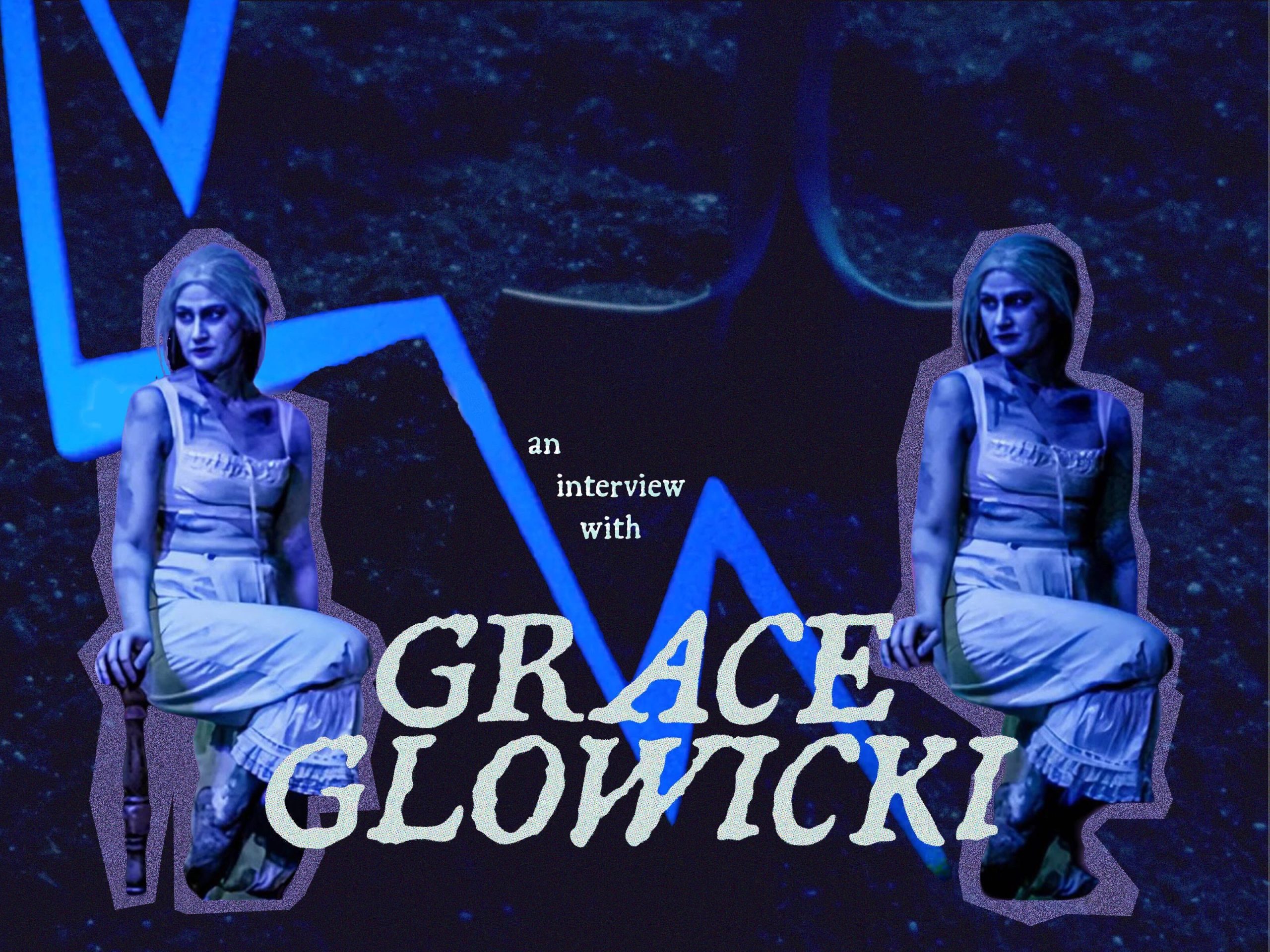
Graphic by Ainsleigh Linnea
This interview has been condensed and edited for clarity.
Nothing looks like this movie. I was really drawn to the cinematography and the makeup. Could you talk a little about those two things?
Totally. The cinematographer is Rhayne Vermette, she’s based out of Winnipeg and she’s this incredible filmmaker in her own right. She directed a film called Ste. Anne and one called Levers, both of which played at New York Film Festival and TIFF I believe. When I first saw her work I was like, “Oh my god she’s the only person that can shoot Dead Lover” because she shoots a lot of stuff really dark and isn’t afraid of being expressionistic with color. I remember seeing her film Ste. Anne, and there was a green front light and a red hair light and I was like “Oh my god no one’s doing this! This is so cool!” Her stuff always looks very dreamy and poetic. Also, her film Levers, she shot an entire feature on a Bolex, which a lot of people will tell you you can’t do because of synched sound but she just doesn’t care and has a real punk attitude about film. The visuals of the movie came from Rhayne’s brain. We actually shot without a monitor or a shotlist, so it’s just Rhayne following her instincts. She’s a very intuitive artist and I think of her more like a painter or a dream weaver than a regular classical cinematographer.
The makeup was done by Joseph Hinds and Samantha Breault. I told them it’s okay if we’re really painterly, it’s okay if we see brushstrokes and cracks and wigslips and stuff. They would also go on to work on Del Toro’s Frankenstein which is very funny. I feel like they did both this ratchet, DIY cheap Frankenstein and the high level Frankenstein.
Of course my inspirations came from black box theater and Kenneth Anger films, these old photographs of Iggy Pop where he’s onstage in the 70s and everything falls to blackness around him and he has a single prop and a lot of emotion on his face. Old cabaret, old vaudeville stuff. That’s a big diarrhea dump of inspirations.
Could you speak a little about how collaborative the writing of the film was?
When I wrote the film I wanted to open a final draft as late as I possibly could, so I workshopped it orally with four other friends. One was Ben Petrie, my husband, one is Matthew Devine, who is a therapist in New York, Haya Waseem who’s a filmmaker in New York, Harry Cepka who is an NYU alum, and myself. I would call these people and start spitballing characters with them, so the genesis of the story came from these conversations between pals. It was a cool way to develop something because it was a little unconventional, and yet a very natural way to tell a story because, of course, the tradition started orally, y’know? I was trusting this sort of more primal way of developing a story through talking.
At any point did you miss writing more solo like you had in your first feature?
Not really. I think this way of working was a reaction to my first feature which is about anxiety and agoraphobia. I made it in this time of my life where I was more isolated so I challenged myself to try to open up each juncture of my artistic practice. And I realized that it’s just so much fun to do it this way. When I strip it all down and ask myself what I’m really chasing in this career pursuit, I think it is when you’re working with a friend and you find yourselves in each others’ heads and have a moment of connection and a giggle. So to incorporate that into every stage of the development has been really pivotal for making it a joyous pursuit for me as opposed to something laborious.
Were there any moments in the making of Dead Lover where you could feel yourself leveling up from your first production?
The first production, we had seven days to shoot Tito and the equivalent of maybe $8,000 USD to shoot the principle photography of the film. We had so much more money for Dead Lover than I was used to. It was only about $350 [thousand] American, so still not that much in the world of film. But for me I had 16 days, all these people, all this money and so by sheer resources it felt like such a leveling up. Also I think I’d gotten a lot of my angst out as a filmmaker. I feel like first feature films are usually very angsty and you’re kind of claiming your suffering in some way. I look at Tito and I love it and think it’s great but I can see how I’m kind of juvenile and emo and needed to get that out. I think there’s something a little more altruistic in Dead Lover even though it’s still emo and personal. I think it’s taking into account the audience a little more than my first film and trying to provide laughter to the audience. Cause I am, as I move forward in my career, honing in on how much I value comedy and how much I want to try and offer that to people, and my collaborators. I think it is a pretty worthy pursuit. So I notice that shift.
Dead Lover is hilarious, and there’s a lot of very funny voices in the movie. How did you find the right voice for the Gravedigger? How did you think about finding other voices for the ensemble?
As an actor, I’m in these other movies and I always ask the director “can I do a character voice?” and they say no for the most part. So I was like “K here’s my shot, I can do whatever voice I want.” In the rehearsal hall one day, as sort of a joke, someone said “what about a Cockney accent?” and I tried it on and it was terrible. Everyone was like “Yo, you can’t do that, it’s so bad.” I thought “you know what, I think that’s exactly why I should do this,” maybe three weeks before shooting the movie.
Then I was in this mode of appreciating inconsistent and bad accents, so there’s a ton of different accents in the movie. For the Widower, Lowen [Morrow] really likes Buffy [the Vampire Slayer] and there’s a character called Spike that they were channeling for that character. The Gossips I think were channeling an old lady, something kind of waspy. And then the Sailors were funny because the morning of, no one had character voices. So Ben thought of this alcoholic belligerent mumble, Laya [Doz] is half Jamaican and was channeling her grandfather’s voice, and Lowen was inspired by Mickey Mouse and found this “H’oh Boy!” There’s no place specificity in the movie, so we were kind of making a salad bowl of accents and it didn’t really matter as long as the actor doing them was inspired to speak like that. It was pretty random and kind of rebellious and probably in reaction to being told no so many times.
What made you land on smell as the erotic center of the film?
I remember talking to Harry Cepka about this in the development phase, how sometimes you’re at a party or something and someone just has a stink on ‘em. They don’t literally smell but they’re repellent in some way that you can’t quite put your finger on. It’s almost as if they stink even if it’s more of an intuitive tacit reaction to someone. Harry and I went to university, so we just started talking about people we knew that caused this reaction of really wanting to get away. Smell was a way to make sense of why someone would be repellant if there was no reason in their personality you could point to. The more I would look into smell I found it’s kind of the funniest sense in some way. Watching people smell stuff just looks silly, when you smell bad it’s so mortifying. And yet we all poo, and we fart, and it’s just this shame. I feel like shame and smell is kind of intertwined, and I like writing about characters who feel ostracized. To be ostracized because of how you smell felt kind of basic in a great comedic way. It’s also hard to show smell on film so trying to show, in cinema language, smell was a cool challenge.
I was very lucky to see the film in stink-o-vision at the IFC Center. Can you talk a little bit about adapting Dead Lover to these scratch and sniff cards?
Yeah! The film was not conceived thinking that we would do it in stink-o-vision. Then as the film would play festivals some people would bring it up “I think you could do this in stink-o-vision, like John Waters did with Polyester.” And more people would bring it up. Then in anticipation of TIFF midnight madness, our amazing distributors Cartuna x Dweck based out of New York were like “lets put some money in this, lets develop this for TIFF and see how it plays.” So they hooked me up with these really cool smell artists at a company called Scented Storytelling, and I worked with them to develop this card that plays along with the movie.
It was so cool to think of how incorporating these smells almost became like another layer of writing on top of the movie, but through the medium of smell. There was interesting conversations of “how do we tell jokes with smell?” In the movie there’s a line, “I want to pick up a piece of your poo and eat it like a banana” and then a number hits for doing the scratch and sniff. The joke is kind of like, does the audience think they’re about to smell poo or about to smell a banana? And then we give you banana. But there’s stuff like that where it became this fun process of how to tell jokes with smell and how to support a narrative that already exists with smell and not disrupt the timing of jokes or exposition when the number flashes. Because there’s so much smell in this movie, there’s like 30 places you could put a scratch and sniff number, but which ones are the strongest? So it was surprisingly really directorial, which I didn’t anticipate. You could think that it would be sort of gimmicky but it ended up causing this new mutation of the film. Yeah, very bizarre process and people seem to love it which is weird.
Were you worried at all that the titles underneath the smells would give away jokes or beats of the film?
That was actually a big conversation in developing the cards of whether or not to put labels. And weirdly, the experience of doing them without the labels became more you’re reaching to find what is it that I’m smelling, and there’s a lot of wasted energy on that. So the labels we ended up finding were really important for cutting that potential ambiguity down. And instead it’s directing you a little bit as to what you’re smelling so you’re not guessing, because smell is so subjective. But also we were able to incorporate some jokes in the labels. Like one is “???” so you don’t know what you’re smelling and the film answers it for you by saying “Pussy” and it’s sort of like a “jokes on you” vibe. So the labels I actually really love, and I wish you could see them in the dark a little better! But we’re trying to develop that for the next round of printing. That’s another struggle with the card— how do you make this card so it’s most usable in a dark theater. And like people’s fingers, at one point we were like “should we provide a scratcher so their fingers don’t get stinky?” and then we were like “no, maybe it’s funny that everyone’s fingers get stinky” so you know, all these kind of weird conversations were happening behind the scenes.
I saw it with my partner and we got the cards, but we weren’t at a screening that had the numbers. So it was this added game of “is this the moment or not?”
Oh my god totally! And P.S. I keep hearing people getting the cards for the non stink-o-vision, and I almost feel like we should put online somewhere the timecode or the lines that come before, so people could know even if they don’t have the DCP [Digital Cinema Package]. Because in the stink-o-vision version a number will flash. We gotta get it so when people are able to score cards that they know when to do it. Maybe we should only show the film in stink-o-vision?
You worked with U.S. Girls to do the score of the film. How did that come about?
Meg Remy is based in Toronto, I heard she was bumping around town and doing collabs with people. So I just emailed her label or agent with a link to the film asking if she’d be interested in scoring it. She had never scored a film, but she responded to the material and said she’d be down to do it, and it was amazing. I think because she’s not a conventional composer she approached it really artistically. We ended up stumbling upon our mutual love of collaging and decided to approach the score like a collage and the different sort of materials we decided we could use were her first three albums. She had this one beautiful track, which is sort of the theme in the movie, she had the amazing idea of using wax cylinder recordings from the public domain from like 1918 and earlier. And then she also allowed me to dig through all of her old hard drives and to use any scraps of unreleased songs or music experiments. The experience felt like the equivalent of when I was in junior high and cutting up magazine pictures to make like a teeny-bop collage, but instead we were working with these different kinds of sounds that she had. She kept saying that if something new doesn’t need to be made she’d rather not make it. And then for the music video, I gave her my scraps which were all of the unused footage from the movie, so we were just into this idea of collage and using things that already existed.
I heard you recently had a kid and you’re already working on your next feature.
So next feature, I’m slowly writing it, nothing really to report on it yet. I think I’m making it in the same way as this last one, which is talking to friends in a very slow brain-jammy development process and seeing what comes out. Probably won’t shoot it for another couple years but I’m enjoying developing it.
Do you think becoming a parent has shifted your artistic perspective in any kind of way?
The biggest thing that comes to mind is when you’re a parent you have a lot less time, so your focus becomes even more focused. You say no to a lot more stuff, and your priorities become a lot clearer. The time scarcity has this effect, at least for me, of cutting through a lot of the bullshit and not doing stuff you don’t really want to do. I don’t notice a shift in my taste or that kind of stuff, it hasn’t changed anything about my voice I don’t think. Yet at least. It’s more just the reality of being a parent in an artistic pursuit.
It feels like there’s this larger movement right now where Canadian films are being seen more internationally. Your husband was recently in Nirvanna the Band the Show the Movie, for example. Do you have any thoughts about what that means or how that impacts Canadian cinema?
Ben and I always attribute it to we have a government that funds the arts. There’s this amazing emerging filmmaker grant called the Talent to Watch grant that gives more filmmakers smaller amounts to make their first feature. Ben’s film The Heirloom is a Talent to Watch grant, this is a Talent to Watch grant. I don’t know if you’ve heard of The Maiden or We Like Movies but these are all from this amazing grant that Matt Johnson worked to help create. All to say there’s avenues in Canada to get your film made on many different levels through this government support. And I think what’s happening, in part because of Matt Johnson pushing Talent to Watch, is it’s creating this community of filmmakers who have more freedom than they would if it was all money from a private company. I don’t have to pay any of this money back, so it gives you more artistic freedom because you’re not beholden to an investor. And it seems like we’re all sticking around in Canada, whereas before if you reached a certain level of success you would probably move to the States to continue ascending in your career. But in the neighborhood I live, I walk around and I run into Matt Johnson, I run into Chandler [Levack], I run into Graham Foy, Ethan Eng, all these amazing filmmakers that are just living around Toronto. It’s this amazing community here and it must come back to the fact that the government funds the arts. We’re very lucky in Canada.
Are there any plans for a physical release of Dead Lover?
The distributors are talking about making a Blu-ray. I believe they’re gonna go with one with stink-o-vision and one just normal; “pure chino” they’re calling it. So there is talk about it, I don’t know exactly when it will be released. My hope is that people will be able to buy a DVD with the scratch and sniff card and have the stink-o-vision experience at home. We could maybe even provide a way if people wanted to have people over and have multiple cards, there’s some way to get them online so you can have a weird stinky party with your friends.