
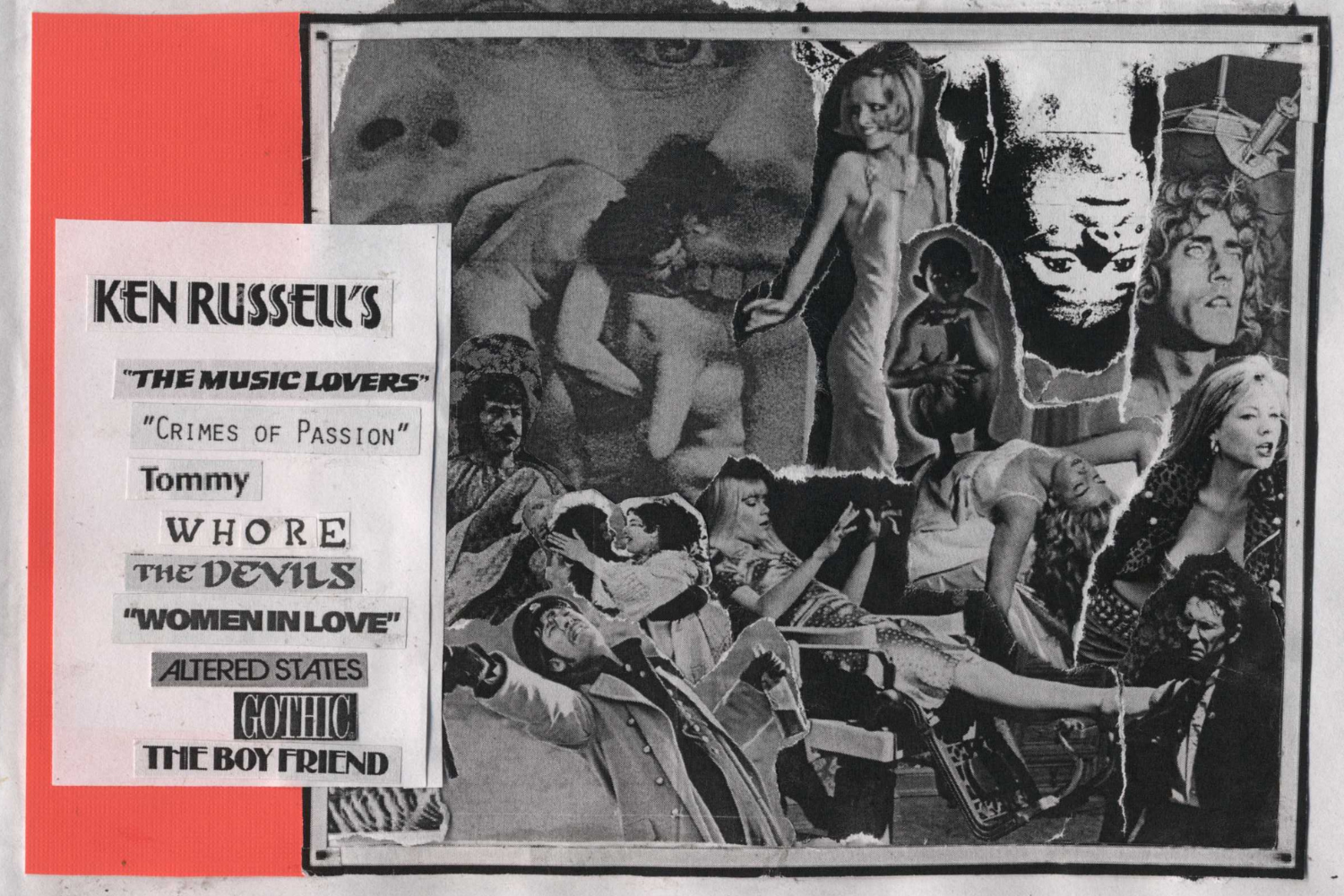
If you had told someone even five years ago that Ken Russell’s controversial 1971 masterpiece The Devils – up to that point only available in highly censored, sloppy standard definition – would become a smash hit in mainstream theaters all over the US and UK, they probably would’ve thought you were possessed too. Buoyed by a splendid 4K restoration, the once-taboo picture has sparked a renewed interest in Russell’s iconoclastic and extravagant filmmaking style, one which perfectly captured his signature obsessions of sex and religion.
In celebration of the re-release of The Devils, the indie theater IFC Center launched The Gospel According to Ken Russell, a series of ten other films by the maverick director. Ranging from unconventional biopics of classical composers, adaptations of iconic literary properties, and flamboyant Hollywood cult hits, Russell’s chameleonic range asserted himself as one of the most acclaimed British directors of all time. In order to find out just what compelled a man to be fascinated by psychoactive drugs, Busby Berkeley, and Pyotr Ilyich Tchaikovsky, STATIC sent out writers to cover The Gospel According to Ken Russell. And much like the Gospels, our findings were inconsistent and revelatory.
Women in Love (1969):
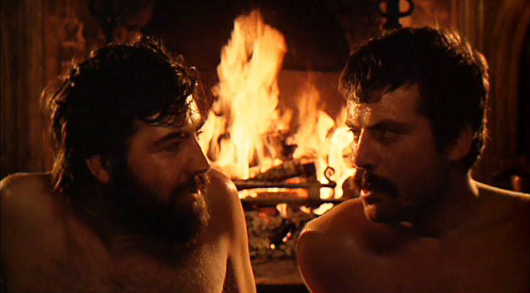
Women in Love, a film about homoerotic bonds and romance in an industrial age, evokes reflection on the cultural and cinematic zeitgeist of 1969. That same year, a little-known movie that happened to win Best Picture features a debilitated Dustin Hoffman fantasizing about escaping the slums of New York to live out a sunsoaked, fruitful life in Miami with his gigolo best friend and roommate. This same theme of male intimacy and unabashed sexuality threads through Ken Russell’s Women in Love: a tale of two sisters, Gudrun (Glenda Jackson) and Ursula Brangwen (Jennie Linden), and their entanglement with a pair of friends, Gerald Crich (Oliver Reed) and Rupert Birkin (Alan Bates), in early 20th-century Derbyshire, a bleak and dreary coal-mining region.
Women in Love is essential to Russell’s transgressive canon, cementing him as an auteur who refuses to shy away from taboos and defies conventionalities surrounding romance, including raw vignettes of human sensuality in his lucid love scenes. Shots are infused with capricious metaphors and lush, bovine-dotted landscapes. One of the first major films to feature male frontal nudity, Women In Love famously features a scene in which the two men, new lovers to the sisters, wrestle naked in firelight. We come to understand the men share an “eternal” connection beyond the heteronormative bounds of love and sex, a blood brotherhood that lingers in the aggressive, cold air of Beldover. Earlier in Gerald’s courtship with Gudrun, he declares he is not angry with her, but rather in love with her. “That’s one way of putting it,” she responds. Gerald’s demise is already evident here; he conflates amorous passion with his penchant for domination: in his hollow domestic life with Gudrun, in his brutalized role as an industrial coal magnate, and in his nude match with his closest companion.
At the end of their wrestling match, Rupert, demoralized by narrow, heteronormative ideals and privacies around monogamy and matrimony, proposes a new kind of love to his friend: while women fulfill certain, arguably superficial romantic and sexual roles, men can share a deeper, eternal bond built on intellectual understanding. An understanding cultivated from “being known” by friends and confidants in a way one’s partner would not (where they know only an idealized version of their lover). A similar intellectual kinship forms between the nihilistic sculptor Loerke and Gudrun, as she becomes disillusioned with Gerald’s cynicism. Gerald promptly rejects Rupert, fixating on romance even though his love craves an intellectual connection.
The ideal of psychological compatibility is what makes Women in Love so alluring. Just think about how absurd our modern dating landscape is: the expectation of being on a dating app and AI startups quantifying “chemistry” to optimize human connection. In a society that champions one specific kind of monogamous relationship, Women in Love’s note of hope is met with open arms: a man admitting that he will always desire unconventional love, even though he’s resigned to never having it. – Rebecca Starling
The Music Lovers (1971):
Revelry, a pig to be roasted, a man riding a white horse on the street and a woman chasing after him from her balcony. It’s a Pieter Bruegel the Elder painting set to cheery ballroom music, or it’s the chaotic opening scene of Ken Russell’s 1971 biographical drama of composer Tchaikovsky’s disastrous love life, The Music Lovers.
Deep in the raucous social scene of late 19th-century Russia, Peter Ilyich Tchaikovsky (Richard Chamberlain) is having sex with men, but he’s also the rising star of the Saint Petersburg Conservatory. The flamboyant costuming, designed by Russell’s wife Shirley (who also did the maximalist outfits for 1975’s Tommy), is the elegant spillover of his private life into the public, as if Tchaikovsky’s (and the film’s) excesses simply cannot be contained.
Indeed, as the obviously passionate, and therefore tortured, young composer’s closeted sexual experiences with Count Anton Chiluvsky (Christopher Gable) drift into the stuffy white halls of the Conservatory, spread by prim, conspiratorial whispers, Chamberlain unleashes in Tchaikovsky a man ruled by his most desired (and therefore most forbidden) life. His contested performance in the academy’s concert hall is a wild slamming of piano keys as he gives the crowd his Piano Concerto No. 1. His colleagues are disturbed. A woman (Glenda Jackson) bites her lip.
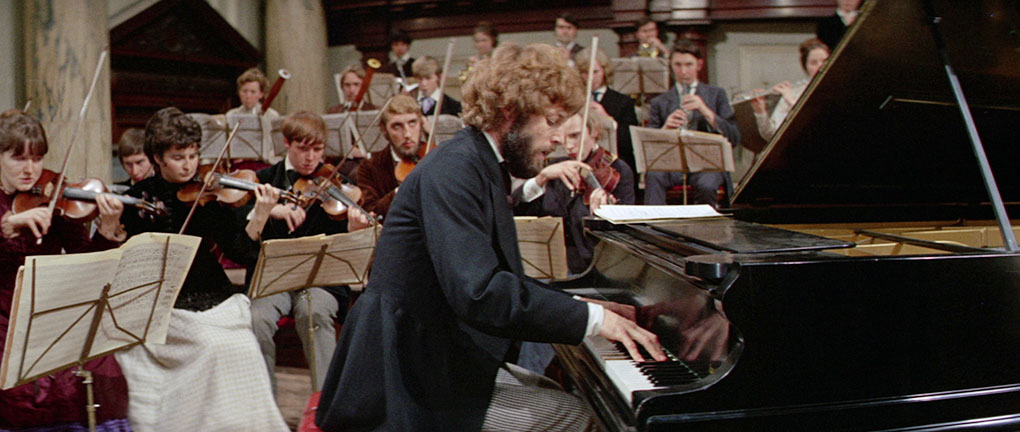
The woman, Tchaikovsky’s manic wife Antonina Milyukova, is played by Jackson as coy, girlish and immensely unstable, just like her husband. The film is an outburst of passion, and although their story is by no means peaceful, their marriage is purely symbolic, lacking any sort of true emotion. The title of man and wife offers no comfort – and the film never pretends it does. Russell realizes the tension of Nina and Peter’s mutually unfulfilled desires with disturbing perspective-jumps into their dreams: collaged, fantastical images of marital bliss which intentionally fail to match with their depressingly unimaginative life together.
The unreachable world of societal purity promises stability that Tchaikovsky never attains, and iterates that perhaps his music (and even the film) are best listened to outside of any attempt at normalcy. Life is portrayed as better when it is free; every character’s deepest frustrations release themselves in the fantastical imagery, the parties, and the overwhelming interior design: incense, champagne, fireworks all fit to music, moving together. Even the privacy afforded by his untouchable love Madame Nadezhda von Meck’s (Izabella Telezynska) estate, where his tortured psyche can fastidiously compose out in the country, doesn’t last for long. The film is a lesson on the dangers of repressing that which can never go away – and the precarity of experience which comes from that is seen as exhilarating just as it is destructive. – Julianna Lindo
The Devils (1971)
Everyone is talking about The Devils re-release. Everybody is dressing up to see The Devils. The film is in its third week in theatres, the film beat Digger at the box office. How can it be that the “enfant terrible” of British cinema is having such a comeback? It isn’t surprising that while the films of Ken Russell have long been associated with controversy, people are finally seeing just how much fun he really is. Appreciating Russell’s The Devils is not simply to recover a misunderstood auteur but to recognize a body of work that anticipated and continues to illuminate the complex relationship between sexuality and systems of power.
The Devils, which received a 4k restoration and theatrical re-release by Warner Bros. this year, immediately wants you to know that while Russell’s hyperstylized anachronistic baroquianssance aesthetic may be distracting, the events of this film are in fact based on a true story. The film recounts the case of an alleged demonic possession of an Ursuline convent of nuns in Loudun which culminates in the execution of priest Father Urbain Grandier (Oliver Reed).
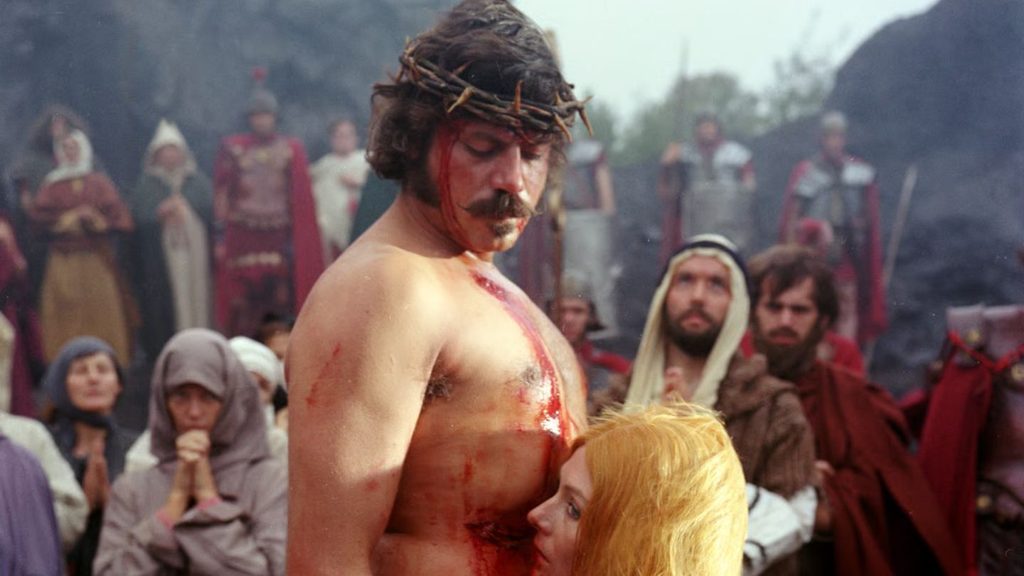
Upon its initial release in 1971, The Devils was referred to as “an insult to cinema” by the Vatican, a sentiment that seemed to be held in consensus by critics globally. The film was laughed at by Ebert, Kael, the Los Angeles Times and the New York Times. It was banned in Finland and Italy, and was significantly edited in both Britain and the U.S. so much so that until this release, Warner Bros. had never released the full director’s cut. On its own, critics would have rejected The Devils hotchpotch stew of orgiastic sex, blasphemy, forcible purgations, 60s-mod-rocker-priests, and torture, but no scene is as infamous as the sequence that takes place during what is dubbed “The Rape of Christ.”
The scene, beautifully restored in this theatrical run, depicts the convent of nuns in a frenzied state of group sexual hysteria. They rip down a larger-than-life statue of an anguished Christ which they proceed to ravage, gyrate on different religious paraphernalia, engage in sexual acts, and run around naked. Both the studio and the British Board of Film Censors wanted this particular sequence to be cut before the film could be released. Russell however knew that for his film to work, Christ must be debased; it was the crux of his idea. The controversial scene was removed before the film was released in Britain. The debasement of Christ is inherently manic and excessive, but not for no reason. Religious authority, in real time, is collapsing into hysteria and spectacle, the scene suggests that by the time the statue is dragged down and violated, the sacred has already been emptied out by the institutions meant to protect it.
Russsell’s themes are further benefited by his collaboration with production designer Derek Jarman for The Devils’ visual style, which no doubt appealed to exploitation film producers keen to capitalize on such publicity. Each detail from the convent’s doctors-office-esque bare white minimalist design, to the use of green lipstick (which was in fact historically accurate, though has the opposite effect of signaling modernity) aims to disrupt the relationship between ourselves and the Renaissance.
The Devils reveals the extent to which institutional power depends on the dramatization of control. This approach distinguishes Russell from many of his contemporaries. The film’s own indulgence is a means of grappling with his own contradictions of faith and desire in relation to society as a whole. The continued relevance of Russell’s films in 2026 lies in their recognition that the regulation of sexuality does not disappear with the erosion of traditional forms of censorship. If anything, this re-release seems to prove that even more pressingly so. – Hanne Brabander
The Boy Friend (1971):
Unbelievably Russell’s third film of 1971, The Boy Friend tells the story of Polly, a timid assistant stage manager (Twiggy) forced to step into the leading role of a 1920s revue after its star (an uncredited Glenda Jackson) suffers an ankle injury via tram. Based on the 1953 musical of the same name, Russell’s emulation of Busby Berkeley’s splendid spectacles was in part an attempt “to prove to people I’m not totally deranged” after the fracas surrounding The Devils. And The Boy Friend is indeed irresistibly charming – what film couldn’t be with the endearing presence of mod fashion superstar Twiggy at its center, whose down-to-earth Cockneyisms contrast delightfully with the dramatized caricatures of her counterparts. The musical sequences – to no surprise given Russell’s penchant for extravagance – are appropriately ornamented and dazzling, often blending on-stage performances with fantasy scenes of verdant forests and psychedelic abstractions.
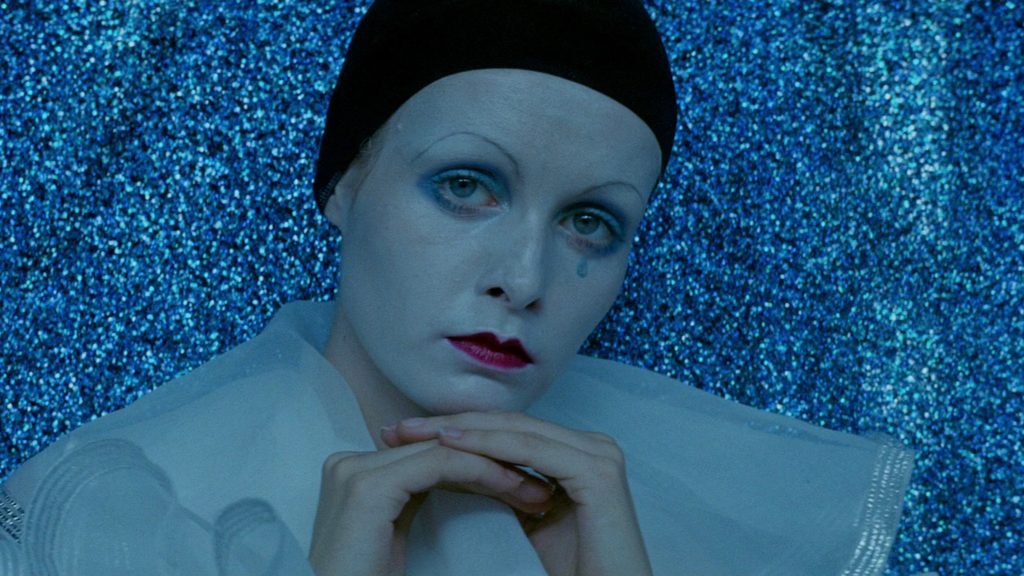
Yet, in signature Russell fashion, the gorgeous exteriors should not be taken at face value; the dozens upon dozens of music hall numbers that fill up The Boy Friend are intentionally annoying and alienating, to the extent that it can often feel like Russell is deliberately playing a joke on the viewer. Additionally, the film derives much of its emotional weight from the precise uncertainty of what is in the story of the musical and what is of real life. The central relationship between Polly and her co-star Tony (Christopher Gable) – a character who she has deep affection for – is one that shifts in and out of the revue’s diegesis as it becomes unclear what their feelings are for each other. To heighten the film’s Brechtian edge, performances in the musical are often set backstage or outside the theater entirely, forcing a contention with the verisimilitude of the performances and the film as a whole.
The Boy Friend works on these two varied but not mutually exclusive planes; Russell’s sheer passion for the form is clearly evident from both the lavishly decorated sets and period accurate music courtesy of Peter Maxwell Davies, but he is inevitably also drawn to the unsettling theatricality and stilted emotions of this now antiquated genre. The film proves that as much as he tried, Ken Russell just couldn’t stop being Ken Russell. – Lachlan Wong
Tommy (1975):
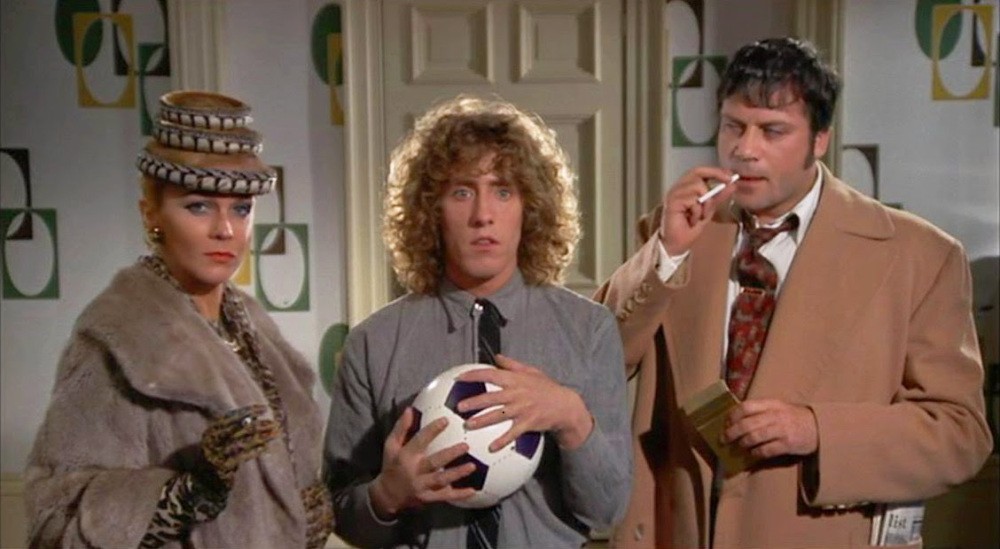
Tommy holds less importance as a rock opera than as an integral moment in the development of the music video, where it began to change from a mere promotional tool to an aesthetic product in itself. Of course, Ken Russell had been preceded by Richard Lester and Michael Lindsay-Hogg in their moderate stylizations of The Beatles and the Rolling Stones respectively (see A Hard Days Night or the promo video for 2000 Light Years from Home), but here his theatricality and German-Expressionist approach to set design raises their primitive ideas to new levels.
We see this clearly in a key scene, where Tommy’s (Roger Daltrey reprising his role from the album) depressed mother (the brilliant Ann-Margret) hallucinates and writhes around in baked beans, foam and chocolate exploding out of a TV. The ridiculously sexual nature of the scene is just one example of how Russell doesn’t take himself too seriously. Thus, the whole film, despite Pete Townshend’s grandiose ambitions, takes on a comic sensibility. In some sense Russell’s campiness has been a blueprint for most attempts to marry pop music and film: a focus on hyperstylization which ultimately overshadows the relevant message, which is usually not too deep anyway.
The Who’s soundtrack, outside of the smashing “Pinball Wizard” and the spellbinding “See Me, Feel Me”, is rocking but mostly forgettable, and Russell’s vision certainly triumphs over Townshend’s. That being said, Tommy does deserve credit as one of the first really ambitious concept albums, but the Who would perfect that craft on Quadrophenia. – Aryan Grover
Altered States (1980):
Ken Russell goes Hollywood! Given that his first stint working in America was with the infamously adversarial Paddy Chayefsky, whose 1978 book and subsequent screenplay Russell was tasked with bringing to the big screen, the result is surprisingly effective. Altered States concerns Eddie Jessup (William Hurt), a psychopathologist obsessed with primordial states of psychological being, which he attempts to access through various means including sensory deprivation tanks and Native American mushrooms. His obsession soon becomes dangerous, much to the concern of his colleague Dr. Rosenberg (Bob Balaban) and his wife Emily (Blair Brown).
Altered States is perhaps most well known for its mind-bending special effects, which seek to portray the indescribable sensation produced by psychedelics; the scene where Eddie feels the effects of taking a large dosage of the hallucinogenic shrub sinicuichi is one of the most spellbinding in all of science fiction. Russell also incorporates Brakhage-esque montages of cosmic reshaping when exploring Eddie’s obsession with primordial consciousness. Body horror is also extensively utilized to frightening effect, recalling the fleshy effects of David Cronenberg films.
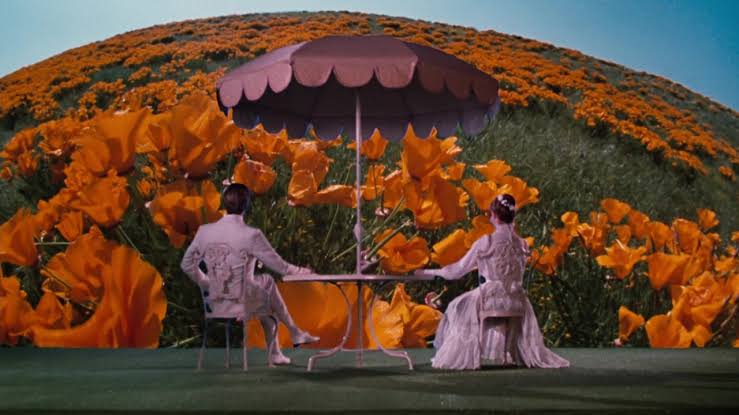
These sequences are undoubtedly the highlight of the film, but the rest of Altered States is still appropriately gripping. The fervor of madness as shown in The Devils is replaced with a more intimate analysis of obsession. Eddie’s obstinate descent into madness is channeled superbly by Hurt, who adopts just the right amount of his signature naivete to portray an intelligent character who becomes unaware of his reality. Balaban and Brown are effective foils to Hurt’s mad scientist, granting the film a powerful emotional center. Chayefsky’s grandiose script – despite Russell often finding it unfilmable or embarrassing – eventually found its crazed, bombastic vision. – Lachlan Wong
Crimes of Passion (1983):
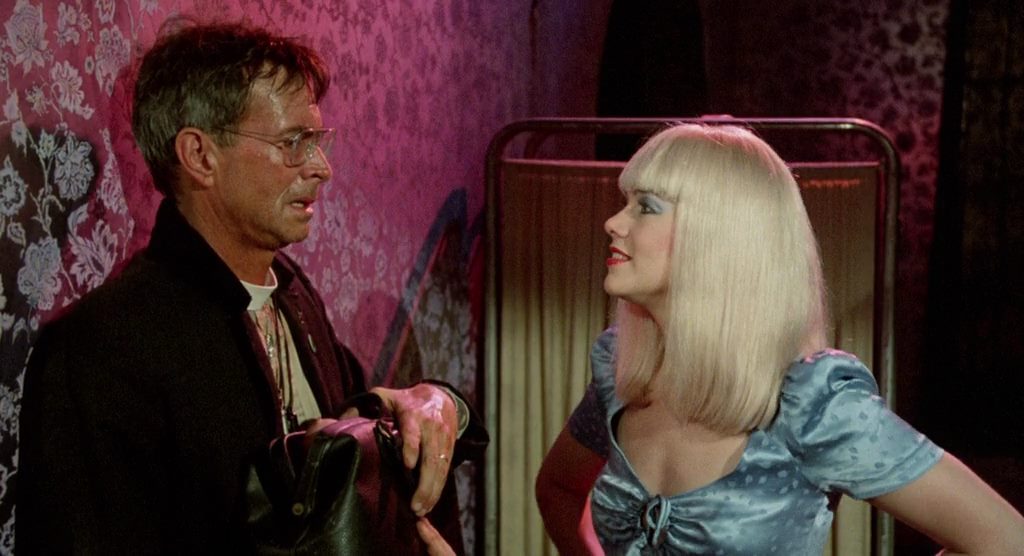
Crimes of Passion is neo-noir that should be cheesy but isn’t. Replete with smoochy saxophones, floating synths and moody lighting, Russell uses his ability as a master stylist to create a movie that feels like a dream-journey into a luminescent red-light district of 1980’s nowhere USA. What invigorates this journey are the two magnificent performances of Kathleen Turner and Anthony Perkins. Turner plays China Blue, a designer moonlighting as a prostitute, with a flexibility that allows her to be sexually hypnotic one second, sardonic and teasing the other, and vulnerable the next. She is thus the perfect foil to the one-note insanity of Perkins’ Peter Shayne, a guilt-ridden street prophet who tries to save her from self-objectification through increasingly violent means. Ultimately her salvation arrives through a romance with the rather dull Bobby Grady (Jon Laughlin). The saving grace of this thread of the story is a wonderful sex scene that shows Russell at his best, as we watch Turner and Laughlin’s silhouettes dissolve on a flower-patterned curtain, the flickering lights hiding and revealing their outlines.
While Crimes of Passion was not very well received on release, mostly due to the prudishness of reviewers and the studio alike, to contemporary film goers it stands out as a forgotten classic and a highlight in Rusell’s oeuvre. – Aryan Grover
Gothic (1986):
Gothic is a drug-fueled psychosexual dream of a film, following the phantom-summoning adventures of four melodramatic hedonists and one grief-ridden Mary Shelley (Natasha Richardson). A loose retelling of the night that Mary Shelley conceived of Frankenstein, her step sister Claire Clairmont (Myriam Cyr), and partner Percy Shelley (Julian Sands), arrive at the castle of Lord Byron (Gabriel Byrne), joined by his doctor friend John William Polidori (Timothy Spall). What starts as a dinner between romantically-entangled friends devolves into a surreal horror as they drink copious amounts of laudanum, practice “free love”, and engage in a seance that taunts them with their greatest fears. Opium is to the Romantic era as LSD was to the seventies, making Gothic a historically accurate drug flick. It’s ironic, therefore, that Russell’s Mary Shelley was the only sober individual throughout the antics of the film. Perhaps he means that reality is the more terrifying beast, not the eyeball-adorned breasts seen (hallucinated?) by Percy Shelley, or the painful yet arousing cuckold experiences of Dr. Polidori.
Lord Byron is our sociopathic party host – he manipulatively indulges in the antics of his die-hard admirer, Claire Clairmont, tenderly comforts the frantic Percy and Polidori with confident homoerotic intention, and never leaves Mary unaware of his unyielding libido either. If Gothic is anything, it is unwaveringly sexual. Christopher Hobbs’ erotic and grotesque production design oozes with carnal imagery – especially memorable is the knight wielding a rhinohorn-phallus. Gothic, after all, is a Romantic-era horror piece. The genre shines most through frantic climax, as each character is haunted by their deepest fears, while a theatrical score keeps you hooked on each moment of terror, arousal, and visions, a surprisingly accurate parallel to the late hours of some hallucinogenic trips. Gothic also has no lack of magnetic performances, and especially that of Timothy Spall. He turns Dr. John William Polidori into a whimpering, sexually confused, religiously traumatized, maggot-lover, pathetically crawling after Lord Byron’s attention with an embarrassing lack of shame: fuel for both laughter and pity. Cyr’s Claire Clairmont, manifests a feral femininity while becoming the ultimate bratty sub to the ego-swollen Byron, creating a dynamic riddled with witty remarks and mischief.
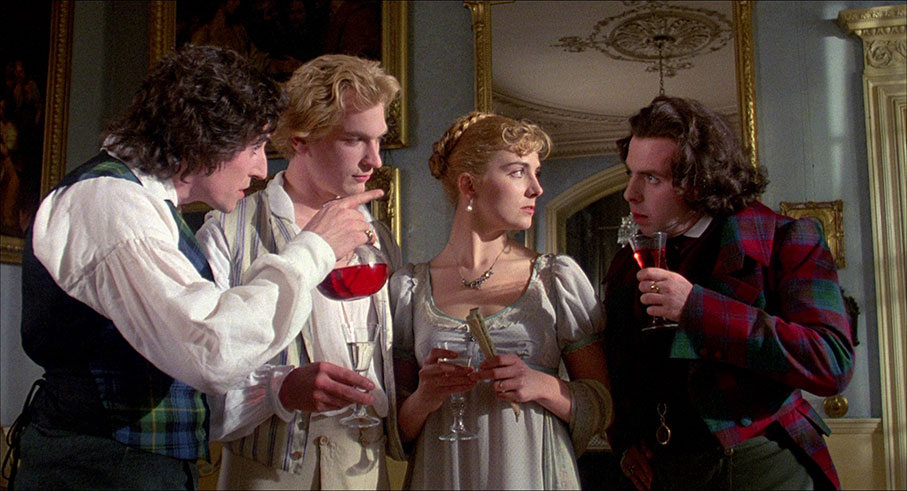
Maybe what makes Gothic appealing is relatability; many end up in chaotic, late-night adventures, over-intoxicated and uneasily surrounded by bizarre companions. For a man whose career has been defined by such brazen style in each of his films, Gothic brims with charisma and psychosexuality giving us a voyeuristic journey of hedonism.. – Lena Haziq
Whore (1991):
Made largely as a response to the romanticized depiction of sex work as portrayed in the smash-hit Pretty Woman (1990), Whore is unfortunately even more misguided and offensive than its rom-com counterpart. Ken Russell’s second NC-17 film after The Devils, Whore is adapted from David Hines’ 1989 play Bondage, which features a prostitute recounting a night in her life in one unbroken monologue. Transporting the story from London to Los Angeles, the film follows Liz (Theresa Russell), as she recounts dangerous encounters with anonymous clients and her psychopathic pimp Blake (Benjamin Mouton), often told through flashbacks. Importantly, the film maintains the direct-address style of the play, meaning that much of the film is made up of Liz breaking the fourth wall.
Whilst the long monologue may have worked within the confines of the stage, the tongue-in-cheek sarcasm of Russell and co-writer Deborah Dalton’s screenplay undercuts much of the genuine attempts at pathos, as seen in some intensely disturbing depictions of violence and sexual assault. The clichéd script isn’t helped by Theresa Russell’s dry delivery, which always sounds like it’s drenched in layers of irony. Even though Whore is somewhat successful in showing the horrors of sex work, its consistently muddled tone means that sincerity is always subjugated to the film’s atrocious humor, which often resorts to adolescent-level sex jokes.
Additionally, the pomp of the rest of Russell’s filmography is barely recognizable. Even given Whore’s comparatively smaller budget, Russell’s style is anonymous. The film was shot in downtown Los Angeles over a little more than a fortnight, and it clearly shows in the bland lighting and boring direction. His last major film, Whore’s poor performance at the box office likely led to a steady decline in Russell’s filmmaking output. Marketed as “no bedtime story”, Whore isn’t even as interesting as one. – Lachlan Wong