
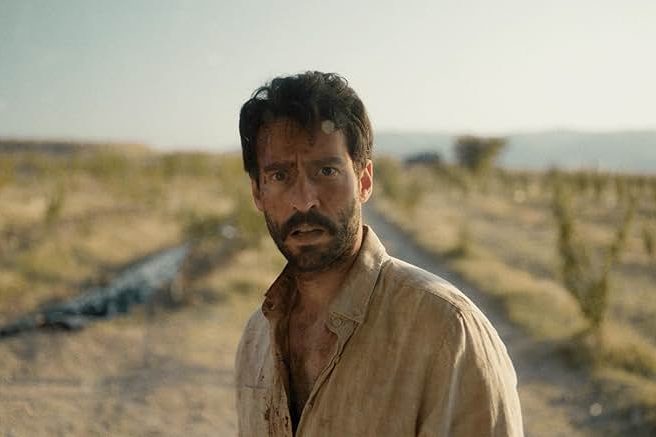
Well before The Things You Kill reaches its first act of violence, something far more unsettling has already begun to take shape. The universe of Alireza Khatami’s new film feels quietly askew. When a university professor returns home after his mother’s sudden death, he steps into a landscape clogged with unspoken history. What follows is less a mystery than a slow moral slippage, where myth, nightmare, and inherited violence blur into one another. After years of revisions and a shift in countries, the film arrived at Sundance 2025 as a bold departure for Khatami.
Our conversation moved through the strangeness of directing in a language not fully one’s own, and how disorientation can become a tool rather than an obstacle. Masculinity, inherited narratives, and the refusal of tidy catharsis anchor his vision. Relocating the film from Iran to Turkey gave the project a new emotional vantage point; one from which the story’s internal fractures came into sharper focus. The Things You Kill ultimately asks what remains when the stories that protect us can no longer hold.
[The interview has been condensed and edited for clarity.]
The midpoint of The Things You Kill feels like a narrative fold, a moment when the film momentarily turns inward. That shift deeply unsettles the viewer but also re-energizes our attention. What draws you to this kind of structural disorientation, and what do you hope it activates in the audience?
For me, it works as a Brechtian point. Midway through the film, it throws you out, and you have to fight your way back in. That creates a space for thinking, reflection, and contemplation. For the rest of the film, you’re watching with a sense of alertness. The suspension of disbelief is gone, and that feeling of being in completely unknown territory is essential for me. I walked the audience into this world as if they knew this family drama. I let them get comfortable, then halfway through, I pulled the rug out and let them struggle for thirty seconds. By then, I’d given them enough that they couldn’t leave. They’re stuck, but they fight their way back to the film. And then I take them to places they’ve never been. I removed all the music at the end because I didn’t want a sense of catharsis; it’s not a familiar movie feeling where you know what happens. No, you have no idea. I wanted the ending to feel like the beginning. And at heart, I’m a cinephile, so I love taking cinema to places it hasn’t been before.
You didn’t have many opportunities to see films when you were growing up. Is there a film that you credit with sparking that love?
There is a movie called Still Life by Sohrab Shahid Saless, which is about a man who has retired and doesn’t know what retirement means. It’s a series of static shots where nothing happens. One of the most significant events in the film is an old woman trying to thread a needle for just one very long shot. When I saw that movie, I thought “Wow. Cinema can be this. Cinema can go there. Threading a needle can be an event?” That was a lesson in seeing the world, and I realized that I can use cinema as a means of navigating my way in this world, as a form of mediation.
You often discuss the importance of empathy, even towards those who do terrible things. As a storyteller, I would love to know how you maintain compassion while depicting violence and even a character’s own moral collapse.
This movie is about narratives. Ali has a narrative that he thinks works, and as cracks appear in that story, and he can’t reconcile it with the world, Reza emerges. A self-negotiation begins. As he negotiates with himself, the female characters continue to challenge his narrative further. Every woman in his life gives him a piece of narrative that breaks his own even more.
The only way forward for him is to build a new narrative. One that isn’t simplistic. Simple stories are dangerous. Fully understanding a story is dangerous. At one point, the wife, Hazar, asks Ali, “Did your mom tell you bedtime stories?” And he says, “She didn’t like bedtime stories. She liked puzzles.”
The world is a mystery. If you put a simple narrative on it, it’s going to collapse. The task, the only task, is to hold the mystery in your hand and live with it, without simple answers. To me, radical empathy means bearing witness. To hold the mystery in your hand.
You didn’t want to perform a simple version of storytelling, and in the past, have expressed a deep desire to push cinema to its edge, even to the point of “failing”. Is there any particular risk you might have taken while making this film that feels prominent to you? I’d love to learn more about your approach to risk-taking, particularly in the process of creating The Things You Kill.
There are two kinds of risks. The first one is formal – the shift. Nobody had done it before. Luis Buñuel tried something similar once, because his actor died, I think. This kind of sudden shift, which isn’t just the imagination of the other character, is rare. This is not Fight Club, where we see a series of flashbacks explaining everything to the audience. I took that away. Both characters have agency, which is something I hadn’t seen before.
Then there are other formal choices, such as shooting a thirty-second, critical confession scene entirely out of focus. We do this a few times. Many people on my crew thought audiences would assume it was a mistake. So yes, those formal risks were there.
But the other risk was personal: to open my heart to the world. If anyone has seen this movie, they know me in an intimate way. You probably don’t even know your own friends that deeply. I told a version of myself that felt risky. And I didn’t fully understand what that meant until after I did it.
Since the film is so personal and rooted in your own life, and given how long the project took to come together, what was it like to relocate it from its original setting, mainly because it couldn’t be made in Farsi? You’ve mentioned that censorship has sometimes pushed you toward creative solutions in previous films, like making Oblivion Verses in Chile. But because this story feels so intimate, did losing the original setting feel more painful or different this time?
Every movie is unique in the way it teaches you about yourself and who you are. At first, it was very challenging to let go of making the film in Farsi. But now, looking back, I think I wouldn’t have been able to make it that way. The mediation, the distance through language and geography, actually helped me add more layers to it. You can rewatch the movie a few times, and each time you’ll discover something new. There are many buried treasures along that road.
I ended up rewatching it right after the screening, and I really felt that discovery process you’re describing, wanting to trace each moment back to its source.
I think that’s a result of having that critical distance. Making the film in Turkey allowed me to find it in that way. And now, it is a Turkish-language film. The Farsi version would have been different, but I’m proud of this one, and I truly gave it everything I had.
You come from a Turkic-speaking tribal confederation in Iran, and you’ve said you don’t fully speak the Turkish used in the film. I’m curious how that shaped your directing process. Did working in Turkish change the way you hear silence? How did you find an emotional rhythm in a language that wasn’t entirely your own?
We don’t speak the same dialect, so I understand maybe twenty or thirty percent of Turkish from Turkey. However, I’ve also made movies in Mandarin and Spanish, and I don’t speak either language. For me, it’s about bringing the right people on board. I’m like a conductor of a symphony: I bring together the best, and then I let them do it.
I trust the emotions behind the words more than the words themselves; the music of the language, its tone, its place of inspiration. That’s far more important to me than literal meaning. And it’s also because I had no choice. I went into exile at twenty-four, when I left Iran and had to learn English. None of these is my native language. I speak broken English. So I had to learn early on to trust my emotions. That’s how I grew up as a filmmaker. I trust the eyes more than the words.
Every room and space in the film, from the garden to the father’s home to the college, feels haunted by the lingering effects of generational trauma. The film’s structure also feels circular, as if the family is trapped within its own cycles. Do you see the act of filmmaking, or storytelling itself, as a way of breaking those temporal cycles of trauma, or are they simply made visible through art?
I don’t think art is that powerful. Art is complicit: it depends on funding, and it takes a long time. It’s not an act of liberation. But it can make things visible, and that’s my job. I put the camera on something and say, “Have you seen this?” It’s not magic. I don’t create something that doesn’t exist. I simply show you that it does.
Have you seen all these flags of old men hanging around the world? In every office, there’s an old man on the wall. People say, “Yes, I’ve seen that.” But then I ask, have you seen it in the hospital too? In schools? At home? On big flags? Once you start to notice it, you realize, “Oh my God, the structure of the world is like this.”
My job is to render the very structure of reality. To say, “This is how it feels to me. How does it feel to you?”
Generational trauma exists everywhere. Especially over the past 50 years, the pace of change has been unprecedented. History used to move more slowly; people had time to adjust. Now I can’t even understand my nieces and nephews. When I make the hand gesture for a phone call, they don’t recognize it. That kind of phone doesn’t exist for them. The world is changing so rapidly that misunderstanding between generations is inevitable.
Maybe for individuals, there’s still a way to break that cycle, at least on a small level, even while the larger structures remain. And perhaps the real task is to confront those structures themselves. Maybe we need to bring down the flags and the photos, rather than trying to kill our own fathers.
Speaking of that — it’s called The Things You Kill. What parts of yourself still live inside this story? And what kind of reflection do you experience when making a film about reflection itself?
Ultimately, the reflection is about letting go of your own narrative: the one that’s been handed to you. Masculinity is defined as “boys don’t cry.” But who said that? Why do I have to hold on to that narrative? Can I hear other narratives? Those of my sisters, my partner, my aunt, my grandmother? What is their narrative? Can I adjust myself to it?
In the end, it’s about letting go. It’s about letting go of this narrative of masculinity in crisis. Because masculinity, by definition, is always in crisis. It’s too simple. It has an answer for everything. But life is far more mysterious than that.