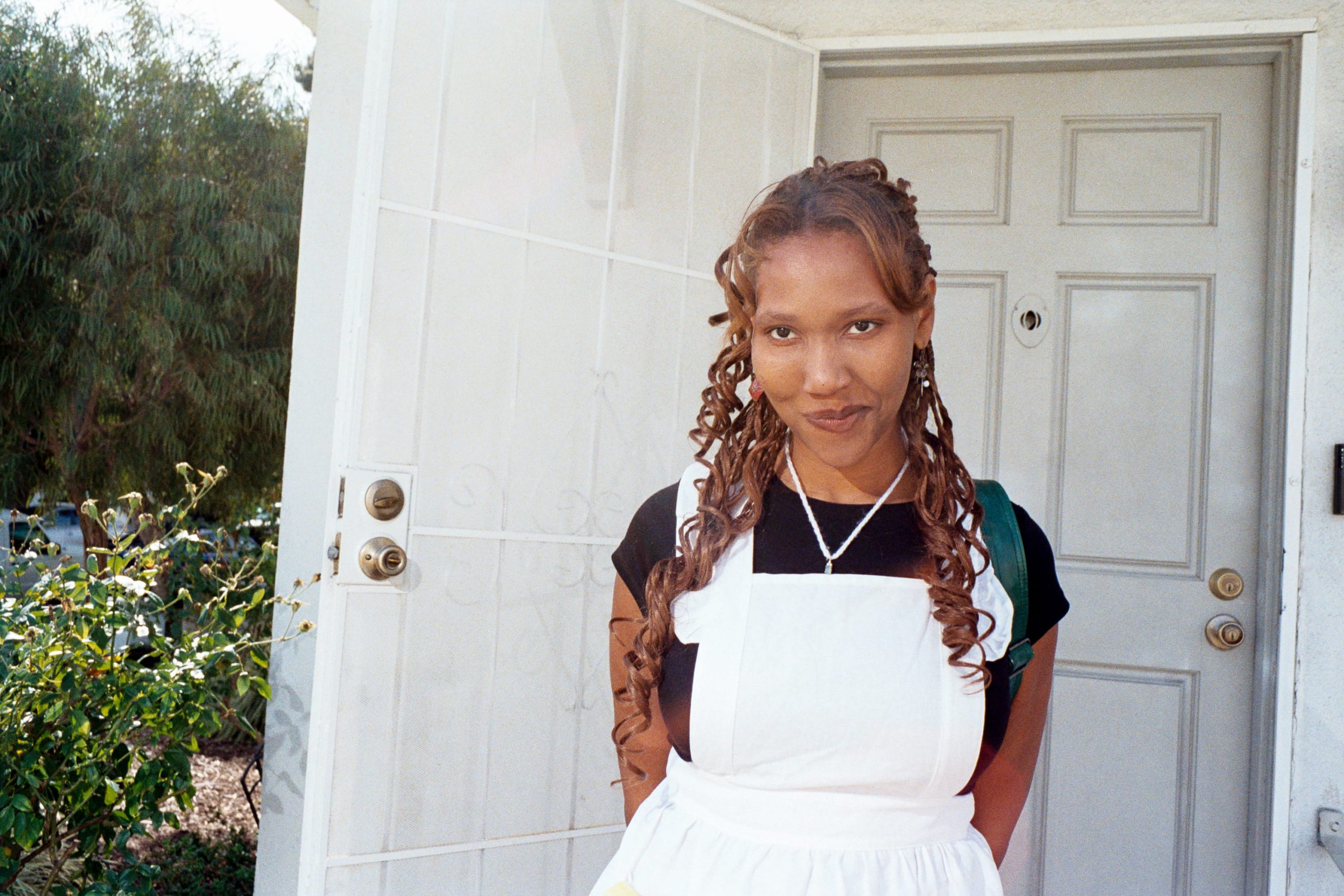
I walked into Union Pool on a windy October evening as Jordan Patterson stood mid–soundcheck with her trio on a bare stage. Having never seen the venue empty with the lights up, my eyes began tracing the cables curling across the floor and the bar stools scattered at odd angles. But Jordan’s voice cut through the room and quietly commanded my undivided attention, filling me with ease. I stayed out of sight as the trio fell into rhythm, going from a gentle hum to suddenly screaming and laughing into their microphones, clearly three best friends doing exactly what they do best. It was that small hinge between a rehearsal and a full-blown performance.
I first caught wind of the LA-based singer-songwriter in February 2025, when she opened for Geese frontman Cameron in Los Angeles. At the time, she had only released a handful of lo-fi folk singles, but a quick look at her social media hinted that something larger was quietly on its way. Her latest project proves that instinct right: a dynamic successor to her early work that showcases her lyrical precision and DIY inventiveness. It feels like the final chapter of a coming-of-age novel—an “adulthood” chapter—where she crosses coasts to sharpen her craft, only to return to the city she’ll always call home.
Seven months after that opening set, The Hermit—her debut studio album tracing solitude, friendship, and grief—was released, and Jordan returned to New York to play it live to a sold-out crowd that included her father, brother, and cousin, who hadn’t seen her perform since she was a teenager. After soundcheck, she introduced herself to me with a tight hug and a beaming smile, and I couldn’t help but notice how her speaking voice carried the same disarming blend of soulfulness and sweetness as her singing. We met outside as she paused to check on her “I love Jordan Patterson” merch table, then settled under the red heat lamps to talk.
Our conversation mirrored the intimacy of her music as we spoke about her creative evolution since taking her art more seriously in 2022. She told me who she considers her community, how those friendships showed her how to love, how romance taught her how to write, and how writing led her to finally trust herself. Watching her perform later, each chord struck me with deliberate emotional precision while her vocals and arrangements were distinctly powerful. The Hermit doesn’t announce Jordan’s arrival so much as it gently reveals it.
[The interview has been condensed and edited for clarity.]
Your music feels like a bridge between where you come from in North Carolina and where you’ve built your world in L.A. How do you hear those two places in your sound, and do you feel that influence is conscious or something that just seeps in naturally?
My mom was born and raised in North Carolina, so I grew up listening to the music she played for me. She came up in the ’60s and ’70s, seeing Prince, Slave, the Gap Band, the Ohio Players, so for a long time, that’s all I listened to. It was mostly soul music, the stuff she’d play on the radio. We used to listen to 94.7 [WQDR], which was this really great soul station. It’s not quite the same now; they kind of play the same 14 songs over and over, but back then, it was magic.
I think that sound finds its way into my music naturally, but also through my process. I’m a very ritualistic person. I like to think I live a Southern lifestyle. Sure, I go out and have my moments, but most of the time, I’m at home cooking, sewing, and washing my clothes by hand. That’s a big part of who I am, but also when I’m in that mode, that’s when I find the space to write. I think that comes from my grandma. She was the kind of woman who’d wake up early to make biscuits and fried apples, and I feel like I followed in her steps, living and creating that way.
Did your musical relationships with the women in your family bleed into your perception of them? And how does that tenderness show up in the way you write about them throughout The Hermit?
Definitely, I didn’t start singing until I was maybe 16 or 17 , and I didn’t start performing until I was 19. I think I would’ve started earlier if I didn’t have such a deep reverence for soul music, which, for a while, existed as an insecurity because soul music, to me, is the best music with the best voices. Voices trained in the church, in bands, in life. My mom played in bands all through her teenage and college years, and she’s such a beautiful singer. When I think about music, I think about her voice and those big, clear, robust voices that defined what I thought music should sound like. My brother sings too, so it really runs in the family. Even if they were naturally gifted, that doesn’t take away from the amount of work they had to put in. Especially as women, to be respected not just as vocalists but as leaders, as bandleaders. That’s something I’ve had to learn a lot about myself in recent years.
‘Extend my fragile heart to the L.A. scene’ is a line from I Can See the Mountains From Here. How has stepping into L.A.’s music world shaped you?
That line is so funny because when I was writing the record, I had just started spending more time around musicians. Honestly, I never really got along with musicians before that, mostly because I wasn’t in L.A. A lot of people in the jazz or indie scenes went to USC, Berklee, CalArts, and similar schools, then moved here. I didn’t come from that background, so I didn’t exactly feel intimidated, but I understood that we were different. We probably just saw things in various ways, and that’s okay. Sometimes I’ll be at a show or a party, surrounded by what you could call my peers, and it can feel a little strange.
But I’ve started to lean into it, because L.A. is home. My childhood happened there. It’s where I became who I am. I try not to judge the scene too much, because nobody’s perfect, and honestly, most people in those rooms are just trying to feel comfortable, stay sane, and stay grounded. That’s what I try to do too. When I walk into those spaces, I can still feel like I’m entering as fully myself as possible.
You’ve talked about spending years creating alone. How did learning to share that private process with others—especially Erik Van Thyne—change your work?
Erik is like a glass of water. He’s one of the calmest, clearest, most grounded people I know. In our very first session, we basically made all of Waited All the While.
It can feel strange and even scary to let someone into your process, the flawed process that it inherently is. I had to remind myself that he was there because he wanted to be, and because he was there to serve the music. For a long time, I made music purely as a mode of healing. So when I started working with Erik, a big question in my mind was: How do I continue that process with someone else present?
Real collaboration, to me, is about acknowledging each other’s spaces and creating a new one together. It’s been the same working with Kali [Flanagan] and Omeed for this show. They’ve been performing together as a cello duo for a while, so integrating their process into mine and mine into theirs has been both challenging and incredibly fulfilling.
I see performance and collaboration as truly interactive, not just show-and-tell. It’s a real exchange. I grew up acting, and in comedy, especially, you feed off your audience. You don’t just speak at people, you engage them. That’s how I see music too: we’re having our own conversation onstage, and then inviting everyone else into it.
At first, did performance feel connected to your acting background, or did it feel like a completely different kind of vulnerability?
At first, playing music was really scary. I felt like cellophane on stage, like everyone could see right through me. Unlike acting, you can’t hide behind a character, a costume, or even a script. It was incredibly revealing, and not in a way that felt safe. People never see us precisely the way we see ourselves, so in a sense, we’re already characters in other people’s stories. When I’m performing, the music is mine, but it’s also not only mine anymore. The audience brings their own meaning to it. I’ve realized I’m just one player in this larger play that is the show itself. Maybe that’s a coping mechanism, but it helps me not implode from nerves.
I’ll always write alone, that’s where most of my songs begin, but bringing them to the stage, whether it’s solo or with my quartet or trio, feels like an active process. We’re doing it together. It’s meaningful that I get to do it with my family. My brother, my cousin Selena Patterson, Joshua Patterson, and Tony Patterson—they’re all part of this. It feels like coming full circle.
The invisible-ink notebook from your childhood taught you to describe abstract feelings. How do you tap back into that childlike openness now? What gives you that sense of freedom?
It’s a constant practice. So I’ve had to make an active effort to keep things simple for myself. I think simplicity is the foundation of childlike wonder. Kids see things precisely as they are; you ask a kid a question, and they’ll just tell you. There’s no filter, no performance. That’s what I’m always trying to return to in music: saying the thing as it is.
Sadness is abstract. Grief is abstract. A lot of emotions are. What I’m trying to do in writing is make those things as simple as possible without flattening them or losing their depth. Keeping things simple isn’t about dumbing anything down; it’s about trusting that who I am will show up regardless.
Upon first listen to The Hermit, you establish yourself straightaway as a sentimentalist in the opening track, “The Sky.” You seem to advocate for slowness and tenderness by inviting us into your little world, allowing us to understand your habits and processes better. A line that really stands out to me is, “You grab a little blue and mix it with white, you took what you got and reimagined the sky.” How does that reflect the way you’ve approached life in the face of adversity?
I had this picture book my grandma gave me called Indigo Moon and Midnight Gold, or maybe it’s Indigo Gold and Moon, I always forget the order. It’s about a girl who goes outside to explore the night, and her mom tells her to come back soon. She floats around the moon and the sky, surrounded by these gorgeous drawings, and at the end, time has passed, she’s grown up and become her mother, now looking out the window herself. That story has always stayed with me. I think of things in cycles, especially lessons. Whenever I’m struggling, I try to remind myself that lessons always return. For me, one recurring lesson is learning how to relax, how to let go. No matter how much I think I’ve mastered it, life always finds a way to bring that lesson back around.
The way I imagine it is that two things, two colors, two moments, always come together to make a new whole. And then that whole meets another, and something new is created again. You’re constantly reimagining what’s in front of you, but also what’s behind you. Memory reshapes everything; it paints over time. The version of something you remember is made from both the present and the past; it’s never exactly what it was. Accepting that—the imperfection of memory, the messiness of change—that’s where I find beauty. That’s how you keep making new skies.
You’ve talked about your grandmother’s Southern judgment and how embarrassment shaped your honesty as a songwriter. How do you turn feelings like embarrassment or judgment into something tender?
I’ll repeat this time and time again, embarrassment is important. Because in reality, there isn’t anything to be embarrassed about. It’s a constant humbling; it keeps me grounded. Judgement is a very human instinct. We all do it. That isn’t always bad; it’s part of how we navigate the world. What I learned from my grandma is that there’s a way to judge without inflicting harm or shame. She didn’t always do that perfectly, but she taught me that common sense is sacred. She used to say, “If you don’t use your common sense, the sense is gonna hate the fuck out of you.”
And she was right. I think people sometimes meet me and assume I’m all woo-woo or airy, but at the end of the day, I value discernment. Judgment isn’t evil; it just needs heart. It’s about knowing that how we see others often mirrors how we see ourselves.
Do you still get stage fright? Is that connected to embarrassment?
I’ve kind of come to accept that people will always have their own perception of you, and it’s rarely the same as how you see yourself. I still get nervous before pretty much every show. But I’ve started to see that as a good thing. Nerves are just a sign that you care. If you’ve put time and love into something, of course, you want it to go well. That little flutter of anxiety is really just hope. And honestly, I do feel like I embarrass myself every time I go on stage. But that’s sort of the point. My friend and I were at this party and realized there were about four of our exes in the same room. We looked at each other like, it’s cruel that there are four people here who have seen us naked. It’s terrible and hilarious. But that’s just life. Not in a shameful way, but embracing how humbling it all is. Life should embarrass you sometimes. It keeps you tender.
This show marks your New York debut. How does it feel to bring The Hermit back here?
I’m so excited. My brother’s coming–he hasn’t seen me play since my very first show with a band when I was 19, almost five years ago, when I couldn’t even hold the guitar straight. He’ll get to see how far I’ve come. My cousin Selena’s coming too; she’s never seen me play either. Most of my family doesn’t even really know that I do music like this. I was so shy growing up. The last time I saw her, she asked what I’d been up to, and I said something vague like, “I’m just figuring things out.” So it feels amazing not to have to explain it this time. She’ll see it for herself. My dad’s flying out too. He’s from here. He told me, “I have to come; this is my city.”
I actually finished mixing and mastering my first record right here in my NYU dorm. So to come back now, five years later, and play these new songs for friends who still live here feels like closing a loop. I love this city. Standing here now, sharing this work where so much of it began, it just feels right.
When did you know it was time to wrap things up and head back out West?
I left in May, but I probably started feeling that way around March. Deep down, I knew it was time. Then everything just started pulling me back to L.A. I wanted change so badly, and when it finally came, it didn’t look how I expected. Independence has always been important to me. When I first moved to New York, I felt free. Going home made me feel like I lost all of that. Eventually, I realized independence was a mental thing. I could create it in L.A., too.
That sounds like quite an adjustment. Was that happening during the making of The Hermit, or did it start before the record took shape?
I want to say the first song was “Hey Mama.” I wrote it in the late summer of 2020. My mom was about to move, and the song was really an ode to her. The last two songs I wrote in my old bedroom were “Jim” and “God.” After that, I moved into my new place, and everything else fell into place from there. The Hermit really became an act of ascending, of letting go. Each song was written as I stepped into a new chapter, saying goodbye to different pillars in my life: my home, my mom, and the little bit of stability I had left. It was a process of shedding, of clearing space for something new.
Did losing that stability shift your focus while making The Hermit? Were you writing more from grief or from gratitude?
I’ve never really had much stability, to be honest. We moved around a lot when I was growing up. I started worrying about things like rent or groceries way earlier than I should have. We lived in a studio apartment. I didn’t have my own room until I was eighteen. Because of that, my friends have always been my sense of home. I spent so much time at my friend Ava’s house in middle school, at August’s place in high school, or with my friend Michaela. She’s actually coming to the show. I didn’t always feel like I had a place to land on my own. Those friendships shaped me. There are a few people I love so much that they genuinely feel like family. My dad probably considers them his kids, too. And when I was writing The Hermit, that feeling of community was everywhere, even if I wasn’t consciously writing about it. When I listen back to the record now, I can hear all those people in it. Whether I meant to or not, the album became an ode to them, to everyone who helped build me. I’m an amalgamation of all of those people, as much as I am my own self.
You trace love, loss, and self-understanding in such distinct ways. Is there a song on The Hermit that anchors the project for you?
Definitely I Can See the Mountains from Here. That was the last song I wrote for the project. My grandma, when she first came to L.A., loved to look at the mountains. That song gave me a lot of perspective on what the project could be. It’s both an observation of my surroundings at the time and a reflection of what I wanted my life to become. The record is me. I try not to have too many expectations, but I do believe in placing what you want into a kind of locket, holding it close, and knowing it will change. That song lives in that space of transformation, and that’s exactly how it feels to listen to the record now. It’s alive, and it keeps teaching me things I didn’t realize I’d already said.
You’ve been described in all kinds of ways—Joni Mitchell with an iPhone, Björk with Southern charm. Are there writers or lyricists who helped you find that balance, and what do genre labels mean to you, if anything?
I don’t really put too much weight on it. I leave that to others to decide. I just love songs. I love music that feels honest, whether it’s folk, electronic, or something in between. And I don’t mean “soul” as a genre, but as a way of creating from the soul. Joni Mitchell is a soul artist. So is Daniel Johnston, or Elliott Smith, or Steve Lacy. They all sing from a place that’s deeply human, deeply felt. That’s what I’m trying to do: to make music that comes from that same place.
Looking back on The Hermit, what moments make you proudest? How should this moment be remembered?
My relationships. The people I worked with on this record—Erik and Jacob—they’re such dear friends to me. I can see myself making music with them, and with whoever else joins our little circle, for the rest of my life. When I look back at this album, I hope I remember the time we spent together as vividly as possible—the laughter, the long nights, the small breakthroughs that made everything click. The Hermit is such a time capsule of being nineteen, twenty, twenty-one. It holds all that uncertainty and contradiction of figuring yourself out in real time. I hope when people listen to it, they remember something they changed and can now look back on with love. If it can remind people of where they once began, that would mean the world to me.