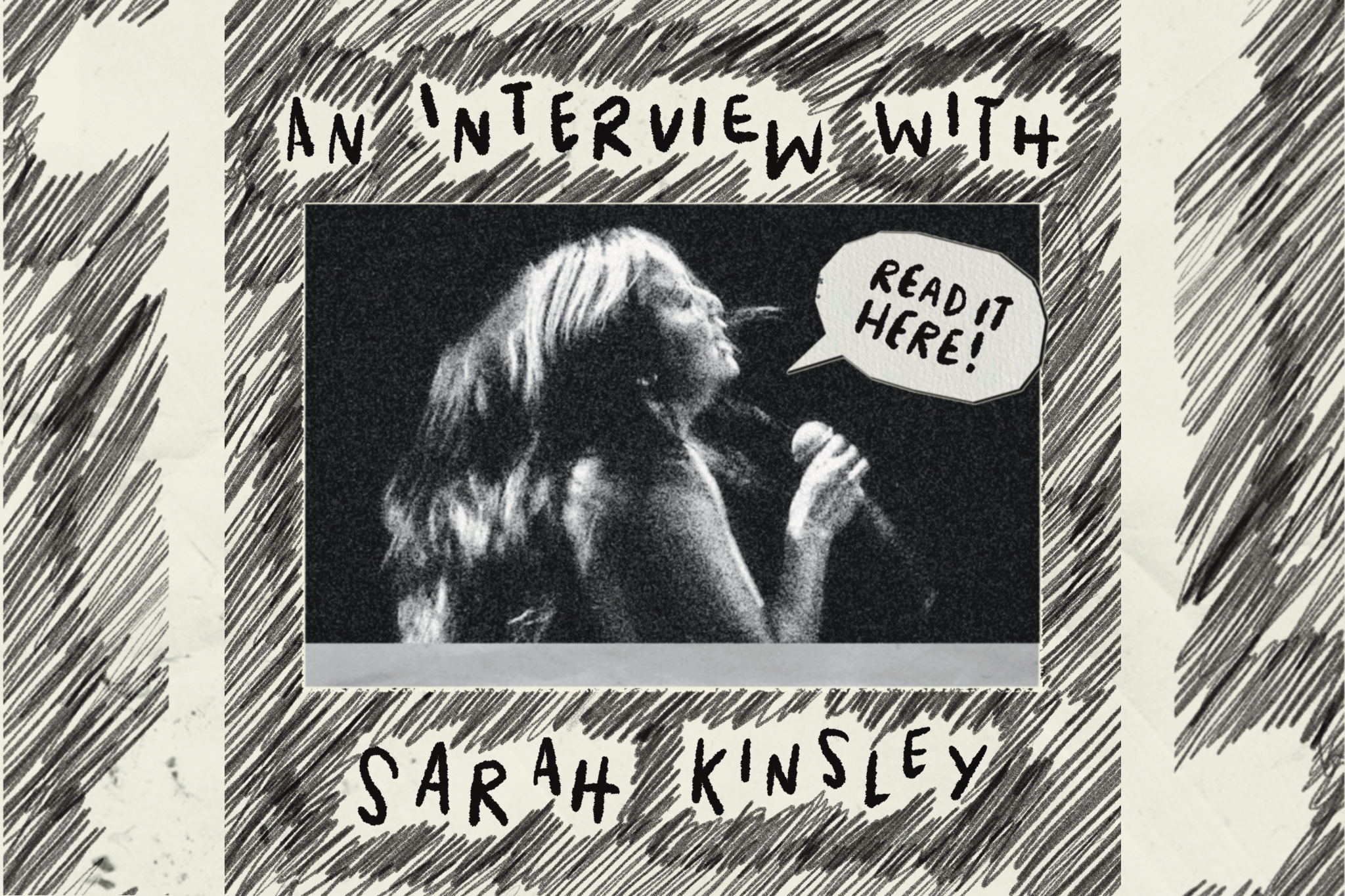
The musical work of Sarah Kinsley draws deeply from the penetrating ache of wanting something that you can’t seem to name. Being classically trained and endlessly curious, she writes pop songs that glimmer with surface-level euphoria before plunging you into colder and more disorienting depths. To search for answers in her work is to overlook the true offering of space meant for sitting patiently with your most wretched feeling before it resolves (because it always does, right?).
Her latest EP, Fleeting, arrives as an expansive world, concisely constructed across just five tracks. While lyrically swimming through desire, fantasy, disillusionment, and release with remarkable emotional clarity, Sarah welcomes the surfacing of her emotions without longing for a resolution. The opening pulse of “Lonely Touch” introduces yearning as restless and bodily, while the title track, “Fleeting,” reframes that same longing as a moment of reckoning meant for acknowledgment rather than escapism. The songs trace desire as a living force worth honoring even as it unsettles the body and mind in tandem. It’s the kind of music that dances even in its sadness, and reaches for beauty without pretending pain isn’t omnipresent. Supported by the immersive production of Jake Aron, the collaborators create a contained emotional space in which Kinsley’s elastic and searching voice prioritizes the heavy weight of vulnerability.
The New York City-based musician has previously expressed a want for her work to feel timeless, not in a grand or self-serious way, but in the sense that it might awaken memories you don’t even remember living. That ambition is entirely brought to light through Kinsley’s new project where she is seen making space for ambiguity and, in doing so, feels quietly radical. Speaking with Sarah prior to the release of her self-proclaimed “best work” left me with the roadmap of her collaborative journey through the twisted alchemy of turning her private desires into something communal. What emerged from our beautiful time together was a portrait of a maturing artist deeply invested not just in making music, but in creating a space where people can feel entirely free inside of it.
I want to start with “Lonely Touch,” since it opens the EP and honestly floored me. Across this project, you explore temporality through moments of heartbreak and celebration—sonically and visually—and that feels especially present here. You have such a knack for honest, textured storytelling, and sonic experimentation really sits at the heart of your work. While “Fleeting” was such a strong first single, why did “Lonely Touch” feel like the right place to drop us into this record and set the emotional and sonic tone from the very beginning?
This is actually the first interview I’ve done where I’m really talking about the EP, so I’m really excited to dig into this. When it came to the opening track, it was never a question that it was always going to be one of two songs: “Truth of Pursuit” or “Lonely Touch”. And I wrote Lonely Touch first, so there was a sense of chronology to wanting to start the storytelling there.
But I also felt like beginning the EP with a song that isn’t wishy-washy was important. It’s a song about longing, about yearning, about devastation, and that felt like the right starting feeling for this project.
Sonically, it’s one of the weirdest songs I’ve ever written. When I was working on it with my collaborator Jake, even explaining the structure to my team or my label was confusing—it’s just this long, climactic release. I was hoping it would have that effect of letting you enter the swirl of the EP, entering the world of everything I’d been writing and thinking about. That’s why it felt right to put it first.
You mentioned having to explain the song’s structure to other people, which makes sense, because lyrically it’s circling something that almost resists language, like the line “just to know you without talking”.
The song captures the ache of wanting something so intensely it’s hard to name, and yet the only way it exists is because you turn it into something articulate: you write it, you produce it, you release it. How do you think about that tension between craving wordless closeness in your life and translating those feelings into something public through the Sarah Kinsley project?
That’s a really brilliant thing to feel, but it’s also really tough. So much of what I, or the people in my life, chase—especially romantically—is feeling like you have an understanding of someone, or of something happening between you and another person, without having to materialize your emotions into language. For me, that process is addictive because it’s essentially like music.
The most powerful connections I’ve had are the ones where I don’t have to rely on my ability to speak well or communicate clearly to understand that something really magical is happening. For me, the best kind of yearning is wordless, which is why I wrote that line.
But articulating that feeling into a song adds another meta level. I don’t want to have to articulate these things particularly well, and music gives you the ability to dance around them lyrically. You can be ambiguous in what you write, hide behind metaphor, and still be vulnerable to an extent. I felt thrilled by the idea of making a song about yearning–which is so personal, so internal, so wordless–while also being very explicit about my feelings and intentions. That irony, to say point-blank: this is the yearning, this is the longing, and then trying to simplify it.
The music video for that track is beautiful, co-directed by you and Chloë Gottlieb, and choreographed by Madi O’Halloran. One moment that really stayed with me, beyond the use of interpretive/contemporary choreography, is the ending. You fall to the floor while the dancers keep moving, as if desire continues even after the body gives out.
I’d love to hear what that moment represents to you and what it’s been like to collaborate so closely with these women, who feel integral to your creative world.
Finding that shot wasn’t really planned. Chloë and I–we’ve worked together many times before– storyboarded the whole thing. I told Madi that I just wanted the song to have feral choreography. I would listen to the demos in my apartment and want to flail around and move, so I gave Madi a really short brief. When we were filming, I kept ending up on the floor, just crawling and moving through space like that. It became almost an editing choice. Mason, who edited the video, found that shot while we had been going around in circles trying to figure out how to end the video.
I read it as desire lingering, but also as exhaustion from keeping up with yearning. Or maybe the bodies in the video—their movement—represent a kind of desire that I can’t keep up with or hold for very long. Especially the rush of meeting someone new or of feeling desire. There’s a comedown. There’s a massive weight that falls after that first burst. I like to imagine the dancers continuing as this idyllic version of desire that I can’t keep up with anymore. It’s too much. It was really fun to film, and it’s my favorite piece of visual work we’ve ever made.
It’s amazing to see the collaboration between all of you come to life. I remember seeing you post something like, “she made my feral dancing dreams come true,” and it struck me because it doesn’t feel that common for someone to confidently say they want to make something feral and have collaborators fully back that vision.
That’s what I love about this EP, especially in relation to judgment, how yearning is treated. It’s never framed as pathetic or embarrassing; you give it space and let it be big, dramatic, and physical through both the video and your voice. Then, in “Truth of Pursuit,” it feels like the moment where the brain is catching up to the heart. I was lyrically very drawn to the water imagery—veins, floods, rain, drains—which makes desire feel both intoxicating and depleting. Was that intentional? Framing longing as something that gives you life while also taking something out of you?
Yeah, I think as much as the EP is a body of work about these feelings, I come to this conclusion that things feel so temporary because these emotions are life forces. They’re intoxicating, but they also have a comedown. So “Lonely Touch” is indulgent, it’s rich, and it has a lot of depth of yearning. And “Truth of Pursuit,” for me, isn’t really a song about love, but about this kind of unsustainable desire. It’s the kind of desire that makes you feel so alive, completely takes over you, and then sometimes leaves you really empty. I’ve had so many experiences like that—the rush! Romantic experiences really enliven me, which is why I’m a songwriter. It’s all I think about.
Meeting someone who completely changes your life feels like a flood. You’re swept up in the magic. And sometimes, especially if it’s not the right person or a good person for your life, you’re filled with this immense wave of emotion, and then suddenly you can’t feel more empty. It’s amazing what we’re capable of feeling with other people.
I wanted to make a song that honored that chase and that literal pursuit. I think I’ve put myself through that process, maybe too many times, but I still think it’s beautiful. I think it’s part of getting older, living, and understanding people. And the water imagery is definitely an extension of that very raw feeling.
I think that really pairs with how slippery the song itself feels. There’s something both funny and sad in the self-awareness of it—recognizing yourself in the act of chasing something that isn’t concrete.
When you were writing it, did it give you clarity about that pattern, or did it feel more like holding up a mirror to something you already understood? Do you experience songwriting as a way of learning something new, or as a way of articulating what you can already see taking shape within you?
I think it’s definitely happening in the process of going through something. It’s like a form of journaling, or like telling your friends, ‘No, no—everything’s going to turn around, it’s fine.’ You hear yourself projecting what you want reality to be, but in talking about it, you’re already communicating this subliminal message of what’s actually happening.
With that song, I wanted the structure to reflect that. The first half is this amazing ascent into something new—it’s thrilling, shiny, exciting. And then as soon as the second half begins, with that scream in the middle of the song, everything kind of crumbles. I like that there’s this really divisive split between the two sections, where what was beautiful and exciting suddenly feels gone, or sad, or dull.
I finished the song because of what was happening in my life at the time. It stayed with me throughout the process, almost like an unfinished journal entry. That one was definitely very close to me.
It’s interesting that you talk about the crumbling in that song, because for me, “Reverie” feels like the emotional hinge of the EP. It’s the moment where intimacy is called a sacred drug, and there’s this realization that you can’t live inside it forever and still survive.
I remember you posted a piano ballad of “Lonely Touch” on TikTok last year, and I kept thinking, why hasn’t this happened yet? Then “Reverie” comes in, and it’s this really powerful and intimate shift. Did you always know this was where the piano would primarily live in the record, or did the song itself demand that kind of stripped-back intimacy as it was taking shape?
Totally. I wrote it on the piano, and I tried playing it on guitar and in other ways, but sometimes when something is meant to be a certain way, the universe makes it very easy to figure out. So that felt like a very natural choice.
My favorite thing about ‘Reverie’ is that it has my favorite outro of all the tracks on this EP. I love how it just grows. I’ve been calling this EP my best work, and I think the reason I feel that way is because, this time around, I feel really comfortable and confident that these songs are sonically representative of what I’m trying to say.
It’s the closest I’ve ever gotten to that goal. ‘Reverie,’ for example, starts as a piano ballad and then becomes something fuller, with drums and this amazing guitar part that Will Graefe recorded in New York. It feels like the song’s sonic identity is also expressing what I’m trying to communicate.
That’s been a difficult challenge for me over the years—figuring out how to say something through the instruments, through the textures and sounds I’m choosing. And ‘Reverie’ really speaks to that.
I think that sets a really high bar—especially for those who’ve been listening to your music from the beginning. This project genuinely feels like a turning point. There’s a noticeable shift from your earlier releases: it feels fuller, louder, and more intentional. Writing, composing, producing, and performing your own music with this level of confidence feels like proof that you’re exactly where you’re meant to be.
You’ve already started sharing some of this work live—at All Things Go, and through previewing unreleased songs—and I’m curious what it takes to trust that instinct and say it out loud: this is my best work, and I’m ready to show it.
As a woman who writes, produces, and performs her own music, how important is that confidence—maybe even an obsessive belief in your work—when carving out space for yourself right now? Or does that confidence feel less strategic and more inherent to how you relate to what you make?
A lot of people talk about this now, so it’s not a huge surprise, but I think you need some ounce of delusion to exist. Not just as an artist—I think that’s too heady for me—but to literally survive in the world today, you need delusion. People talk about radical optimism, about belief in yourself, and I don’t think that’s just an artistic practice. It’s very human, and it feels necessary to survive and make something of yourself.
In art, especially, I’ve always shied away from appearing too confident in my work. I’m a perfectionist. I work almost entirely alone most of the time, which can be really isolating, but also really beautiful—discovering yourself through the process of making something.
It’s hard to trust or believe that something is truly your best, because that belief feels like both a blessing and a curse. It comes with this fear of, am I ever going to make it back here? For me, being an artist requires a level of self-perception that can feel overwhelming.
But with this EP, it felt necessary to say it out loud. Even if I don’t call it my best, it’s the closest I’ve ever gotten to feeling my best about a body of work. It’s the closest I’ve gotten to feeling like the songs are truly cohesive.
I don’t know anyone who enjoys looking at who they were five, six, or seven years ago. So that’s how I feel about this EP. I’m just really proud of it. And it doesn’t feel like delusion in the way it did earlier in my life—it feels more like knowing. When you know, you know.
There’s something devastatingly unresolved about “After All”—the piano, the strings, the recurring rain imagery, and especially the line “after all, love is just a man I used to call,” repeating almost like a question.
You’ve talked before about wanting to make music that feels nostalgic for a time you can’t quite place, and this song really embodies that feeling for me. It sits in a kind of painful emotional suspension. When writing it, were you looking for an answer, or were you coming to terms with the idea that there might not be one?
I think both of those sentiments really resonate with me. I was definitely looking for an answer. I went through a breakup that made me question why anyone would ever suggest love to us in the first place. It was a really intense period of reckoning, and I was thinking about love constantly. From a very young age—and I think this has something to do with growing up as a young girl—I was fed this idea that love would satiate every corner of my life. That it would save me, give me purpose, be the thing that drove me forward. And then you feel these incredible things and realize how deeply sad it can be to expect love to be all of that.
I think love can be that for some people, but I don’t know. I genuinely feel like I don’t know anything about it. I don’t feel equipped to give advice or make claims about what love is supposed to be. I was searching for an answer when I wrote the song, and it was very therapeutic to finish it. But I don’t think “love is not enough” is an answer for me—it feels more like a question I’m sending out into the universe. I’m still unsure, and I hope I don’t have an answer for a long time.
Love is beautiful. It’s powerful. It’s all-consuming. I’ve been nervous for people to hear that track.
What about people hearing that one makes you feel nervous?
I think it’s coming from two places. I’ve met so many people through touring, playing shows, and even just talking online, and the people who listen to my music are genuinely the kindest people I’ve ever met. I feel really lucky—I’ve only had good experiences with people who come to my shows.
But there’s also this association I feel sometimes, where people tell me they go to my music, or to specific songs, when they’re in really deep pain. I’m incredibly grateful for that, but it also makes me sad. There’s a nervousness of hoping the song doesn’t make things worse for someone. That feeling comes up for me a lot.
At the same time, that song was a safe haven for me—a place where I could exist inside those feelings. I think part of the nervousness is also that this is one of the first times I’ve really talked about that song in terms of its lyrics and themes. People have asked me a lot about the collaboration, which has been really fun, but I haven’t gone into much detail about what it’s actually about yet. So yeah, I feel a little nervous—but also excited—to finally talk about it.
The weight of people coming to an artist’s music in moments of devastation is so intimate. But when I was listening to this song repeatedly, it wasn’t sadness that pulled me back as much as a kind of shock, and I think that has a lot to do with your vocals.
On this EP, your vocal performances feel especially striking—more dynamic, more exposed. There are moments where it almost sounds like you’re reacting in real time to what you’re feeling: the way your voice drops unexpectedly, or lifts mid-phrase, as if the emotion is discovering itself as you sing it. That quality adds something really raw and heartbreaking to this song in particular.
When you’re recording vocals—especially on a track like this—are you chasing a specific emotional place, or are you trying to leave room to be surprised by what comes out in the moment?
It’s a very fine line going into a vocal booth, because you can get frustrated very easily trying to evoke something. But my friend Jake, who I worked with, understands me and my process really well. He’ll push me for a few extra takes—just, ‘let’s get a few more.’ We did so many vocal takes for ‘Lonely Touch’ that I was going crazy, and the same with ‘Truth of Pursuit.’ A lot of the heavier pop songs required that kind of repetition.
But with the ballads and the more emotional songs, there’s this perfect balance between doing something so many times that you erode the performance and trying to get to something raw. It’s hard for me to critique my own voice—I don’t really know how to judge it, because I’m listening for other things—but I think there’s a middle ground that Jake and I were always trying to reach together.
When you first step in, you’re thinking so much about being perfect, about getting your voice exactly right. And then by the fifth take, you’re warmed up, looser, and you care less about that. It becomes about dissolving the superficial feeling of ‘I am singing on a track right now’ and getting to a place where it feels raw enough, but still good, like I’m actually going through the things I’ve written.
That process can drive people a little crazy, and I’ve definitely seen that happen, but it’s also really exciting. We were especially trying to find that balance on “Reverie” and “After All,” which needed less perfection and as much vulnerability as possible.
Luckily, that vulnerability in the vocals is paired with your strong lyricism. “Fleeting” feels like the foundation of the whole record. You managed to create a reassuring bridge without lying: “It’s not forever, it’s just now.”
Was it important to you that the EP doesn’t end in despair, but also doesn’t offer fake certainty? Was that something you were thinking about in choosing to close the project with this song?
Absolutely. I do think it’s a truth I’m trying to hold onto. I think the worst thing you can be told in moments of despair—whether you’re grieving, going through immense heartbreak, or just feeling a general sadness in your life—is that things happen for a reason, or that things will get better. Even if you know, factually, that they probably will, because time does wash over things and smooth out rough edges, it’s still a really frustrating thing to be given as advice.
What sustained me most while making this EP and while moving through the moments in my life that inspired it was knowing that feelings can make it feel as if the entire world is stopping, or as if you’re completely frozen in something—choices you’ve made, things that are happening to you.
The only truth that coexists with all of that, without demanding that you immediately get better or be okay with a new reality, is that it’s just not forever. Things don’t last forever. That’s it.
I hope people don’t take this project as a kind of nicety, like, ‘don’t worry, everything will be fine.’ I want people to sit in it and feel it. At the same time, I think there’s real value in deeply understanding that a feeling is ultimately just a feeling—and that everything is fleeting.
That idea has guided me so much throughout my life, so I knew the EP had to be called this. And I’m really glad it doesn’t come across as something like ‘keep calm, carry on.