By the time Cameron Picton emerged from slumber with My New Band Believe, the world that had birthed him seemed like textbook history. Its most significant players had put space between themselves and the grimy teen angst that had defined much of their seminal work. So after the soaring heights of black midi came crashing down in 2024, Picton took it upon himself to discover a new methodology, one that felt independent from his life as a teen rock phenom.
On the long road to a new record, rules had to be set: no electric instruments, no black midi members allowed (both were quickly broken), and no songs that were written for the old band. Songs were tried on stages around the world: big ones that Black Country, New Road brought him on, and small ones like the Windmill in Brixton, home turf if there ever was one. The result is My New Band Believe, a self-titled effort that drips in the same virtuosity that defined black midi, but allows itself to play in newer waters. When there is chaos on deck, it reminds one less of Mahavishnu Orchestra-esque blackout and more of the psychedelic arrangements of Milton Nascimento’s prog-ier folk tunes. There’s a gay bravado that explains not only the maximalism, but also the indeterminacy; when I ask whether he found inspiration in the 60’s of John Cage at all, he responds, delightfully, “I think it’s more like Judy Garland!”
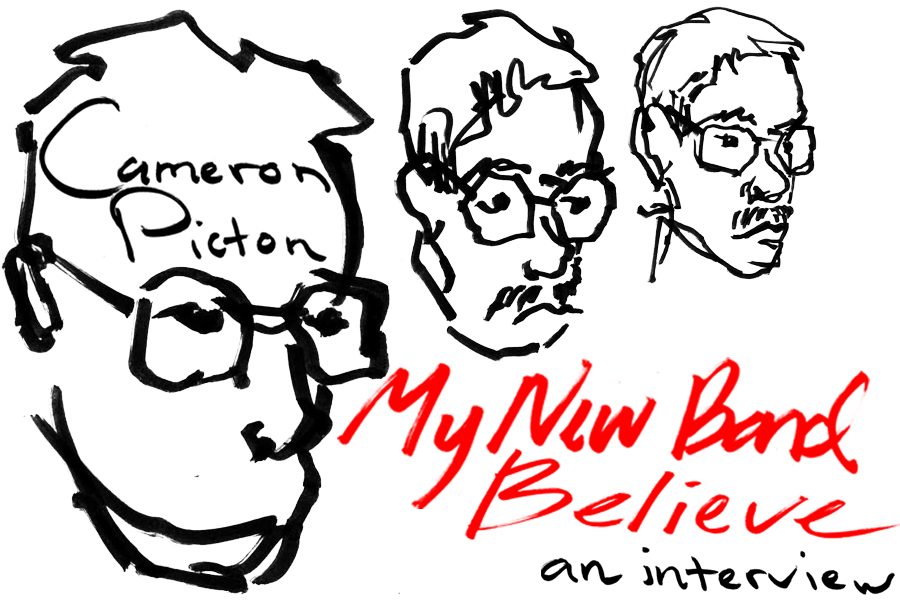
Graphic by Sawyer Harris
What was the timeline of the record? When was the earliest song written and when was the last song finished?
The earliest idea is from April 2020. I put it away afterwards and didn’t really think of it as something worth developing or anything like that. I came back to it after a few years and thought, “Oh, this is kind of good.” The newest song was pretty much finished as the record was being finished and I was making lyric changes even in the mixing process.
You did a lot touring before the record. What feedback are you looking for when you’re doing a road test? Are you trying to see how people feel or look, or are you just trying to get reps in on the songs?
To be honest, I have my eyes closed the whole time, which is a really terrible habit. It’s more a thing of how I feel, how it sounds to listen to myself, and how it feels to deliver and perform it, as opposed to hashing it out in a room.
Did you ever think about just doing a guitar record? When you toured with Black Country, New Road that was a very minimal experience.
I figured if I did that, it would be a bonus thing, concurrently, but I always wanted to do the songs with big arrangements, to make them quite ambitious.
With those arrangements, do you consider yourself a perfectionist? There’s a lot of the record that feels timed to the millisecond.
It’s not necessarily a thing about perfection, it’s just about it feeling right. There’s a lot of mistakes, there’s bits of the record that are…for example, the drums at the beginning of “Actress” sound really bad. But it’s an intentional effect. It’s not necessarily that they sound bad or distorted, or bad in a way that sounds cool, but they actually sound bad and weak. That was something that I spent a lot of time trying to sound the right kind of bad, and I think it sounds the wrong kind of bad, but the effect of when the music comes in after is the same, and maybe even more. I’m not a perfectionist, but there’s things I want to feel right. Even though I’m not happy with the way the drums sound on the track, the feeling of what happens next is the same, and that’s what happens more.
Do you generally have a hard time listening back to studio recordings, the way actors have a hard time watching their movies?
It’s not something I do. With all the black midi records, I would listen to it once the day it came out and that would be the first time I listened to it after mixing and mastering. I wouldn’t really listen to it again. I’ve been doing this listening-in-houses thing, so I listened to the album last night, but I probably won’t listen to this again. It’s not necessarily an aversion thing, but I’ve heard it a thousand times.
Did you anticipate this record taking these years to come out, or were you trying to beat the clock and it kept taking a while?
I definitely set conditions for the record that meant it wasn’t going to happen for a long time. I was initially going to do it with caroline, and knowing they were doing their own record and knowing they spend a long time on records they did make, I knew it was going to be at least a year before we could work together. It gave me time to do other things and have something ticking along, but be able to procrastinate, make the stupid mixtapes, and do the solo touring with Black County, New Road and all that stuff.
What sort of specificity have you been able to pull out of solo material that you weren’t able to get out of a band?
When you’re working with other people, you can present something that’s from strumming out chords then working out an arrangement together. Whereas when you’re performing by yourself, at least me, performing by myself, I want to have something that satisfies what I enjoy doing as a guitar player, as a lyrical interpreter, and also as a singer. It’s a nice challenge to fit everything and have the band be your hands.
Which is more true with these songs, that these were things that were gestating that could never find a home with black midi, or that you were going to write something that felt like a total reaction, a 180, to what you were working on in the past few years?
When the band was falling apart and I started doing these solo shows, I stopped thinking about writing for the band. Anything I had considered at any point to be potential material for the band, I scrapped. I started getting way more joy out of just writing something for the show. I had no interest in being a solo artist or doing a solo album, so everything I was doing was very, “Ok, I have a show in two weeks and I want to have two more songs that I’m happy with.” It just became something for the half an hour I was on stage. Not even a thing about getting feedback from people in the room, but just doing it and having an excuse to write the songs that wasn’t for the record, or a release. It was just something for the moment.
I’ve been thinking a lot about PC Music, and how people have been arguing about whether they’re doing satire or sincerity. I’ve always been on the side of sincerity, that they love this stuff.
Yeah, the Pitchfork review. That was unnecessarily cynical.
When you’re being funny, how do you straddle the line between taking the piss out of something that you love, and just hoping that your audience will understand it?
In this, there’s a thing of having a funny line or having a joke with a punchline, then following it up with something else that puts it in a different light. Let’s be serious for a second, or something like that. A lot of jokes, they’re being told for a reason. With certain catty lines, there’s something else in the song that shows it in a different light. There’s quite a few songs where two or three things are happening that can be read in different ways and you’re not sure who the person who’s saying what is.
I think it’s funny how often people talk about irony as a main driver of stuff that younger people are working on. I read a lot of your work as ironic, but almost like an anti-joke, an irony buried below three layers of irony?
Is there a specific song that you’re talking about?
I find that there’s an irony to paranoia and nervousness that flourishes throughout. I also think a lot of the paratext of the work can be semi-ironic, but I think in a very fascinating way, like the Shaad magazine thing, or the name My New Band Believe itself.
It’s a stupid name, but if you take it very literally, it works. The band is literally a different band every night at the moment. There’s a lot in the ethos of the band, or the idea of what it should be, it’s very literal. On the surface, it can feel like it doesn’t make any sense, but in terms of the way the band operates, it does make a lot of sense, it just depends on how you engage with it.
Like I really love “Love Story” the song, what was the naming process behind that?
It’s just very literal. But also, the song is slightly referential to lots of love songs. The obvious one is that Jockstrap song, but there’s other bits in there, maybe twisted beyond anyone claiming copyright on it. It’s just literal. The song is a love story.
Do you worry about misinterpretation, like an article writing that this is an album of insincere jokes or something like that?
I don’t know, I think it’s very specific, also the music is very serious. In “Actress,” when it goes to the show tune bit, I’m not being silly. There’s the undercurrent of the serious thing. It’s not goofy or anything, or at least I don’t think it’s goofy. It snaps into the emotional payoff of the track. You wait five minutes for the chorus to be properly played, and we’re gonna commit to it for a minute.
I’m guessing a lot of this is pulled from a 60’s, John Cage school of thought?
I think it’s more like Judy Garland. When I did a show with Black Country in New York, I did Barry Manilow in the song. I just worked it out on the tuning, and instead of going to [the chorus] I went to the Barry Manilow tune.
I remember reading that the band came from when you were sick in China?
Yeah it was literally experiencing some delirious, 3 a.m. crayfish induced psychosis in Xi’an. I had the wherewithal to write all of it down , and some of it became anchor lyrics for songs.
Do you think that’s why Lou Reed was so good, because he was just in that state all the time?
Instead of heroin, I had some crayfish on the street.
More broadly than crayfish poisoning, do you worry that you wouldn’t be able to create broadly, or at a high level, if you didn’t have an underlying anxiety, or if you’re not tweaked out all the time?
A lot of it I take from other people’s anxieties as well, some of it’s not necessarily personal to me, it’s processing something that someone else has said and thinking about that. Or just one line from someone sitting at the pub, thinking that’s interesting, and coming back to it. It’s not necessarily a personal anxiety, it’s just a general thing. That’s just to draw on.
With these songs, since those earliest moments, do they change for you in meaning or context on the backdrop of the world or your life changing? Do these words take on different meanings since the day you write them or are you still always captured by the situation that birthed them?
The “Target Practice” tune, every time something happened, I was like “Fuck man, I wish this song was already out.” There were so many political assassinations after I wrote that song. That’s a rewarding thing, beyond the immediate satisfaction of having finished a song, is that something else happens that adds to that, and you can iterate on that through doing a different song, it’s an endlessly rewarding experience, especially if you’re happy with how that song was. But sometimes you can be like, I’m not happy with this song that I’ve done in the past, I’m gonna do it again.
How do you straddle writing something like “Love Story,” that’s so centered around something that happened to you, versus something like “Target Practice” that’s fictional? Which one’s more personal to you?
There’s an element to which I’m the narrative voice and I’m the one performing it, but I don’t think it’s really personal or, even characters. A lot of the songs are like a conversation happening. For example, it’s sometimes not sure who’s saying what part of “Actress.” That’s the thing I was interested in exploring. By it just being one voice, being able to blur the lines of a conversation. What you said about “Target Practice,” I think what I was trying to do in the song was get at this thing where, when they see a piece of news, everybody is like “Imagine if someone just got rid of that politician.”
But obviously, no one can bring themselves to do it apart from some people, who do. But normal people, the thought would never even leave their mouth, it would just be an internal thing. I just thought that was worth talking about, because people get really agitated about this stuff. It’s a real thing that they want this thing to end, but they would never act on the thought or the feeling.
Graphic by Sawyer Harris