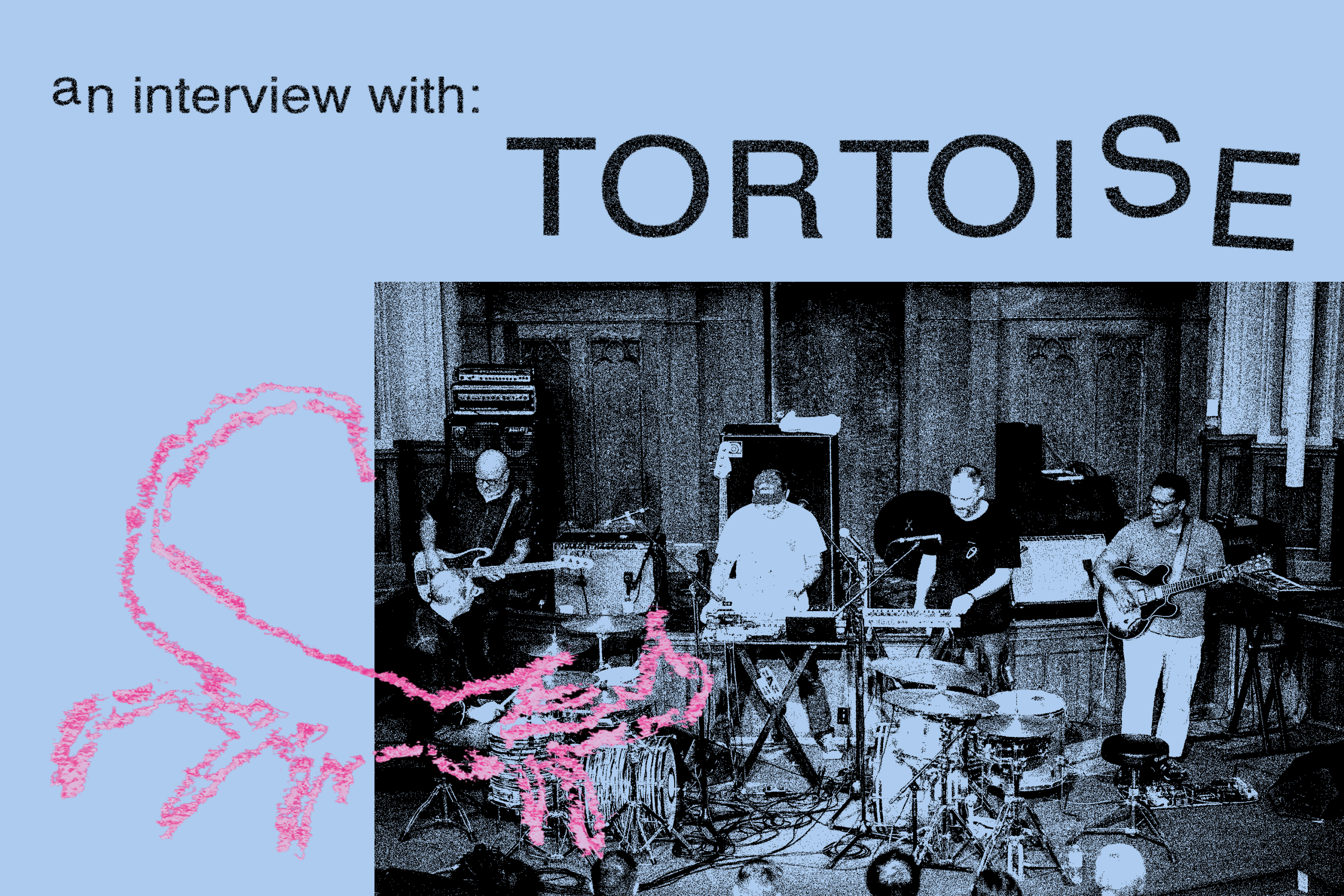
There are a few worthy places where the 20th century of music could have “ended.” Think about the lineages required to culminate in, say, A Tribe Called Quest’s sweeping blends of funk, jazz, and rap, or the plundered collages of Portishead, The Avalanches, or Handsome Boy Modeling School. But few bands drew the curtains close on a hundred years of rock, jazz, and electronic musicianship at large than Tortoise. The band blew the doors open on the possibilities of rock music with Millions Now Living Will Never Die before putting the final stamp on the form two years later with TNT. At their height, Tortoise drew from swirling lineages of Chicago experimental jazz, the buzzy minimal electronics of Basic Channel and Mille Plateaux, American classical heavyweights like Reich and Glass, and contemporary rock reinventions from Slint and local counterparts Royal Trux and Smog.
The five-piece has since grappled with what it means to be Tortoise in the 21st century. Though they were among the first bands to embrace digital techniques, digitalism never suited the band quite right. The members are all trained traditionalists, to one extent or another. Jeff Parker is a Berklee trained member of the famed Association for the Advancement of Creative Musicians (AACM). John Herndon’s instrumental hip-hop stems from a very specific moment in the independent rap culture of the 2000’s. And John McEntire, who is in conversation here, became a reliable producer for bands like Stereolab and Yo La Tengo precisely for his modern ability to produce hyperretro textures. Thanks to the luxury of burgeoning side gigs and growing legacy of their classic material, Tortoise have been fairly free of that worry; they’ve scant released new material since the 2000’s.
Touch, the band’s first record in nine years, cracks the code on a modern Tortoise. They stick to much of what they know, but tracks like the opening “Vexations” and single “Oganesson” feel packaged precisely for the contemporary moment. There’s still a lingering sense of timelessness to the material, but there’s an urgency and conciseness that feel tailored to the modern moment. Written and produced over the span of the pandemic, the carefulness of a typical Tortoise record remains; no note feels astray or diluted. Touch is Tortoise in classic form, primed and prepared for the new world. Here, drummer John McEntire discusses the record’s creation, as well as his personal production processes throughout the years.
You guys have been playing shows sporadically since the pandemic ended. How crucial was the live performance process for finishing and thinking about the record in general?
Those were two pretty distinct things to be honest. The shows that we did play and there weren’t a ton of them, it was all older material we know very well. We didn’t really start incorporating anything new until about a year ago, when we were getting close to being done with the record.
When you revisit and play the old material alive, is there ever an urge to switch things up and change the way you’re playing them or are you guys sticking with compositions you wrote back in the day?
They’re pretty locked in at this point. That rarely comes up, if that ever happens.
The band speaks very importantly on the sequencing and curation of records to be a very important part of the Tortoise process. How reflective are you guys of the final product? How much are you guys listening back to that decided and complete tracklist and putting it in the context of your previous material? I know some artists, once it’s done, they’ll just never touch it.
I understand that impulse, but with this record in particular, I found myself wanting to revisit it because I really just enjoy how it flowed and where we landed with everything. It wasn’t really clear until, obviously, the last minute, how it was all going to piece together. I’m really happy with it.
Does the band still continue to surprise you?
Yes, actually. John Herndon contributed a whole bunch of stuff towards the end of the mixing process and added a bunch of great overdubs that really brought many of the songs together into a final form.
I’m speaking to you from WNYU so I’m wondering what was the impact, if any, that college radio had on the early days of any number of your bands. I know Drag City was intertwined with the alternative radio scene in Chicago back in the day.
I grew up in Portland and we had a really good station around. It wasn’t a college station, but it was an indie station called KBOO. That was where I really first heard a lot of different punk rock and things of that ilk. This was in the mid-80’s. Then I went to Oberlin College and I was involved with the radio station there. I did kind of a more traditional show for two years and then a friend and I did an audio collage show for half-an-hour each week, which was really fun.
In my time in college, I’ve been thinking about what the classic college rock records were and what they are now, and I think Tortoise are especially amongst them. Who do you notice to be embracing Tortoise these days? Are there any surprises in demographics and faces at your shows?
Oh yeah, for sure, but I’m going to backtrack for one moment. For some reason at WOBC, we got every single Jandek record. Everyone was kind of obsessed with him.
Is Jandek from Portland?
No, he’s from Texas.
You know what, now thinking about it, there’s a chunk in WNYU’s archives about [a foot long] of just Jandek. Every single Jandek record.
Maybe he just sent stuff to all the college stations and hoped that weirdos like us would play the stuff. Back to your question, demographically, it’s kind of crazy. It’s all over the map. We’ve got a lot of people coming to the shows and buying a record that are definitely young. They’re discovering our older stuff for the first time and that’s really cool.
I tweeted once that the little guy on the TNT cover would make a really good tattoo and someone responded with a photo that they had the tattoo, like “I got one.” Does that freak you out?
There are many of those out there. No, I think it’s hilarious.
Tortoise is such a fan band for people like me, or critics in general, because it gives us so much agency with references and things that critics love. I know you’ve somewhat disavowed that jazz comparison, that it’s just a nature of certain members’ backgrounds. But how much of those references are explicit? TNT, for example, a lot of people were pointing towards the minimal techno that was happening. Was that one of you bringing in a Basic Channel record and being, like, “This is the shit,” or was that just a simultaneous convergence, subliminal thing?
I don’t know how direct it was but that stuff was around for sure. We were listening to all kinds of things all that time. We still are. There was definitely more electronic music floating around in our orbits. It’s just osmosis, like you can’t avoid it somehow.
Were you guys into the Chicago house scene and things like that ?
Not directly. That was very much its own sort of world. We had a lot of crossover with the jazz community for sure. Even the Americana sort of scene. The house thing just felt like it was insular mainly because it was a little bit geographical, it was all on the South side. Whereas everything else – I mean the jazz scene was all over the city, but we’re on the North side. So it was a bit different.
I think Chicago, still, has a reputation as the city in America that you can bum it out as an artist and survive. I think New York is totally unfeasible for that. How enabled did you feel by Chicago being this cheaper place that you could just hang out and make records?
It was great, and you’re totally right. For a couple of years, I had a job delivering the free weekly newspaper, which I could live on working one day a week. We had this loft space that five of us lived in, like a 4000 square foot loft. Each of our rents was $300 or something. It was insane, it was so cool. Psychologically, in that weird industrial area we lived in, it was just this openness. That feeling permeated things for me. I love New York, but I’d never wanna live here. You’re totally right. It seems like it would be soul crushing if you’re trying to make art or do anything creative. Except writing perhaps.
That sounds like the kind of destitution of the 60’s and 70’s in New York brought.
Yeah, very much so. I think back to the whole Velvet Underground extended, LaMonte Young, Tony Conrad scene, the places where they lived and the things they were able to do for no money.
I read this oral history of the debut that super quickly, in succession name drops: My Life in the Bush of Ghosts, Steve Reich, and Can’s Ege Bamyasi. What three or four records were on your mind this time around with this record?
That’s always a tough question. Even before, but during the pandemic, I started listening to a lot of library music. There’s a couple of really good compilations. That Unusual Sounds thing is really good. I can’t remember who put it out, but there’s these two massive boxsets of Piero Umiliani, those are really great. That was kind of fodder for me.
A more technical question: how much of your workflow these days is digital versus analog? p
It’s all digital. I have an analog path. So I do analog summing. But that’s it.
I think heavily of Steve Albini’s insistence to record analog, but how much of the music world’s insistence to stick to the warmth of tape is almost a form of fetishism.
Very much so. I used to get clients who would be insistent on working on tape. I would have to say to them, “Well what benefits are you going to extract from that process?” It’s going to slow everything down. It’s not fundamentally representative of the sound that you put into it.
Steve’s whole thing was archival, right? And he wasn’t wrong about that. You can still play back tapes from 60 years ago and they’ll essentially be fine. I’ve lost a lot of work from the early digital days, just obsolete formats or media that no longer functions. That’s frustrating. On the creative side, that made up for it. What we were able to do with these new mediums, in the late 90s especially, was completely groundbreaking.
SOPHIE spoke a lot about the ability to generate sounds, in the same way Autechre did with the Monomachine back in the day. What was the most interesting for you when digital production came around? What that scope and unlimitedness?
In terms of writing, that was a big part of it. Having the ability, with MIDI and samples and everything, to try out ideas and not have to commit immediately to something. But yes, also the sound design, all of it. It was incredible.
Other than DAWs, what were the biggest inflection points that changed the way the world was making records?
The sampler. 100%. For me too, once we got that first sampler, the world just opened up.