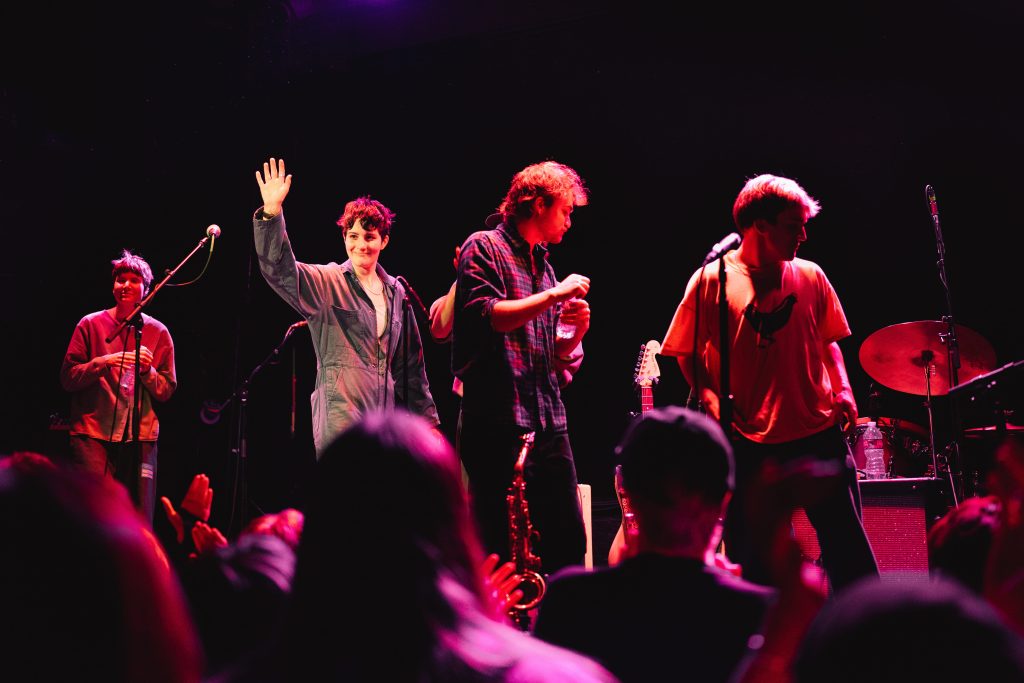
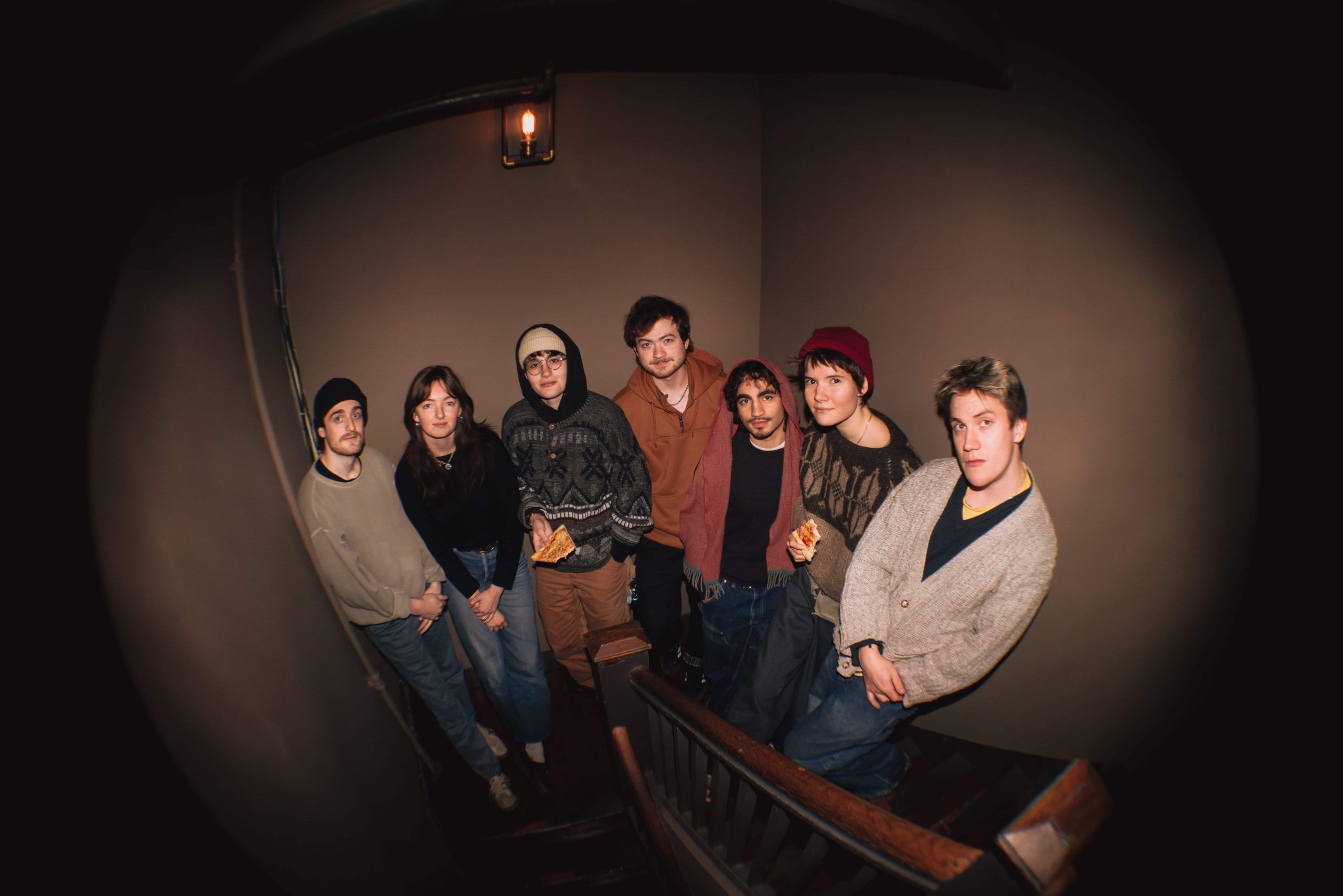
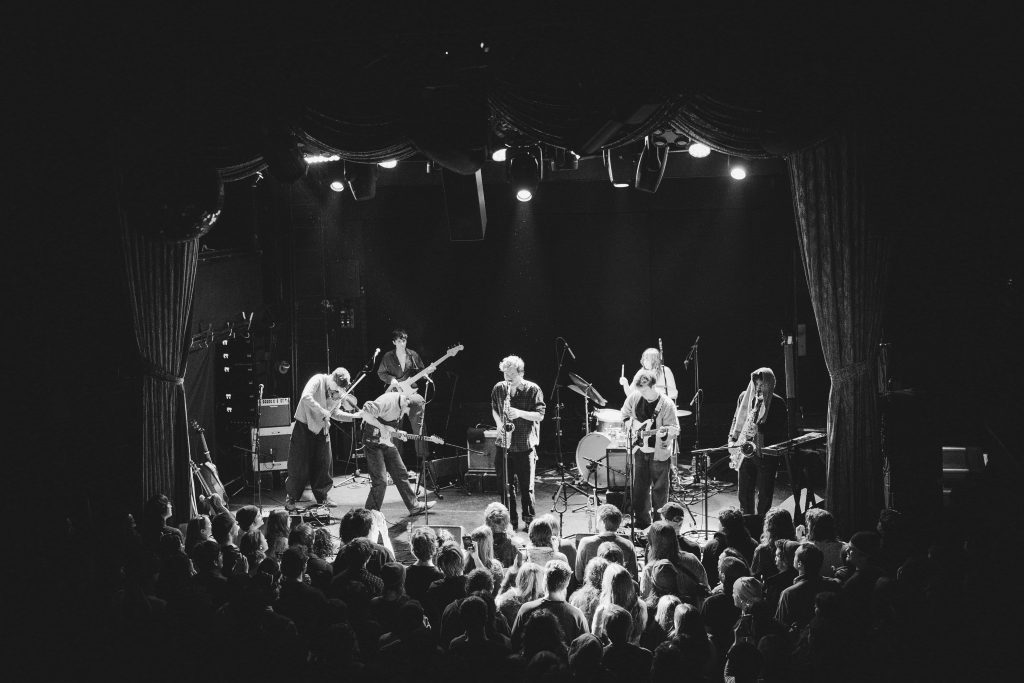
Perhaps it was the icy album cover, lyrical references to coldness, and the frigid sounds of woodwinds and strings on the Racing Mount Pleasant’s self-titled sophomore record, but the wintry atmosphere outside the Bowery Ballroom seemed like a perfect backdrop to witness the band’s signature brand of frosty chamber pop. The inclement weather was not as benevolent to the band however, as, according to the band, their biggest tour yet was almost postponed due to the storm. Having opened for Geese on the Getting Killed tour last November, Racing Mount Pleasant have been experiencing an albeit more modest ascent of their own. This show at the Bowery Ballroom was but one of a litany of sell-outs on the band’s first major headline tour, an upgrade from their past of playing crowded basement stages.
Consisting of a cohort of longtime college friends, many of whom met in all too perfect circumstances at the University of Michigan’s freshman orientation in the fall of 2019, Racing Mount Pleasant’s rise to success has been a steady journey. Starting in earnest under the name Kingfisher in 2022, years of playing in living rooms, bars, and church halls were balanced with the necessities of college life. The band consistently explored their one-of-a-kind sonic palette, consisting of a classic guitar-bass-drums setup in addition to the jazzy textures of trumpet, violin, and saxophones. Their debut album, 2022’s Grip Your Fist, I’m Heaven Bound, delivered a lush marriage of disparate influences including Bon Iver and Steve Reich as the band mazed their way through multi-part soundscapes.

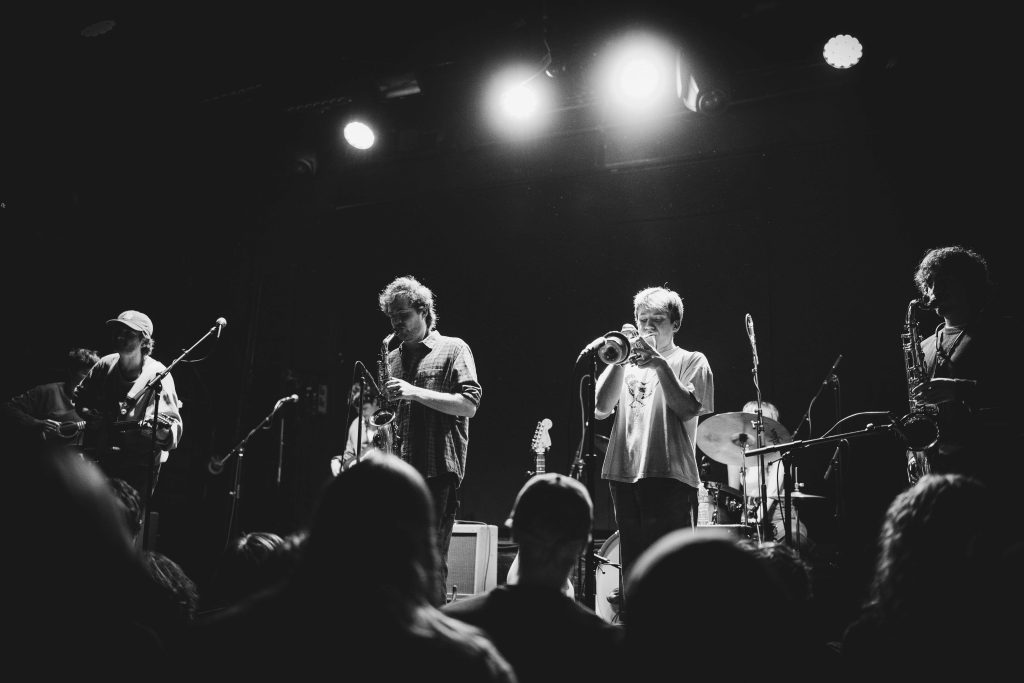
The meditative patience that characterizes much of Racing Mount Pleasant’s music feels like a reflection of their creative process. Racing Mount Pleasant, which marked a name change for the band, was recorded in bits and spurts over the course of three years in locations as varied as churches and 19th century attics. Listening to the record, the fine-tuned intricacy of its construction is clear to see. Fiery emotionality is juxtaposed with soft-as-silk tenderness, whilst the melodic complements of sax and violin weave in and out of songs with controlled dynamism. Each band member instinctively understands when to hold back and when to let go, granting the album an unmatched sense of ebb and flow. On stage at the Bowery Ballroom, the band powered through a setlist of the album’s lengthy highlights plus some new unreleased material, performing not only with note-perfect accuracy but also an unbridled exuberance and vivacity which made the moments of explosion on the record sound tinny by comparison. It was a portrait of a band who clearly relished playing every note of their music live as they smiled at each other from song to song.
This interview has been condensed and edited for clarity.
This is your first headline tour under the name Racing Mount Pleasant. What’s different from your last time headlining as Kingfisher two years ago?
Sam DuBose (Guitar, Vocals): When we were Kingfisher, our headline show was a lot of basements. This time, it’s actual venues, some of which are sold out. People now know the words and specific parts, and so it’s quite different from when we played for 20 people in a Philadelphia basement.
A lot of your early shows were played in DIY venues like living rooms and student co-op festivals where there seemed to be a shared intimacy. Do you think that feeling still comes across when playing larger venues?
Sam DuBose: It really just has to do with how well we can hear each other on stage more so than the size of the venue.
Sam Uribe Botero (Tenor Saxophone): Our goal is to always maintain that sense of group intimacy, whatever venue we’re playing. It does always help when we have someone from the venue who’s taken the time to listen to the music and has a preset plan for the visual element. We would love in the future to work with a lighting crew to have creative visuals in that realm because that’s something we have done in the past and it would be great to continue that.
Kaysen and Callum, you two both change instruments throughout the set. Does your mindset ever change in the middle of a song depending on what instrument you’re playing?
Kaysen Chown (Violin, Guitar): Definitely. It’s stressful in the sense of the logistical element of switching instruments and making sure your cable management is such that you’re not tripping over cables or you accidentally pull up your guitar and then a cable comes undone. But it is really fun, say, in “Emily” to be playing violin and playing these really lush, long tones, and then at the end having that cathartic moment of grabbing my guitar and ripping a power chord. It’s a very different way of engaging with the song which I love.
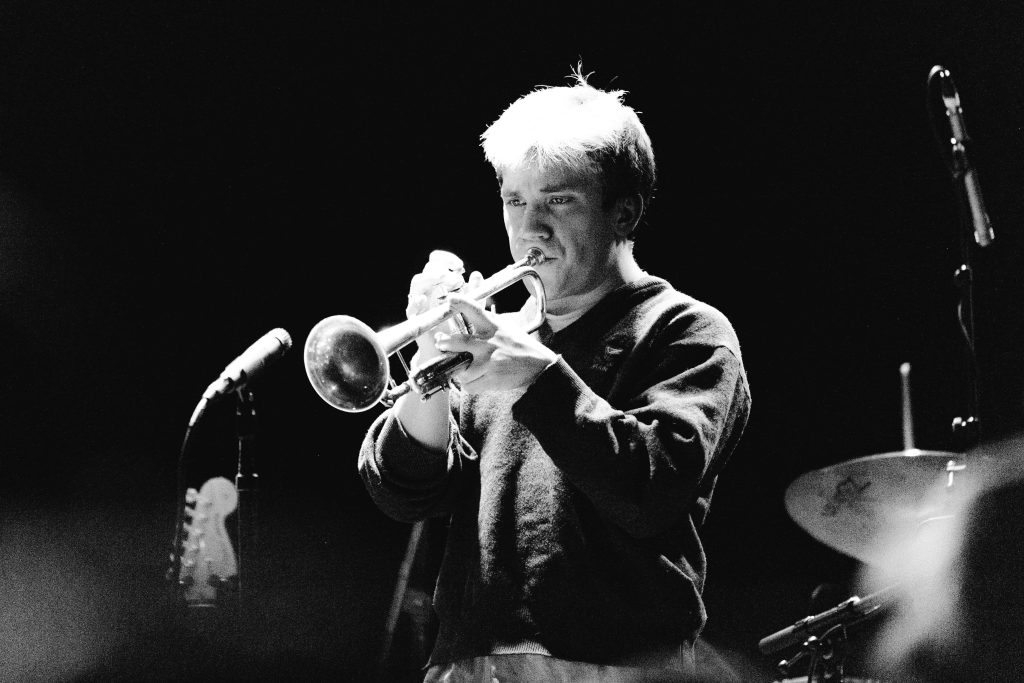
Callum Roberts (Trumpet, Guitar): I find that I get to do two pretty opposite things. I only ever started playing guitar for shits without any training because I had a lip injury when I was 17 and I couldn’t play trumpet. When I’m playing trumpet I’m typically trying to be very delicate because in contrast the saxophone is quite abrasive. And then the guitar is very cathartic. When I play loud and aggressively it’s all vibes. It’s very intentionally dumbed down.
Kaysen: Yeah, it’s definitely sexier to play.
Callum: It is. There are times I’ll look at photos from a show and I’ll be playing trumpet and will be standing very still and my face is all contorted in a very funny looking way. And then the guitar photos always look so cool.
Do you ever try to highlight individual players at certain points or do you move together as a singular unit?
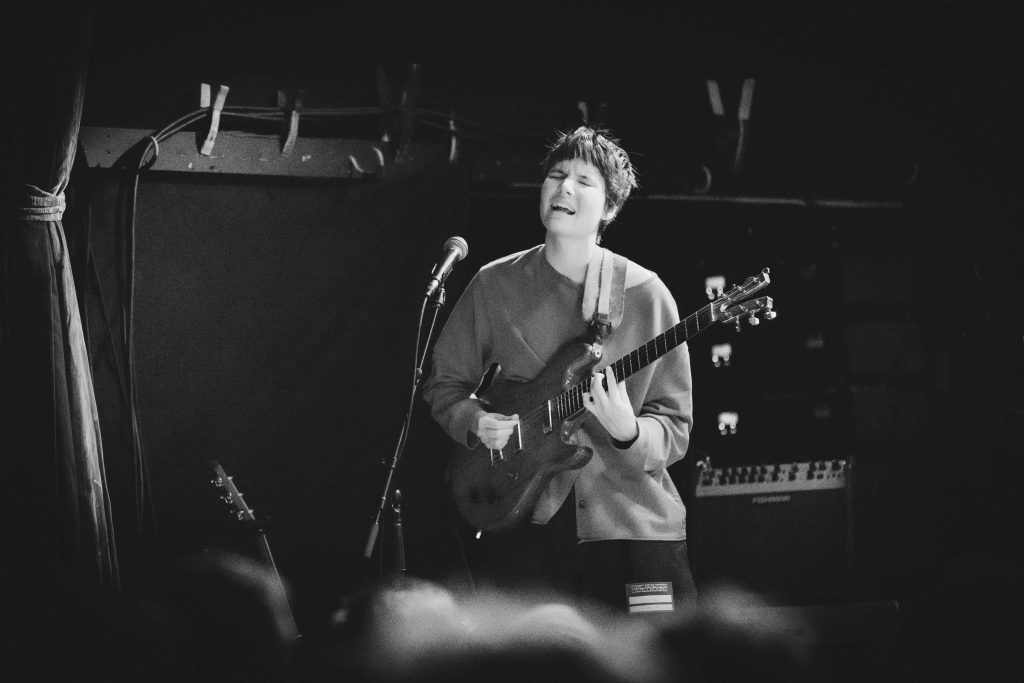
Sam DuBose: We try and make it exclusively about what is going to sound the best and then the showcase element will come after. Sam’s solo on “Call It Easy” is an example where he takes that solo because we thought that it was the best musical decision to make. And he gets to look awesome doing it every time.
So do you allow for improvisation or spontaneity on stage during those moments of climax?
Connor Hoyt (Alto Saxophone): A lot of our parts were improvised first before they were recorded. Emily is a great example. We all found our way a little bit more as we played it into the solid parts we had. The harmonies therefore became closer to the exact harmonies that they should be. There’s still little bits of improvisation in the set in those soloistic moments, especially for new music that we play.
Callum: On “You” and “You Pt. 2”, all of the brass parts are completely improvised.
Sam DuBose: We’ve been sticking to the same loose framework for a lot of these songs for a long time. The new stuff we’re working on allows even more room for improvisation.
Were there any artists you were really influenced by during the long recording of this album?
Sam DuBose: Feeble Little Horse. Definitely.
Callum: We were listening to Big Thief’s rock stuff in a new kind of way.
Kaysen: I’m always going to say Caroline. I’m really trying to channel Magdalena the violinist in my violin parts. I’d love to meet her if we ever got the chance to go to London.
In that vein, are you guys happy with the post-rock label that you guys have been dubbed as or do you want to be something more than that?
Kaysen: It is really funny that there are so many arguments online like, “Oh, they’re tagged as Windmill Scene, but they’re not from the UK”. People get really mad about it. We definitely do get influence from some of those windmill artists but it is funny how people get so obsessed with labels.
Callum: Yeah, you can’t have a band name with three random words and not be called Windmill Scene!
So is the Black Country, New Road comparison something that you’re comfortable with?
Sam DuBose: We’re comfortable with it. There are points where we can definitely see the parallels between us. There’s seven of us, our bass player is named Tyler.
Tyler Thenstedt (Bass): And I’m not a boy!
Sam DuBose: We listened to Black Country, New Road for the first time when we were finishing up our first album, and we are definitely inspired by them, but sometimes individual songs will be compared to theirs which make no sense to me at all.
Callum: Sometimes people will make the comparison on certain songs and I’ll think, ‘we were not ripping THEM off!’
Connor: It’s important to mention that there are various songs that sound similar that were written before we had ever listened to them, so chances are that both bands are just inspired by the same music.
Tyler: The main thing is differentiating comments that accuse us of being ripoffs versus having creative integrity which is maintained as a value for both bands. Some of the comments that diminish that creativity kind of sting, but beyond that, I’m honored!
One thing that sets you guys apart from other big ensemble bands like BCNR or Arcade Fire is a willingness to embrace silence. What do you think is the value of those soft and intimate moments in your music?
Tyler: We’ll start writing songs by just trying things out and improvising, then we’ll try and strip things away very intentionally.
Sam DuBose: Some of our songs can be quite angry, but I don’t think we make really harsh music at all. We’re really inspired by a Bon Iver style of sad and quiet type music. Whatever song we’re working on is usually going to start quietly. And then we just throw whatever we want at it. We still try to maintain the origin of the song throughout a few measures, or we’ll definitively say that this is clearly a quiet song.
So many of your songs ebb and flow dynamically whilst exploring a myriad of sounds and ideas. Are there ever ideas, melodic or lyrical, you want to explore when you’re starting to write a song?
Sam DuBose: We’ll have a conscious conversation before we actually start working as a full group on a song about how we can make it different or exciting to us from what we’ve done before. For example, we’ll talk about what new instruments somebody can try or what production choices we can make during recording, which plays a big part in the actual organization of the song.
Kaysen: There’s also a lot of experimentation with form. We’ve been writing new songs just before this tour and figuring out the form of one of them has been such a headache. We tried maybe around 20 iterations of a form, and so we are kind of perfectionists in that way. Questions will come up about how the arc of the emotion is going to occur through the song, or how we can accentuate that through the specific structure? Then we’ll throw a lot of darts on the wall and compare different versions when listening back to them. So it is a pretty intricate process of nailing it down.
Were there any themes, musical or lyrical that kept coming back during the lengthy recording process of this album?
Sam DuBose: Yeah. From the first and second album there are a handful of musical motifs that show up a lot. I think sometimes it’s accidental and sometimes intentional. Like Sam mentioned earlier, some of the songs from the most recent album were written before the first album came out, and there’s a lot of very similar themes about the same things essentially throughout both albums. We just recorded basically two albums in five years at the same time, so it’s kind of hard for things to not fall in line with each other through two separate projects. Some of those songs are about or reference the exact same things.
Tyler: A friend of mine used to say that Sam writes songs a little bit like musical theater, where a lot of the songs have a thread that connects them, whether it’s like a little guitar motif or a lyrical line even if they’re quite different. And I think that that is so true.
What did you learn from recording Grip Your Fist, I’m Heaven Bound that you applied to the recording of the new album?
Sam Uribe Botero: As a group we have honed in on each of our individual sounds that we like. And then I think through experimentation in the studio we’re able to make a lot of left field choices. One of my favorite recording moments from this past album was the very end of “Emily”. We weren’t sure how to end that song and we ended up just throwing saxophone through an amp. It’s become a challenging process of experimentation and refinement; figuring out how the fuck you record 7 people at once is a fun headache to have.
Callum: “Emily” and “Racing Mount Pleasant” were recorded in completely opposite ways. The base track on Emily was just one guitar and bass, and then we added a bajillion layers on all parts of the song to make it really big. When we did the title track, you hear 7 instruments playing live all at once, but it still sounds huge. So we were trying a bunch of different techniques when recording this album.
I’m curious about the ending of the album. What was the intention behind pulling the rug out from the audience so abruptly?
Connor: We recorded that song before the order of the album was necessarily set in stone, and the decision to end the album like that was kind of an audacious decision. We thought that it might be too on the nose in how comical it was, but we just said “Fuck it” and ended the album like that.
Sam DuBose: We recorded the end an amount of times that felt right and then were getting down to the wire, but we really wanted to be done. That was the last thing that was written for the album. Maybe this takes away the magic of whoever is listening to it, but I was just thinking of what I could write that fits in this random amount of time, and I thought it was kind of funny in how bold it is.
To leave us off, you guys have talked about wanting to do a film score in the past. If you were to make one, what kind of movie would it be?
Callum: I’d love to make the soundtrack for one of those insanely stressful Safdie brothers movies.
Sam DuBose: It would be really fun to do a horror movie.
Callum: We could have the classic high strings and low brass!
Kaysen: I love Philip Glass’ soundtrack to Koyanaaqatsi. The film is filled with all these beautiful timelapses, and I’d love to work with a videographer who could do something like that.