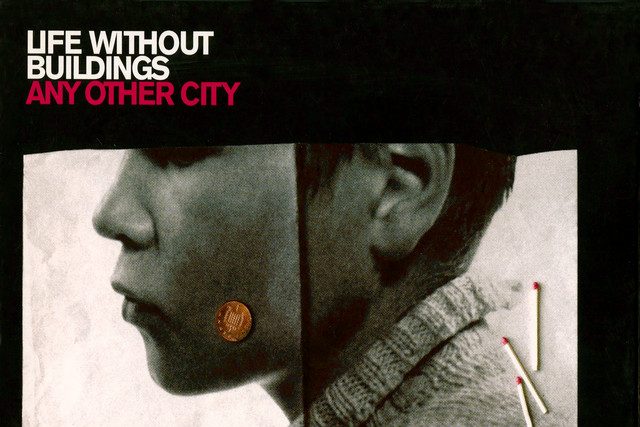
In retrospect, it doesn’t seem right that Life Without Buildings came out of Glasgow at the turn of the century. Throughout the 90s, Scottish alternative music was indebted to the melody-first vitality of indie pop. Teenage Fanclub put on their best Big Star impression to ecstatic effect, while Belle and Sebastian pushed twee pop to new literary and introspective heights. Yet, Life Without Buildings, the spontaneous side project of four Glaswegian visual artists, was still able to cut through that noise. Standing out as one of indie rock’s great anomalies, the band’s embrace of spoken-word swagger, glitchy lyricism, and oblique songs that snaked through loose song structures was antithetical to delicate twee, or the bombastic Britpop that dominated the charts. With their sole album Any Other City, Life Without Buildings moved British indie rock into the 21st century.
The project started when three electronica-obsessed artists – Robert Johnston, Chris Evans, and Will Bradley – happened upon an improvisatory spoken-word performance given by vocalist Sue Tompkins and instantly asked her to join their fledgling indie band. The band’s bypassing of traditional rock influence colors their idiosyncrasy. Johnston, Evans, and Bradley (who would go on to take up guitar, bass, and drums respectively in the band) were profoundly captivated by the pulsating techno of Detroit’s Underground Resistance as well as the futurist atmosphere of the revolutionary Optimo, Glasgow’s recently inaugurated club night. They also counted an unconventional mix of Don Caballero, Television, and Missy Elliott as key influences. Tompkins came from the world of performance art, delivering manic free verse that married the chaotic sensibilities of Pollock with the pop-culture references of Warhol. Thus, the rock music that emerged was amorphous but cohesive, mutated but familiar. Any Other City became the fruit of these contradictions, a smattering of indie conventions as refracted through a prism of disparate sonic mediums.
Contributing to the record’s sense of elusive mystique, Life Without Buildings employs a sonic profile that feels unsuitable in any period at all, haphazardly shoehorned into a time for rock without a pre-ascribed identity. There are shades of post-punk, midwest emo, art rock, and vocal jazz. Sue Tompkins’ wild sprechgesang shakes and undulates like an unwieldy hybrid of equal parts Ella Fitzgerald and Mark E. Smith. The twisting instrumentals, at least on the surface, occasionally seem to recall The Velvet Underground at their heaviest. But all of these stylistic markers are transmuted and adapted to a singular context that make them barely identifiable. It was the amalgam of wayward influences into something entirely new, yet familiar.
“No details, but I’m gonna persuade you”, Tompkins yelps to start off album opener “PS Exclusive.” It’s a bold declaration, buoyed by Johnston’s guitar and Evans’ winding bassline which instantly establishes a sense of constant propulsion. The instruments weave amongst one another with no clear direction, while Tompkins’ spontaneous name-drops and arcane mantras obfuscate almost any sense of narrative or thematic clarity within her scattered lyrics. The album is captivating in this vagueness, functioning almost as an inscrutable code that may be cracked with enough listens to reveal something hidden. Tompkins’ umpteenth repetition of “the right stuff” becomes a language in and of itself, like a comprehensible form of speaking in tongues. The rhythm section acts as a shifting canvas on which Tompkins uses her voice as a brush for her expressionist scatting. It’s a breathlessly dynamic experience.
The rest of the album mostly ascribes to this arresting framework. “14 Days” possesses fragments of a narrative, presenting a couple at the edge of separation with a sense of eye-winking foresight (“I’m leaving you in 14 days”). “Juno” almost has the semblance of an intimate character study, the titular protagonist seemingly unmoved by any external emotion, before Tompkins drops a reference to Jane Wiedlin’s “Our Lips Are Sealed”, derailing the faintest hint of narrative. It is in fact these impulsive phrases, chosen for their rhythmic cadence rather than any comprehensibility, that make Tompkins’ vocals so beguiling. There’s the repetition of “night scene stealer” on “Young Offenders”, “chi sound” on “Let’s Get Out”, and the odd phonetic pairing of “salt” and “assault” on “Envoys”, all earworming patterns that dig past normal methods of auditory encoding. From song to song, her speak-singing bemuses and excites no matter the instrumental.
The shining example of this is the album’s centerpiece, “The Leanover”, which functions as Tompkins’ attempt to cram as many catchy lines and music references as possible into one song. The opening has the swirling vivacity of a fast paced tango. Starting acapella, Tompkins’ stuttered scatting dances around Evans’ twisting bassline and Johnston’s delicately arpeggiated double stops. When Bradley’s loose beat comes in, just for a moment, it sounds as if all four members are in a rhythmic world all of their own, and yet the song still remains perfectly synthesized. It’s a stunning moment of musicianship which introduces a song that refuses to find a place of rest. Tompkins’ vocal tendencies are on full display here. There are references to My Bloody Valentine, “Virginia Plain”, and the Budokan. She briefly switches to French before returning to her chipper English accent with an impassioned delivery of “freestyle!” “The time ticks slightly back,” “days like television,”, “he’s the shaker baby” – all nonsense that nevertheless feels like the most important thing in the world when Tompkins sings it. During the the song’s lengthy recording process, Bradley poetically imagined it as “amber light radiating from a central core, surrounded by a shower of blue sparks”, and indeed the band does move around the vibrant central core of Tompkins’ vocals with the cosmic energy of planets revolving around the sun.
Any Other City’s last two tracks signify a break in the album’s style. Penultimate song “New Town” may just be the most conventional on the album, a chugging bassline and the closest Johnston gets to laying down a riff creating the sound of hypnotic post-punk by way of Neu’s “Hallogallo.” Tompkins’ vocals here are no less spontaneous, but there’s a distinct element of structure with her repetitions as she hurtles towards the song’s ecstatic chorus. As the last vestiges of Evans’ bass gives way into the closing track, the nearly 7-minute “Sorrow,” the band seems to finally give in to calmness, swapping constant motion with languid lucidity. The relaxed “Coney Island Baby”-esque instrumental is the perfect backdrop for Tompkins’ most introspective declarations. Slowing down her vocals until they sound like one end of a delicate conversation, she speaks of beauty beyond description (“eyes like lotus leaves, no, not even like”), tongue-in-cheek yearning (“I thought about you to like the ninth degree”), and the inevitability of transience (“You’re beautiful but you’re gonna slip away like that”). In this fragmentary dreamscape of free-association, Tompkins finally allows for moments of emotional tenderness to shine through.
Any Other City was released to mixed reviews in February of 2001. Some seemed optimistic about the band’s future, but one particularly vicious NME review, which claimed that Tompkins’ voice was “the sound of a performance artist having a self-conscious breakdown” touched the heart of the sensitive singer. A combination of mounting pressure on Tompkins, a lack of new material, and the band’s growing malaise led to a quiet mutual dissolution at the end of 2002. Looking back, it isn’t all that surprising that the band didn’t last long. Whilst their scrappy, post-punk revival sound may have been more resonant in the cultural zeitgeist had they stuck around just a little longer, being part of NME’s “New Rock Revolution” was not something the band looked towards. As Fergal Kinney wrote in his 2021 feature of the band: “Life Without Buildings sidestepped only very briefly from the art world to the music industry, and back into the art world again for good.”
In the years since the band’s breakup, Any Other City’s impact has greatly expanded. Retrospective reappraisals from critics kept their reputation steady across the new millennium. An unexpected resurgence of “The Leanover” on TikTok brought a new generation of fans to the band. Repeatedly dismissing the idea of a reunion, it was a massive shock when the band announced a series of shows to celebrate the album’s 25th anniversary, but the legacy of Life Without Buildings has only solidified within the past decade, reinforcing that this musical aberration may simply have been ahead of their time. There’s a certain feeling when listening to the nonsensical ramblings of Dry Cleaning’s Florence Shaw or ex-BC,NR frontman Isaac Wood’s celebrity namedrops that the band’s distinct style would’ve fit perfectly into a future period of post-ironic rockist deconstruction, rather than one which reinforced the genre’s well-worn archetypes. Even without a proper follow-up, Any Other City remains a vital artifact of indie ephemera, and its trailblazing singularity and indelible influence quells any lingering questions of what could have been.