
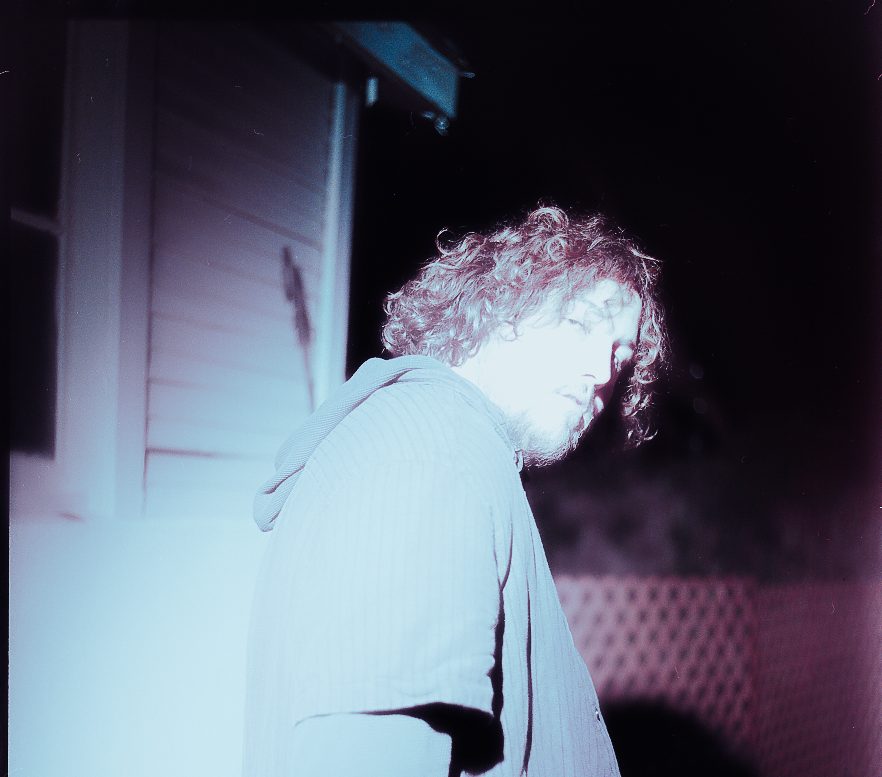
Jack Rutter’s mellowed out. He says so himself, but you can tell as much by his slow speaking cadence, unkempt beard and his latest album as Ritt Momney, BASE, which also happens to be his best. Gone are the hamfisted odes to Mormonism and jittery pop-rock of his past releases. BASE is a breezy, stripped back record with a raw analogue edge. Take highlight “SOMEMORE” for example, an R&B interlude with only seven words. Rutter claims to not listen to much music these days, but you can hear him gently exploring different influences across the tracklist; on “CAT” he’s Imogen Heap, on “RIGHTBACK” he’s Alex G (though to be fair, Rutter’s been using autotune since before House of Sugar). Even “LIGHTSHOW,” the most familiar ‘bedroom-pop’ song on the release, feels more natural, like its just drifting out of the band.
The Salt Lake City musician rose to fame in 2020 with a TikTok hit cover of Corinne Bailey Rae’s “Put Your Records On.” The song scored him a deal with Columbia Records, a pandemic appearance on The Tonight Show and some passing Twitter backlash. He quickly became jaded with the music industry and largely bailed out of the public eye. Five years and a marriage later, he’s back to releasing independently. BASE was recorded on tape in Rutter’s backyard studio with bandmates Rick West, Chris Peranich and beloved indie rock producer Alex Fararr, in tow. We talked about how this was a departure from making music on his laptop and how the tape and his newfound peace informed the album.
Image by Sam Angeletti // This interview has been condensed for clarity.
What’s the first time you can remember hearing a song with autotune?
Ritt Momney: It’s gotta be Kesha, right? I remember being really interested in the sound. My older brother got obsessed with it when he was making music. He was 13 or something. I was just thinking about that song he made today, it’s like crazy autotune in Garageband. Pretty funny song. There was also the Jason Derulo song that sampled Imogen Heap with the vocoder. But yeah, Kesha really started something. I wonder how many avid autotune users would cite Kesha as the initial inspiration.
Have you ever seen Kesha live?
We played at the same festival as her once. I remember being so surprised at how many songs I knew really well. How many songs I’ve heard like 100 times.
This record has a very different sound to it than your past work. Can you talk to me about the recording process and how you went about getting the sound for BASE?
The tape was a big part of it. Before I was gonna start recording the album I got a 388 eight-track Tascam tape machine. I think both sonically and in the ethos of the album I can really hear the tape all throughout. For the first couple weeks of recording, I flew out my bandmates Rick and Chris. We did no screens in the studio and we had to get the sounds on to the tape. It was so different for me because all of the music I’d done had been in my computer using Logic pre-sets and plugins. When you’re doing that, there’s this lack of finality to each individual instrument as you’re working. It can be pretty overwhelming and I think it can lead to not finding the right sound.
There have been so many times where I’m on my laptop, using some MIDI synth sound, and it’s like, “I’m going to get the idea in there, and I’ll figure out exactly what I want later.” And then you keep listening to it and you never really get around to that. There was something about having to put it onto the tape exactly as it’s going to be in the song. You have to make sure the guitar sounds exactly how you want it to sound as it’s going into the tape machine. We messed with some stuff in the computer later, but I think it helped me restrain a little bit.
Do you feel that way when you listen back to your previous work? Does it feel unfinished or unrestrained?
My first album feels a little neurotic. I was going crazy on adderall and staying up all night working. And that led to every possible avenue being gone down and a lot of it making it into the final master of the song. Which I think is cool, it’s its own thing. Then I maybe underproduced Sunny Boy because I just wanted to get out of there. But this album feels exactly the right amount of produced to me.
You’re working with Alex Farrar as a mixing engineer on this record. How did you get involved with him?
I think I heard of him from the MJ Lenderman record. Chris—who is in my band—is also in this band called Mercury that works with Alex a lot. He definitely has a rock leaning with a lot of his projects, and there’s some rocky stuff on this album. I thought it’d be interesting to see how he’d mix some of the more synthy electronic stuff. He did a great job. It all sounds enhanced without being sterilized. A lot of mixing can be too far on one side or the other, and he does a really good job of not overmixing.
What were you listening to while writing? Were you listening to different stuff while you were recording?
I don’t really listen to very much music at all. I was listening to the Mk.gee album a lot while we were recording. The big indie records that come out, the Mk.gee one and Cameron Winter and Geese and Dijon before that, I tend to listen to those. But I just don’t really listen to anything most of the time. I’m wondering how that kind of affected the music, cause I think for the first couple of albums I was probably listening to a lot more.
There’s more dead space on these singles, which feels distinct from your previous work.
Good point. A word I would use to describe the making of this album is “settled.” I felt a lot more okay sitting in the song. I’ve kind of mellowed out generally.
That was also a product of the tape, you only have so many tracks to work with. If you’re in Logic, creating a new track takes two seconds. When you’re on the tape machine, it’s pretty inconvenient to set up a new track. I felt a lot more comfortable on this album knowing when it was done. If anything, it was taking stuff out that didn’t need to be there—that Rick Rubin approach of “If it’s not really helping the song it doesn’t need to be there.”
Did you ever have any problems with the tape while recording?
There were a couple of times where we’d accidentally record over something and have to do it again. It’s pretty annoying. A lot of the stems went back and forth—they started on the tape then went to the computer, then back to the tape, then back to the computer. In that transfer there tended to be some happy accidents. It felt like the glitchiness was taken care of by shitty equipment, and it didn’t have to be contrived in the way it maybe would’ve been earlier. It felt more experimental in that way. It was less convenient, for sure, but honestly it doesn’t feel at all like a deterrent from working with tape again.
You’ve mentioned the limitations that come from working in the DAW. Did you ever feel penned in, not just by how you were producing, but by the bedroom pop sound?
I did at one point. It sounds kind of fake when I talk about this, because it feels like something I would be saying even if it weren’t true, but I really let go of those kinds of expectations or genre boundaries. Obviously it’s not some crazy genre-bending thing, but it happened naturally. If I was thinking, “I have to maintain this bedroom pop sound because that’s what people like” or “I need to not sound like that at all,” those are externalities that can only sterilize your creative output.
This has been a fairly short LP rollout, it’s only been about a month since the first single came out. What was behind that?
We actually thought about surprise dropping. In the past, I’ve released a million singles before the album comes out, and that’s usually because the album isn’t done yet. With Sunny Boy, I released a song and not a single other song on the album was done. I wanted this to feel more like an album than a collection of singles.
Since Sunny Boy I’ve gotten pretty jaded with the industry. I mean, I’ve done the major label thing with “Put Your Records On,” and social media has been pretty annoying in that way. It’s upsetting that the industry makes people feel like they have to post multiple times everyday in order for people to hear their music. I started thinking really hard about what music was going to be for me.
I thought about it as a career for so long. Like, “This is how I make money, and I’m going to do album cycles and tour and write a new one and record it and release it and tour it.” I realized I strongly disagree with the idea of art being a job. I’ve tried to stop thinking about it like that. It just kills you. When I’m writing a song and at the same time I’m thinking about my mortgage, it’s insane trying to create under those mental conditions. I was really deliberate about letting go of all of that and not expecting anything from this album. As a result, it was by far the best experience I’ve had making music. It’s made me think a lot about the spirituality behind creativity and the way it’s commodified. Mixing money into it, your creative soul knows. It knows why you’re doing it, and if you’re not doing it for the sake of making something cool or beautiful, I think it really eats away at you. It filters and sterilizes the output in a way that feels disrespectful of that gift of being able to make something.
Those ideas have come up in your music before. I listened to an interview you did with Dayglow, you were talking about writing a lot of music about writing music. I hear that in “RIGHTBACK,” especially in the lines near the end: “Is the fire at my feet really so gone?”
That’s an interesting take about “RIGHTBACK.” I think that song was intentionally vague and kind of underwritten almost. I don’t really know what it’s about.
It’s actually really encouraging to me that I don’t think I was writing about music there. That’s totally the kind of thing I would have written about being a musician, but I think I was just writing about my life. In those lines I was writing just as much about eating healthy as I was being prolific with my music or something. That’s really cool. I hadn’t thought about that in a while, how I used to write about being a musician all the time. I don’t know how much there is to be gained from that and how much of that is relatable to other people. It also is a lot less fun and a lot less pleasurable to write about music. Thanks for pointing that out.
You recently got married and bought a house in Salt Lake City. How does that feel?
Being married has been amazing. We had been dating for eight or nine years and we’d been living together, too, so not as huge of a change as it could have been. But having that third entity that’s our marriage has helped me feel more comfortable and settled.
Sometimes I look on the Ritt Momney Reddit. Someone posted a few days ago, they said, “this dude has never been happy.” I’m afforded the opportunity to live such a comfortable life right now and I’m grateful for that outside of my music. But having–to invoke the album title–this base I have right now enables me to go in different directions with my writing. I can get down into something really scary or sad because I know that I have this place to get back to. This baseline comfort. It’s really dispelled this notion I used to have, and I think a lot of people have, about what fuels good music. There’s not much of a headline in “I’ve been feeling pretty good recently,” but it’s when I’m feeling safe and comfortable that I can exert that creative energy.
On a scale of 1-10, how sick of talking about the name Ritt Momney are you?
I don’t really mind anymore. Obviously, at the beginning it’s like, “Oh yeah, that’s funny.” Then it’s like, “Wow, I hate it so much.” And then the pendulum came back to the middle and it’s like, whatever. It probably is sort of a turnoff and makes it so some people can take the music less seriously.
I think that’s silly. Do you know the band Michael Cera Palin?
Yeah. But, I mean, I’ve never listened to them. And maybe it’s because of the name. Who knows. I feel comfortable with it now, it feels just like my name. I don’t really have much of an opinion about the name Jack, you know?
Last question—I heard you like to bowl. What’s the best score you ever threw?
246. I was obsessed for a little bit. I was going all the time. I got all my friends into it, everyone bought their own balls.
You have your own ball?
I have like five.
Do they say Jack? Do they say Ritt?
Ugh, I need to get them engraved. But no, they all just have some stupid graphic on it. It’s hard to find bowling balls that look cool, honestly.
What weight do you throw?
15. I guess it’s standard, all the PBA guys throw either 15 or 16. But it’s heavy! It hurts sometimes. It’s like a workout.
Do you hold the ball on the outside or—
I kind of do a hybrid thing. So the two handed bowlers, they have two finger holes, they don’t put their thumb in but they use two hands. I only have two finger holes but I only use one hand. I think it is sort of sub optimal. I can throw two handed, it’s different footwork and it’s pretty tough. The thumb has always been so hard for me! I don’t know how to get my thumb out correctly. I’m bowling less these days. In the height of the obsession I would watch some of the PBA tournaments. It’s not fun to watch.