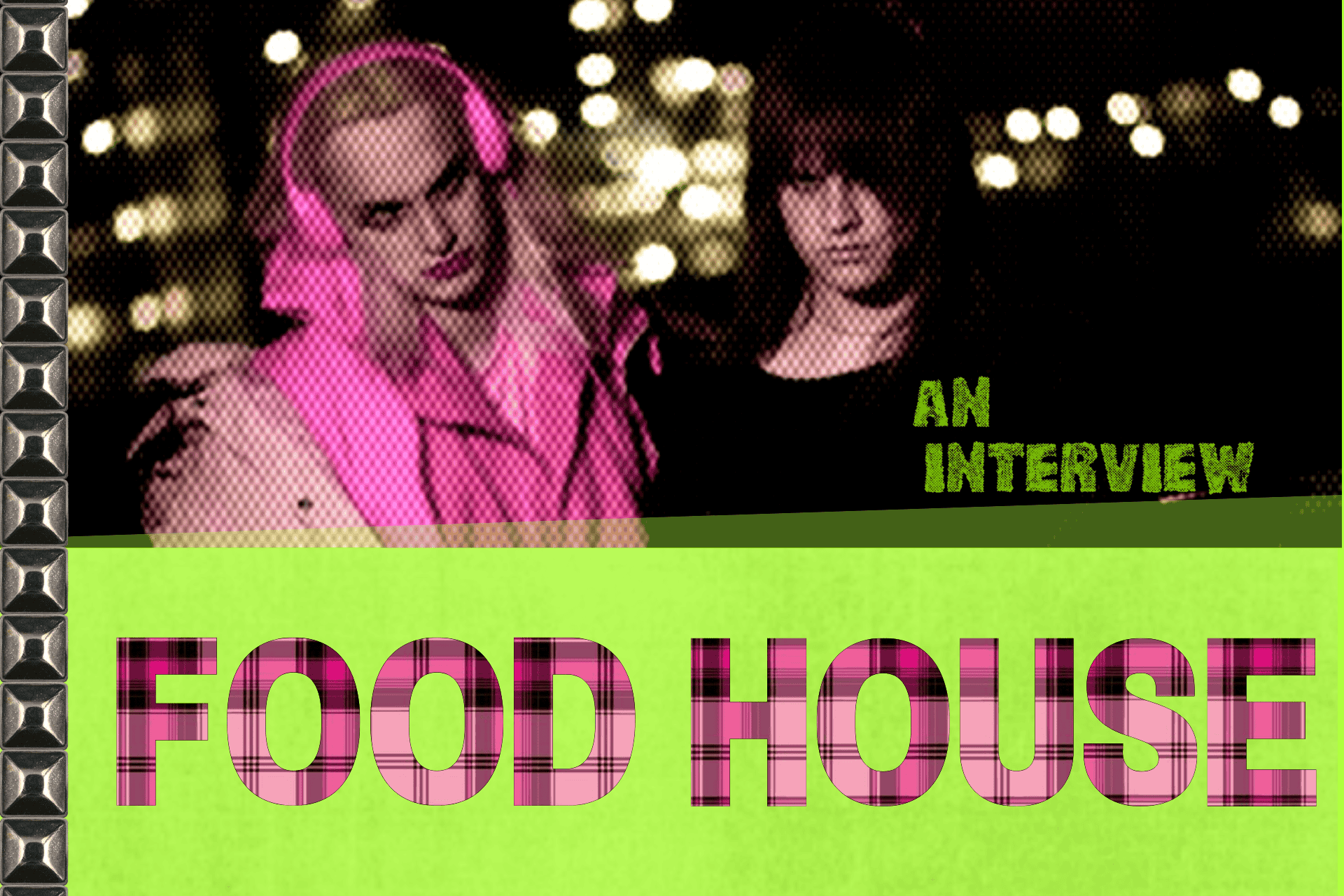
Gupi and Fraxiom are children of the internet age. As the hyperpop duo food house, they create music that unabashedly embraces cringe and niche; through high-pitched autotune, abrasive synth, and booming drums the duo have created a sound for the terminally online.
Food House was formed through performances at house shows and festivals in the late 2010s where Gupi and Fraxiom formed a musical and personal bond. The duo rose to prominence in 2020 with the release of their debut single “Thos Moser” — a true-to-the-word banger which set the framework for their unapologetic production and reference-filled lyrics. Later that year, while quarantined, the two created their self-titled debut album food house further pushing their production into experimental extremes and thrusting them into fame with the pandemic-era hyperpop scene.
But after a year of Minecraft concerts and livestream festivals, the duo largely stopped releasing music. Feeling constrained by their record label and disillusioned with the music industry, food house took a five year hiatus returning with their independently released second album two house in 2025. Increasing their bpm and rpm (references per minute), two house fully embraced the maximalist wonder of their earlier work, diving into the deep end of hyperpop absurdity.
Shortly before the interview, I sat in on the duo’s performance in the WNYU basement. Fast-paced, high bpm, dopamine-fueled noise filled the studio as the duo dj’d samples of “Hit or Miss” and Smash Mouth capping off their set with their newest song. And after talking with them, I’d say food house shows no signs of slowing down — musically or professionally.
Graphic by Stella Chen
This interview has been condensed and edited for clarity.
As a duo, you really got your start releasing music during the pandemic. Given how much your music is inspired by internet culture and given that it was such an online time. Does it feel different making music now that the pandemic is over?
Gupi: I, for one, feel a lot more experienced, and I feel like our music still roots from the same things it did. I don’t think we really made music about the pandemic, I think we just happened to make music during the pandemic. We still make music, and I feel like it’s still just as true to what I’m trying to express, but I just have a better vocabulary for it now.
Fraxiom: My addition to this is, I think that we were always doing like most of our music shit online, like scenes, and making friends, and working with oomphies who are producers, and all that, and I think that…
Gupi: I think people miss that. People don’t know that our music was always internet music. We didn’t meet each other for a long time.
Fraxiom: The reason why our music was only on the internet until after the pandemic was because our type of music was literally too weird, and too cringe, and too lame to get booked in real spaces. So we were doing live streams, and shit on like Twitch for most of the time, and people think that we learned that from the pandemic, and we didn’t, we were delegated to that by society. And now that everyone is done saying cringe is cool, and they’re not playing with that anymore, but it’s like we were always there, and yeah…
Gupi: We had been doing those internet shows, like datafruits would do those like internet streams, way before any of the Minecraft shows, or any of those kinds of things. That just is our culture, and it isn’t just pandemic culture to us — it’s just our culture.
With Charli XCX releasing Brat and hyperpop starting to seep into the mainstream, how has that influenced your view of the genre?
Fraxiom: It kind of hasn’t influenced me. When I try really, really hard to think about and define my place in the world, it makes me want to not make music. So I think it is really good for me, personally, to never think about that just because that makes me want to be authentic, and it makes me want to try when I’m not trying to piece together how I fit into the zeitgeist.
Gupi: I have a lot of mixed feelings about it, because for one when you’re a fan of something you’re like, “Why doesn’t everyone like this? Why isn’t this the mainstream?” And then it becomes the mainstream, and there’s weird like bitterness to it. Because I’m really happy that more people are hearing that kind of sound and that does bring me joy. For instance, PC Music had been doing this thing called Pop Crypt in London for many many years, and my friends would always go to it, and PC Music had always been pretty niche. There weren’t a lot of fans of PC Music before Charli got on the scene. But like I said, with our internet culture and all that, that was the music. Our music bible was PC Music — and among other things — but that was a really strong influence for a lot of us since 2016 or so.
I think where the bitterness comes in is that — I try to just let go, because I want to just let people enjoy things — but like there was that show series they had done for many years, and people would always go to see these niche artists that they don’t usually get a chance to see, like [Finn Keane fka] EASYFUN, and Kane West, and Hannah Diamond, artists like that. Then after Brat came out, people would go to those events in hopes of seeing Charli XCX, and then they would buy out all the tickets and not dance until Charli shows up, and then my friends would hear people in the crowd as A.G. Cook is playing, who produced her album, and they’re like, “What is this, this is bad.” And I can feel it too in the culture, because there’s a lot of, maybe not disrespect, but just disregard for the roots of that music. But, like, Underscores just released an incredible album, and we were just talking about this on the way here. We all were in those same circles together before anyone knew who we were, and it’s so cool that that sound is being pushed out to a bigger audience and I do have a lot of good feelings about it too, but it’s mixed feelings, there’s a lot of feelings about it.
Your music draws inspiration from all kinds of things on the internet. What’s your process for finding that inspiration and putting it all together?
Fraxiom: Don’t fucking overthink it, music is supposed to be fun, and that’s why you press play. Because we’re playing, the overthinking leads to the inhibitions, and the inhibitions lead to you never releasing the shit, and you never releasing the shit leads to you being bitter forever, and you have that DAW on your laptop, and you release nothing, and all your favorite artists, they got the same DAW as you.
Gupi: I think we draw our inspiration just from our experience, like anyone else does. And a lot of our experience — like in our youth and growing up — we were online and we were very avid with like memes, and just funny videos.
Fraxiom: A lot of people thought we were really lame!
Gupi: Yeah, but whatever, that’s how it goes. Our inspiration just, I mean, at least my inspiration for like sampling and stuff just comes from things that I think are funny, or things that I think I want people to hear.
Fraxiom: It’s like an inside joke for people who will recognize the little sample, and they’ll be like, “what the hell, like I feel crazy, like why is it there?”
In your music, you’re able to blend these fun, campy elements with more serious and personal topics. When you’re working on songwriting and you’re trying to blend those elements, what goes into that?
Fraxiom: I would compare it to like, when you try to be funny about your trauma to your best friend, to make it go down easier. It’s like that, literally being a little silly makes it easier for me to talk about things that are really hard for me to talk about. And I think that it’s helped me because shitty emotions can be just as absurd as good emotions, and they can make you feel just as crazy, good emotions can make you feel really crazy too, and sometimes aren’t even good. I think like diving into all of that silly realm, it’s not the same kind of ocean as the serious — the serious ocean is way more deep and treacherous and whatnot — but the silly sea, It still teaches you how to hold your breath and you get stronger, and then you can dive into the serious shit later, and you already know how to talk to yourself, and write about yourself, and dive into yourself, because you’ve already explored really heinous and absurd things that most people have not. So if you can do that with something absurd and silly, you can also do it with a tragedy, or your central trauma, or the kind of shit that. If you were not presenting it in such a grandiose way with music and visuals accompanied to it, it’s the kind of shit that you would be like saying sorry every three sentences while talking about it even if the other person thinks it’s okay, and you got to be able to tell that shit without the sorry.
Gupi: Frax writes most of the lyrics, so I think that’s where the emotional aspect comes in and I’ve been told that my music — like by my teachers, and other reviewers, and stuff — that it’s corny or hokey — that’s what he said was hokey — but to me it’s not and I think to you it wasn’t. Because you were a fan of mine before we met, and I know my music can be pretty in-your-face happy–
Fraxiom: It’s very earnest to me, it’s the kind of earnest production that I hadn’t heard a lot before seeing your music.
Gupi: But I guess a lot of people can interpret that as corny or goofy, and in any aspect people can interpret earnesty as corny or goofy. But it’s me and it’s you too — it’s your lyrics, and I think that’s how we talk about traumatic stuff a lot of the time too.
Fraxiom: Yeah, and it just is you.
Gupi: I think it’s best to not dwell on things and just kind of make the best of it, whether that be art or jokes.
When you did first meet and you did start performing together, what was it like getting yourselves started as a duo?
Fraxiom: When we first met, and we were first performing together, I knew it was gonna be something even before we had words for it. And, I think that’s because I was just so excited playing and making music with Spencer [Gupi] in a way that I had not felt with anyone ever. And it was definitely sort of this eureka moment of… I don’t know, I guess I just felt really seen. And, it’s like even if everyone else, wanted to do something different or stopped fucking with it or whatever; I just feel like I have a lot of unconditional support from Spencer always. And it helped me a lot to become a musician that I enjoy listening to. And, before we were making a lot of music together I never really had a space to explore that a lot. So it was cool to be able to do that and also cool that, I guess, we were supposed to do that because a lot of people fucked with the result of that.
Gupi: That’s really sweet. I feel the same, I feel like Frax really brought my music to life. I didn’t work with many vocalists, and when I did it was kind of not exactly what I imagined. And I think I was kind of adverse to it. But yeah, like Frax said, as soon as we… because we were friends for two years before we even started trying to make music. We would just hang out, like you were just who I knew to hit up. We didn’t really have anyone else, and one night I was like, “sing on this, let’s do this shit!” The way we work is just so natural, it doesn’t feel forced, and I feel like we’re barely ever butting heads about what to do creatively. I feel like most things we bring to the table, I’m like, “oh that’s sick.” And then we’re like, “oh that’s sick!” It’s really fun.
What’s it like performing live now that you’ve found your community?
Fraxiom: Our most recent show was one of the most surreal shows we ever played. Cause we had Divio and Maxo open and like 10 years ago — not to the day, to the day it would be really crazy — but literally 10 years ago in 2016, when I grew up in Massachusetts, they threw this show called Jack NYC. And I begged my parents to go to New York to see this show that they were putting on. And they threatened to put me on Amber alert. It was a time, but like, I just think about the FOMO I got was so so so insane. And now literally a decade later, throw a show where those people play at our show. I don’t know, just the full circleness of a lot of stuff. Even like now where we are at, there’s a lot of moments that I’m trying to have more words for besides “full circle.”
Gupi: It was though, it was really cool. Cause we were both fans of them growing up and they inspired a lot of the sounds in our music. And it was just really cool to be able to do a show and I want them to play cause I just wanted to see them play live. It’s also cool that we’re all still doing this, and there’s such an appreciation for it, and it’s really cool.
Fraxiom: I had never hung out with Divio until that show, and instantly it was like click.
Gupi: Cause I feel like you can kind of hear how people see the world through their art.
Fraxiom: Either makes you really want to meet them or really want to stay away from them.
Gupi: That was cool, and all the shows have been really fulfilling — I guess that’s the word for it, it’s just very fulfilling. And it makes all of the hard times seem worth it getting to this point, cause it was hard. Like during our peak of popularity, it was pretty difficult being tossed into the industry, cause we didn’t have any experience with that, and there was a lot of learning to do. It just makes it all feel all worth it.
Talking more about the industry, you’ve talked about how much friction you had with record labels. Now that you’re finally releasing music independently, how does it feel having that sort of artistic freedom now?
Gupi: I love it, I think.
Fraxiom: I don’t feel stifled as a person anymore… well, not even that it really felt stifled then, actually, maybe that’s a bit too dramatic.
Gupi: It kind of just felt like we were neglected.
Fraxiom: Cause other people get signed and thrown into it the same way we did, but then they get like resources and support and follow up.
Gupi: I don’t know. It’s not like we’re owed any of that, but like when you do sign a contract, you’re supposed to work with that label on those things, whether it be merch, or tours, or anything — selling physicals of CDs or vinyls or what have you. So there would always just be a lot of red tape to cross, and chain of command telephone kind of shit, and also we were just inexperienced. So, we never toured food house or anything, and we never released physicals, and it just kind of disintegrated and I’m kind of at peace with it now, like I don’t blame any one person.
Fraxiom: I think staying bitter is bad for the art.
Gupi: Something I want to clarify too is that we were assigned Dog Show, but Dog Show is a subsidiary of Mad Decent and Mad Decent was the real problem. Dylan Brady actually really did look out for us in a lot of ways. Like he was trying to get our merch going and like he would talk to the label people when they were being difficult for us. But he’s busy too, and his career is taking off at the same time, and I think he got caught up in that. They split from Mad Decent, it just kind of just disintegrated. But I’m glad that it did, cause I’m really liking what we’re doing now. Frax planned our whole last U.S. tour on her own which was an incredible feat and it totally paid off. And, I’m really glad we got to do that — it was our first tour, basically — and it didn’t feel like anyone forgot, everyone was like, “oh my god, food house is finally touring!”
Fraxiom: I was really afraid for our first U.S. big tour. I was afraid that it’s… cause people always fuck with it, but it’s like–
Gupi: I just thought too much time had passed. I got nervous, but no, it was really good. And I’m really happy about that, I’m thankful.
Fraxiom: Going on that tour, and realizing that nobody forgot and everyone actually does still fuck with you — it felt like trying to jump off a cliff, but there’s a force field and you can’t actually do it and you’re like, “fineee, guess I’ll stay around.”
Speaking on your artistic process — you of course work as food house the duo, but you also both make music on your own. How does your artistic process differ when working together versus working alone?
Gupi: I think for me, I make a lot of instrumental music. I like making a lot of dance music, like hard style and breakbeats and stuff. And then when I work on our stuff, I still incorporate those elements, but I am trying to make it more like pop music too, like for vocals and stuff. So I guess that’s where it differs for me, but I love doing both, I just love making music.
Fraxiom: For me, there isn’t that much difference, except for — and then maybe I have had this a little bit with some other people, but, by far, always the best was Spencer — it’s so easy to communicate an idea that I have for the structure of the song or like the sound and the sonics of the beat, and Spencer will produce it — and of course it like still sounds like Gupi — but it’s also fucked up because it sounds almost exactly as I was expecting and imagining it.
Gupi: I almost think that’s how food house comes to be, is that you will give me an idea. You’re like, “can you make a beat like this?” And I’ll be like, “I can try!” And then I try and it’s not quite right, but it is what sounds like us.
Fraxiom: Your art style is just how bad you are at copying your faves. That’s like literally all there is to it. That’s the main thing that’s different is that — it’s not that I haven’t ever done this with any other producer — but we just have such a good flow with that. Sometimes from the songwriting and lyric-writing perspective, it’s usually kind of still the same, but sometimes I feel like I will either want Spencer to be in the ad-libs or have a verse, or I will feel more like I’m with the band and I’m not just by myself. And even though some of the songs are kind of solitary, like oh, I’m One Direction right now and I’m not like Drake right now, but like, we can be Fifth Harmony right now, but later on we can be someone else.
Where do you see food house headed?
Fraxiom: Our new song!
Gupi: I will always want to make music with you, and I think that’s just how we think about it. I think both of us try to not stress about the future too bad.
Fraxiom: Like future tripping. I know that we’ll always want to make music together and I know that it will always be easy for us to communicate together about hard and complex things. I am so so grateful that the main person that I do music with all the time is not a music industry type person — like if I had to talk every day with a shallow motherfucker.
Gupi: Cause even the way we do business is incredibly similar. I think we have a really good thing going — friendship wise, business wise, and music wise — and I don’t think either of us want to lose it.
Fraxiom: Us being here right now, like us being independent and touring, is the result of us having to set a lot of boundaries in a lot of different nuanced ways for us to not lose it. I’m proud of us for doing that. If you want to know where Foodhouse is headed, if you want to think about it in that way, we just made a new song a couple of days ago — it was the first song of 2026 that we made — and it sounds to me like our next sound, it doesn’t sound like two house to me. I’m not going to say like, “Oh, like we’re going to go make three house right now” but like we’re making music and it sounds new and I’m excited for it. And you’ll probably get at least one or two of them this year.