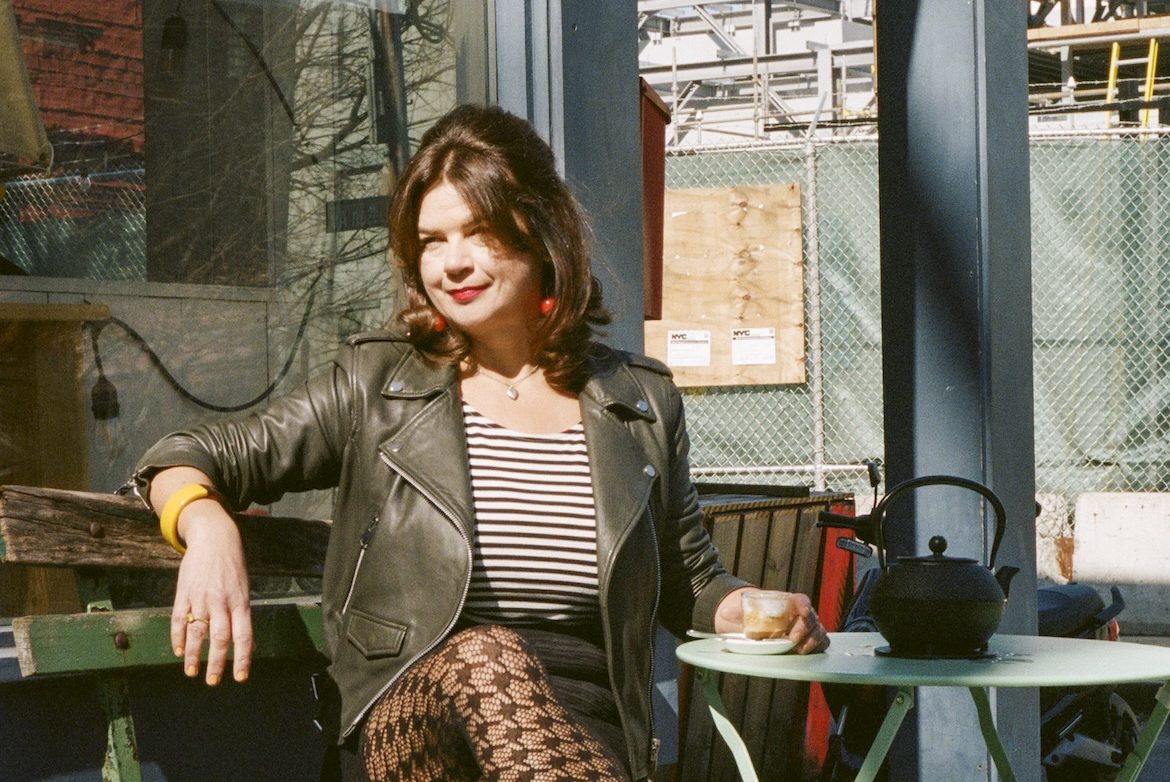
Chicoutimi is both the name of a town in Quebec and the moniker of Thessa Mooij, a Dutch singer hailing from the seaside town of The Hague. Chicoutimi had always been musical, taking guitar lessons from a young age, and being from a city filled with Dutch-Indonesian rockers. Many Indonesians settled in The Hague after WWII, bringing with them knowledge of the Hawaiian steel guitar and American rock and roll. These rockers were the backbone of many bands that arose out of The Hague, such as Shocking Blue and Golden Earring, both being sources of inspiration for Chicoutimi. She also cites seeing Poison Ivy of The Cramps play live as a life-altering moment, culminating in the eventual release of her debut album Ghost Town on Halloween 2025.
With lyrics about fairytale creatures, traveling without destination, long-lost lovers, and mysterious strangers, Ghost Town feels like a hazy dream or a folktale you once heard. Chicoutimi’s romantic attitude towards life shines through in her storytelling. Blending together country twang, delta blues riffs, and European folk, she creates a distinctive, nostalgic sound that evokes a long-lost memory.
A week after seeing Chicoutimi perform her song “Cherry Blossom Waltz” live at the KGB bar, I sat down to have a conversation with her about her then up-coming debut album, and everything that went into it.
The first question I wanted to ask you was just about your name. Where does Chicoutimi come from?
Chicoutimi is the name of a town in Quebec, province. It’s a native — first nation word. It means the “start of the water”, I think it’s where big river starts. I found the name because it was on flight maps, on the transatlantic flights, whenever I flew back to Holland, you know, you have these flight maps and it’s got all these really big cities like New York, Boston, and all of a sudden, it would have Chicoutimi. I was like, wow, what is that? And it was just so exotic, so cute. And I just love the cadence of it, Chicoutimi. It’s pronounced shih-koo-tim-ee, I just say chic-oo-tee-mi because it sounds cute.
Listening to “Ghost Town”, I noticed a lot of themes of water. I know you’re from the seaside town of The Hague, and on the cover of the album you’re sitting on the beach. You also mention water and drowning several times in your album.
I was born really close to the seaside, and grew up there and just going to the beach. The sea is really important, and even in my bio, I have something about crossing the Atlantic Ocean and washing up on the shores here of New Amsterdam. I shot a video in Iceland, two videos, also on the beach. Water transports people in life, and it’s important to me. Whenever I go to the Hamptons, the beaches there are very, especially the North Shore, are very similar to Holland with the dunes and the sea, just makes me happy.
You mentioned that water transports people. Another thing I noticed in your music were themes about traveling, adventure, being on the road, never staying in one place. Would you say these all influence your music a lot?
Yeah, anyone who travels, or goes to another place, it changes you. It changes your environment and it changes you. And that means drama, and that means for a song, there’s an interesting– it means there’s drama for the song, right? Like in “Tulsa”, the character goes halfway across the country to Tulsa, invited by a lover who’s not even there when she gets there. For songs it means drama because you travel around, you move around and you change, you change the people inside you. Or you discover who you are because you’re in unfamiliar places because of the journey.
You’re from The Hague and now you’re based in New York. How did you make your way over?
For work, I do communications and public relations. I worked in film for a long time, and was lucky enough to live in London for a couple years, where I worked for the Goethe Institute to promote German cinema in the UK. And then I came here and started my own PR company. I was a journalist too for a long time, covering film but also business. But then I started my own PR company, mostly doing film, a little bit of music. And yeah this is the place to be for film and entertainment, and to grow. So I’m lucky enough to been able to establish myself here.
Speaking of your origins from The Hague — I know Shocking Blue and Golden Earring are from there as well. Would you say that they’ve influenced you?
Absolutely, they’re a really big influence, that kind of raw rock and roll sound. In the mid-to-late 60s, Shocking Blue, Golden Earring for sure, I once interviewed them when I was still a girl. There’s also a band called Q65 — they’re very raw, if you like The Cramps. The reason why rock music in The Hague was so strong is that after the Second World War, we decolonized Indonesia. So we left Indonesia and a lot of mixed race people left to Holland too, it was just a better place for them to be. But they were super musical, to begin with, Indonesians, and they were the first to pick up on Hawaiian steel guitar in the 20s and 30s. But they also, during the Second World War, started picking up rock and roll from the GIs’ radio stations out of the Philippines. And the Indonesian or mixed race musicians picked up the rock and roll just like that and adopted it. They brought it to The Hague where most of them settled because that’s where the government is and the queen lives. So they started teaching people like Shocking Blue and Golden Earring. They were their guitar teachers or bandmates. And that’s why the level is so high. That scene of Indonesian bands, I worked on a documentary about this, dominated the GI clubs in Germany. The Beatles got started in Hamburg, but before that was all these Dutch Indonesian rockers that dominated that scene. I was lucky in my hometown with so many local artists.
Seeing Poison Ivy of The Cramps was a big moment for you. What was that like?
I took photos on film, so I had my camera with me at the time. I saw them when I was like 19 in Amsterdam in a club called Paradiso. This amazing club where, it’s an old church where everyone plays. It’s like where the bigger shows are before you transition to stadiums. This was before there were cellphones or even night trains. I lived in The Hague, so going to a show in Amsterdam meant afterwards, you’d have to just go out, and hang out until the first train home. I positioned myself in front of the bass player because I played bass at the time. It was Fur Dixon, was the bass player at the time. And she had a pink mohawk, and no underwear — just see-through plastic shorts. And then Lux, as a singer was very menacing but in a very thrilling way, and he was like poutering around the stage and throwing whisky bottles. And then, that Poison Ivy on guitar was just so intimidating. I’ve been thinking about role models a lot, but they were just so intimidating. I even got a Gretsch like her, and you know, she got me to want to play. But at the time I was so intimidated. I was like, this can never be me. The thought didn’t even occur to me, that I could be that. But the energy, and my hands just started shaking from the excitement and of being really upfront and the exciting music. And then this menacing, super raw rock and roll energy.
Have you always made music?
Yeah my parents were pretty good about recognizing that I loved music in school, so they put me into extra music classes outside of school so I learned to read music and play, from when I was like seven. And then at some point I wanted to play guitar, so I started getting guitar lessons, and it was mostly acoustic and classical, and we learned some Beatles stuff, which would be my first rock and roll. I think at the time, because Holland has always been a place where American music is first launched because we have such receptive audiences who were open. So a lot of artists get launched in Holland first, and I remember in the 70s seeing Link Wray and Robert Gordon, and they were on TV, and that with “Fire”, the Bruce Springsteen song, and that just blew my mind. And it was like Iggy Pop, and they were on mainstream pop TV show. It was just mind blowing and that was all at the same time.
What prompted you to just now start releasing music officially?
Around the time that I discovered Ray and guitar playing and everything, my dad, bless him, came home with a magazine, and it was The Face. It’s this British magazine that got started in the 80s. There’s a bookstore called Left Bank Books that sells a lot of their issues. But that was like a mix of fashion, new wave, and punk. It was just so international. And that blew open my mind. There was a lot in there about rockabilly and the Stray Cats specifically. So that’s how I discovered rockabilly, like The Cramps and Link Wray and Robert Gordon, the rockabilly trifecta. And I’m so grateful my dad exposed me to that. I was yoked, like he created a teenage rebel because after that I started dressing like this. Like oh, what happened to their little girl?
So coming to your question, like seven years ago my dad got very sick. I spent some time in Holland a couple weeks. And we knew he didn’t have much longer to live, so very intense time. My old classical guitar was still there in my room, and so I started playing obsessively and it just gave me a lot of comfort. I’d become obsessed with Ukrainian rockabilly, because I spent some time in Ukraine and Kyiv and I love it. And then I saw the guitar player doing some solos on YouTube, and I was like wait, I can do this, I’m sure I can do this. That was just so comforting and reignited everything. I found a great guitar teacher here in Williamsburg and I had lessons for about two and a half years. He taught me a lot of rockabilly, but like Western swing and just a lot of Americana chords. Then, because he taught me so much, I started writing songs and playing around with all these different styles. I never thought of myself as a singer, but okay well, I guess I’ll sing.
I recorded two songs, and a producer out of Hoboken, John Roccesano, had a studio there. I would go there and I recorded two songs. He recorded the drums first and then I recorded guitar over it, and then I’d sing over that. And then I had bass player friends record remotely and send me the tracks and he’d mix it. I’m just super lucky to find really great collaborators. Like, I’d done a PR campaign for a Nashville musician called Megan Palmer, and she put me in touch with her producer in East Nashville, The Bomb Shelter, Andrija Tokic, and he produced early Alabama Shakes and early Hurray for the Riff Raff, amazing track record. So he produced the rest of my album remotely during lockdown. I was lucky to connect with a drummer out of Philly, Patrick Berkery, he’s the backup drummer for The War on Drugs, and he works with Strand of Oaks. So nothing except for the things with John in Hoboken got recorded in the same studio.
You said you used to work in film, and listening to your music, there seems to be a lot of narrative and strong storytelling elements.
For a couple of years I did screenwriting. Besides journalism, and I had some great teachers from USC, from LA, that taught in Amsterdam, and I learned so much about plot. You have a person, and something happens and their situation changes, and then what happens, and that’s the resolution. And you can do that, even song, even with the free verses. It’s very cinematic. Writing the lyrics is the funnest part and the easiest part for me. The hardest is singing. Or, I don’t know, by the end of the album, I got really into it. I felt like truly, I found my voice. All throughout my life, people were like, “yeah, you’re not a great singer”, so you start believing it. My message for your audience is that these times call for people to just be yourself. Believe in yourself, especially women. Young women, just believe in yourself and just bring in that, not naïve, but sort of indie spirit. Like The Cramps never wondered if they were good singers, right? They never asked for permission, and I just love that spirit. I took some singing lessons, one really good teacher. She helped me find my range. Everyone has a good range for their voice, that’s what nobody tells you. I discovered I don’t have a great voice for rockabilly or country, as much as I love it, I don’t have that super sassy sound. Then I realized I’m much closer to French chanteuses like Françoise Hardy, not that I would dare to compare myself. But sort of that French, breathy, lyrical chansons for singing.
What’s the story behind your song “tulsa”?
The inspiration for the song came from reading a book on Nelson Algren. It contains some letters and he traveled all the time. It’s interesting since we talked about travel before. Nelson Algren was a writer in the 30s and 40s and 50s, out of Chicago, who wrote about America’s underbelly or the people struggling to survive. There was one letter where he arrived in Tulsa on a train, and it was cold and it was New Year’s Eve or Christmas, and he just went around looking for food kitchens. So I took that image, and I’ve been to Tulsa on a trip. I always want to have female characters or from a female perspective. So she arrives, but I want her to have empowerment, so it’s like, okay her lover is not there so maybe she should find some food first and maybe some shelter, but also maybe other people.
Anything else you want to add?
I’m just grateful, I was thinking about that on the subway. The world needs some more punk and indie spirit and uprising. We got to a point where you have to make a stand for things, sometimes physically. Music can be a good source. I’m not hugely into punk rock but I’m just really hoping it can grow, or any other kind of music honestly. I want people to find strength in music, and not let other people tell them what to do or if it’s good enough. Because I worked in entertainment for so long, I was lucky enough to get some praise from Lenny Kaye, who is Patty Smith’s guitar player. Same with the Calexico drummer who I was friends with even back in Holland. What I’m finding is that, musicians like them, or lesser known musicians that I’m friends with, still name musicians, they’ve been super supportive. But then, if I meet people who are at the beginning level like me, or mid-level, especially guys, they’re super judgemental. It’s like, you meet people, and they don’t respond. It’s just people should support each other, and indie is good and raw and bedroom music. If you record something in your bedroom and you put it out there on bandcamp, don’t ever let anyone tell you you need to be a songbird, or you need to do X, Y, Z for it to be good or professional. Just do your thing and find power in that. It happened to me a lot where people, I think, were disappointed by my voice. I’m not a songbird, but I’m indie. And I want people to embrace that if they sense they might have that in them.