Daniel Avery was always a rock kid who revered Kyuss and Black Sabbath and felt determined to one day play in a band himself. Yet, upon moving to London from his small coastal hometown, he found community in the open arms of acid house and in the acceptance of techno. Since the release of his debut album Drone Logic in 2013, Avery has been DJing internationally and has become a staple name in dark basement clubs worldwide. His rock roots have always been present in his music, but they’re clearer than ever before on Avery’s newest album Tremor, which blends together elements of ambient electronic with hard guitar and drums. This album is a conversation, a push and pull, an uniting, and a homecoming.
Nearly every track on Tremor is in collaboration with another artist, people who Avery had met over the years and people he grew up admiring. He sought to preserve the artists’ voices while bringing in his own sound as well. “A Silent Shadow”, for example, keeps the shoegaze elements bdrmm is known for as it leans into a heavier, synth sound that is more characteristic of Avery’s work. Collaboration, in Avery’s eyes, holds the spirit of raves and clubs, places where people come together and connect. Tremor is all about this connection and moving beyond individual limitations.
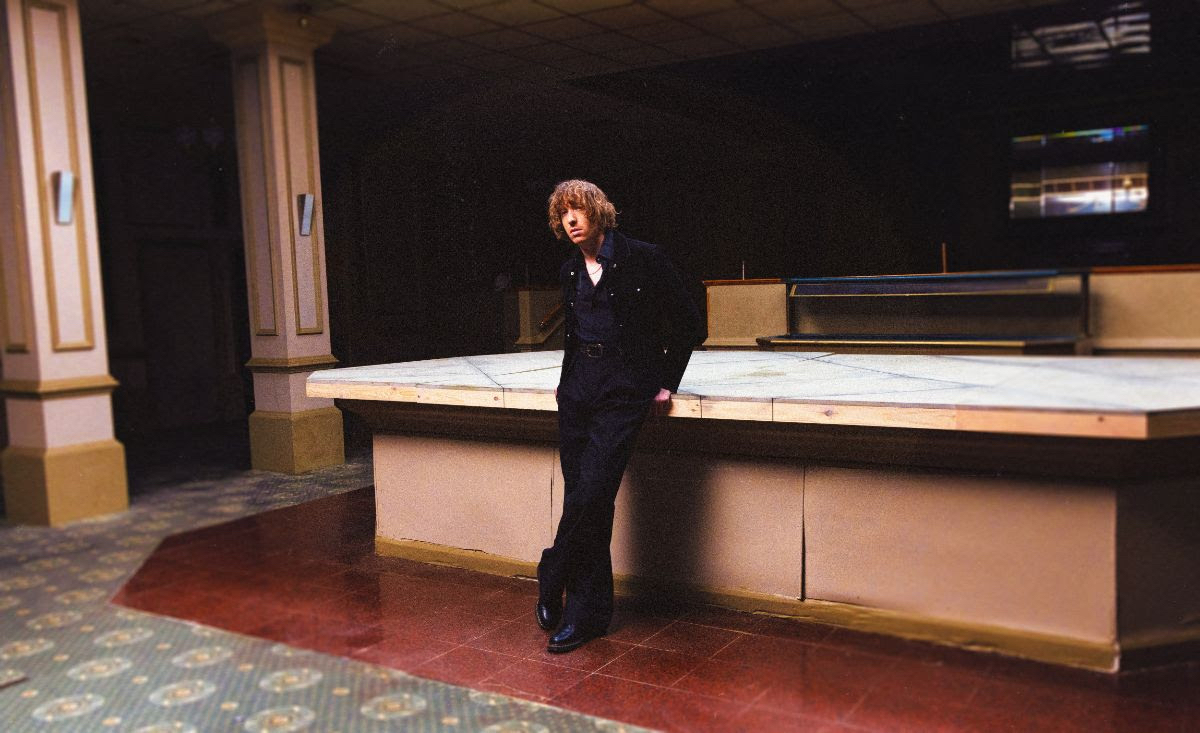
Photo by Kalpesh Lathigra // Courtesy of Pitch Perfect PR
Your new album just released less than a week ago. How’s the reception been?
It’s been so nice. The reaction’s been really lovely, and in lots of ways, this record feels like I’m coming home. Like it’s me returning to so many of my original influences. It just felt like a really comfortable, organic experience. And so putting out into the world has been nothing but exciting. Yeah, I’m really happy with how it’s been received so far.
You said that this was a return to a lot of your early influences. I’ve seen in other interviews that you said as a kid, you were really into rock and guitar music with bands like Black Sabbath. So how did that manifest into you making a career out of DJing and making more electronic music? And then now, with your new album, you’re back with those rock influences.
It’s a really good question, and it’s one that I have asked myself over the years. When I was younger in my teens, all I wanted to do was be in a band and to follow that path. But then, as I got a little older and when I first moved to London, the world of techno and underground electronic music just really grabs me. I just got sucked into the vortex of it in a beautiful way. I love that. The spirit of those nightclubs and that scene and those raves, the togetherness of it, the sort of acceptance of everyone. It just felt really amazing. So I feel really that looking back at my career, it’s always been a source of conversation between two parts of me: the rock guitar kid and the guy who loved and was accepted by the world of underground techno music. I would like to think that my music has always sat somewhere between the two. Same again with this record. Even though it leans more heavily into the guitar influence, it’s still someone who is in the middle of several worlds.
You said that your music has always sat between the two, and then with this newest album, it’s continuing further with even more rock influences. Is this a trajectory you’re following? Do you think your future music will continue with even heavier rock influences?
Well, I can say two things here. One, right now, this world of tremor feels much bigger than just this one album. I’m in this mindset where I want to do more in this style, for sure. But saying that, one of my favorite things about being an artist, or art in general, is as long as you stay true to yourself and an inner voice, then really there shouldn’t be any rules about what you can and should do. I really felt that on this record. I look to my favorite artists from all different mediums, and they’ve always maintained a sort of nucleus of who they are, but have been able to try an experiment. So in short, maybe my next album will be entirely ambient. Maybe it will be electronic. I think as long as it comes from a genuine place, it will still sound like me. And that’s not unique to me. That goes for any artist of any style. So, there’s two things I’m saying. One is that this world of Tremor is definitely bigger than this one album. But, I do feel a level of freedom where I’m at right now, that I could kind of do what I like.
You mentioned in other interviews as well that this newest album has the freedom of a debut album, that is, freedom from pressure. Have you felt the pressure of expectations in previous albums and has that changed the way you made music in the past compared to now with this newest album?
Well, in retrospect, that pressure was only ever coming from me. What really happened is that my first album, Drone Logic, came out in 2013 and launched me way higher than I ever imagined it could. It sort of turned me into an international touring techno DJ quickly. That became my identity. Well, I felt it became my identity for a few years, and I was determined then to be a “true” techno artist, and one who made techno records. The truth is that I struggled with that. However hard I tried, I just couldn’t make the sort of direct techno music that I thought I should be making. Now I look back at that stuff, and I’m glad I went through that. Because what I did eventually release, none of it was straight up techno, and I’m so happy about that. Obviously, again, it was a bit of a conversation, or maybe even a struggle with different parts of me: a techno DJ who’s not really from a techno background, a rock guy who’s now in a DJ world. All of these things, now I’ve come to cherish and love them all because that’s what’s made me, me. It’s my own story, my unique story. So the pressure was there for me, but I’m very proud to say that I never fully gave in to that pressure, and what I’ve eventually released has always been what I wanted to do at that time. But that’s not to say there hasn’t been internal struggles in getting there.
You’ve talked before about the importance of sequencing in an album and how that contributes to the overall story. What kind of story would you say that you’re telling with this album?
In an abstract, overarching sense, I really like when albums have a dream-like quality to them. The idea of a dream being sometimes realistic, sometimes surreal, sometimes loud, sometimes extremely serene, but then having all these different elements woven together. I say that as a fan of music, and those albums that I love all feel that way to me. They all have that quality. I think, to be a little more specific, I’ve always been interested in the idea of quiet or stillness within distortion. Or something beautiful being buried underneath something kind of heavy and oppressive. That’s what I get from heavy music that I love. From shoegaze or even metal music, there’s always something comforting about the distortion and about the noise of it that I really love. Musically, that’s just what I have always been drawn to, and I’ve really pushed it forward. I don’t know if it has any meaning beyond that, but I do often reach for things that feel like hope within chaos. You know, I think that’s kind of what gets me through life, is some kind of hope within this chaotic world, some kind of order in this bizarre life we will lead. And again, I don’t think I was overtly trying to write that way, but that’s just what I’m drawn to in life. And I guess that does come through, in some way, in what I make.
How do the physical elements of music affect your work? As in, how do people’s physical reactions to music influence you, as well as the live feedback that you get when performing in front of an audience as well?
For me, it’s all about the physicality, it’s about that connection. That’s how I fell in love with music. Every physical element of it, even down to the small specifics. Like looking at a record and pouring over the artwork, and, as a kid, putting up some of these records on my wall, or being handed a cassette tape by a friend, or going to a gig with friends and meeting new people, and the physicality of it. That could even be an intimate physicality, too, of putting on a pair of headphones and getting lost in that world. There’s still something very physical about it that I’ve always cherished and has always been really important to me. That’s just what I want to try and contribute to as well. I’ve never stopped making music that has a physical side to it, or putting on shows, or DJing. That connection is so crucial to who we are as humans. From my side, it’s just always been a really important part of it. In terms of how it influences me, I don’t know other than it’s always present in my mind in some form. I don’t make any music thinking, “I wonder how people will react to it,” but I do think the physical side of it is always present in some form.
There’s also what you’ve described as the “transcendental beauty of noise.” The transcendental and the physical are two opposite aspects of music, but I feel like they come together really well. I mean, music has this physical effect in part because you’re able to transcend beyond what’s physically in front of you right now.
The older I get, the more interested I become with that side of life. That idea of that stillness within and how music can sometimes play a part in that. Not always, but it can. I grew up pretty much an atheist, but the older I get, the more I think those beliefs are dropping away from me in some way. The reason I bring this up is, I played a festival in Albania last year, or two years ago. I played an ambient drone set where people were laying on the floor, and it was all about this search for transcendence. A guy came up to me at the end, and I’m paraphrasing here, but he said, “the Albanian word for God roughly translates as the two words: ‘your voice,’ and that inner peace or inner voice is what we’re all searching for.” Ultimately, it really stuck with me when he said that. It’s just such an interesting idea and something that is becoming more important to me the older I get, for sure.
You’ve always done collaborative projects, but this album ramps that up even further. Why is collaboration important to you, rather than just creating completely on your own?
I’ve always loved it. I’ve always just preferred doing things this way. I don’t know why, but there seems to be a trend I see on social media when it comes to some electronic musicians, where they want to be seen as doing absolutely everything from beginning to end. Writing, mixing, mastering, artwork, whatever. I guess it’s commendable in some way, but it’s just never appealed to me. It just comes back to some form of human connection, where I love bringing as many talented people in as I possibly can, and creating some kind of collective that feels bigger than all of us. And in the same way, it goes back to DJing. What I think is so interesting about clubbing is that a club is only a club when everyone in the room is there. If you just put a DJ behind a table, it’s just a nerd playing some records. But the second you form a room of people who are all transferring energy to each other, and everyone is equally important, then you’ve got something that can be literally life changing. The same as a gig. Just that power of everyone’s energies coming together has always really appealed to me. So that’s why it’s something that has always really meant something to me.
Building on that, what does the collaboration process look like? How do you work with someone else to create something that is true to both of you at the same time?
It’s important for me to say that my favorite thing about collaboration is when two or more artists come together and create something that none of them would make on their own. There’s something magical about that to me, something kind of almost inexplicable about it. On this project, obviously I trusted and admired greatly everyone who I worked with. I showed them the idea of the album. I had some demos and I had some musical references, but there were also lots of visual references and artwork ideas. The world of the album was quite expansive from the very beginning. Then it was important for me that the artist went away and put their own stamp on it, so I wasn’t standing over them. All the singers, all of their lyrics are their own. I introduced them to this world of Tremor, but I wanted them to put their own mark on it as well.
Then from there was it a back and forth process of trying to find something that worked for both of you?
I’m really happy to say that there was very little of the back and forth. I was just so blown away by everyone’s contributions. There was no point where I said, “oh, this isn’t quite what I’m looking for.” Everyone just delivered something special straight away. And that might sound like I’m lying, but that’s absolutely what happened. Half of the collaborations happened in person, half of them were done remotely, or partly remotely. I can safely say it’s been such an inspiring and natural feeling experience. I really loved every part of it.
And what about the music videos? Was there a specific vision going to that?
The videos, again, same thing. I worked with this guy, Zach Watson, this young director from London who is just incredible. Showed him all the references, and we just talked a lot about this wider world of Trenor. Again, growing up, I always loved music that felt bigger than just the music. So the artwork, photos, even like the adverts, the videos, merch, everything just felt like a wider world. It’s been a conversation that has encompassed the entire project. It’s always been far bigger than simply just the album itself.
Do you find a lot of influence from older shoegaze bands like My Bloody Valentine or Slowdive, in addition to a lot of the newer shoegaze bands that have been popping up recently as well?
Shoegaze was a really early love of mine. My Bloody Valentine for sure, Slowdive, Ride, even more dreamy stuff like Cocteau Twins. It’s all about that idea of something heavy and distorted but underpinned by beauty that’s there if you look hard enough. Just so fascinating to me that idea. There’s so much incredible new stuff, which is such a great feeling. Some are on the record, like bdrmm or NewDad, but then others like Glixen or Julie or who else is there? Just Mustard, a new band I really love, or They Are Gutting a Body of Water, I’ve been really into. So much happening right now.
How would you say the energy or the crowd of a certain city affects your experience when performing live?
It changes everything. Going back to that idea of an event, a gig, a DJ set, or whatever, it’s always about everyone in the room. It’s never just the band or the artist or the DJ, it’s everyone in the room. Everything feels different, and that’s what I think is good about it. The world of streaming and online shows is cool, and it’s very modern, and it’s an exciting extension of what we do. But I truly hope it never fully replaces the in person experience. I don’t think it can, and I hope I’m right. It’s all about going to a show, and maybe that night there’s a different crowd in and you’re going to get a different energy from the band. But that’s only going to draw you in further because then you might go and see them again, and it might be totally different. And that’s amazing to me. That’s what it’s all about, that’s what I think we all love about the live experience.
Do you have any standout experiences from touring or performing live?
I feel so fortunate to have experienced so many different kinds of events around the world. I can’t really single any out. Everything is different, and I just feel so fortunate to be experiencing all these different energies all the time.
Any favorite cities that you’ve been to or to perform at?
No, I mean, I’ve always loved Glasgow in Scotland, or Berlin, or Paris and France, or New York. Philadelphia has always been a beautiful city to me. Tokyo, Sydney and Melbourne. I just feel very lucky to have been around the world. All over really, I can’t pinpoint one.
You’ve said before that you always knew you’d end up in London. What is it about the city?
Something about how it’s so multicultural and just constantly exciting. There’s so much art being created here all the time, so much creativity, and it’s just a melting pot, as I feel any true big city is. We live in strange, dangerous times where there are certain figures trying to tell us it’s all about shutting doors and building walls. But it’s not what we are all about. I was just always drawn to London. So much incredible art has been made here over the years and I just feel really happy being a small part of that.
Anything else you would like to mention?
No, other than this new live show of mine, which I will be bringing to the States next year, at some point. It’s a new, reborn version of my live show with a full band. It’s something that I wanted to really honor the new album with. It sort of has a techno heart to it, but it also has a shoe gaze side to it. I’m just really excited about what happens next. It feels like a new version of everything I’ve ever done, and the future feels bright right now.
What has this process of bringing this band together been like?
I wanted to have the energy of all the rock shows that I loved growing up, and still do love now. Yet, obviously, to maintain the identity of what I’ve been doing as a techno DJ for however many years now, and to marry those two worlds and make it feel genuine. To not try and be anything that it’s not, and ultimately just be an expression of who I am, which is several of these characters. They feel like they’re living in harmony more than ever with me right now, and it feels cool.