
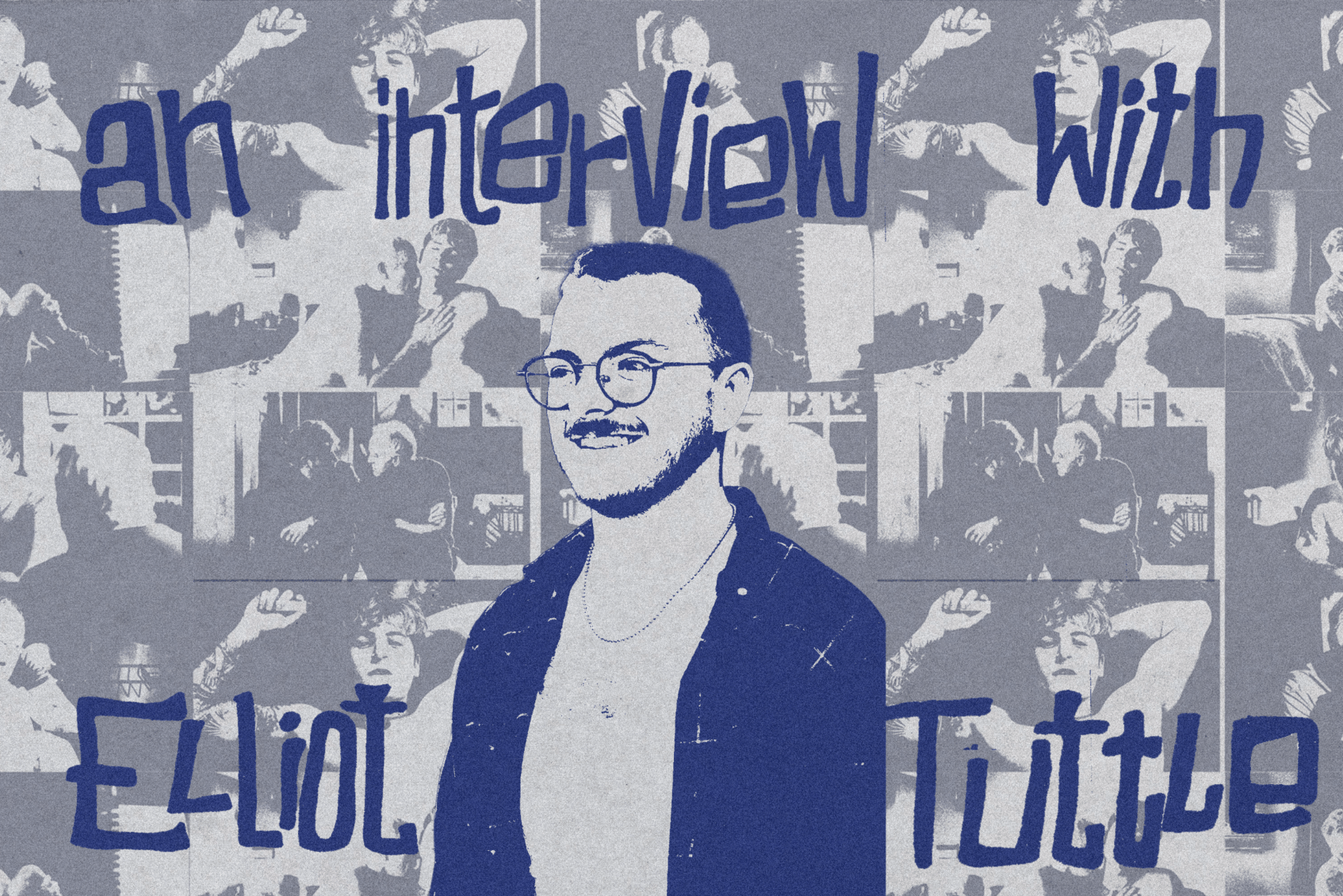
A gay guy in his prime. Is there anything more dangerous? Elliot Tuttle stands outside the grand SVA Theatre, wearing a glitzy black top and holding a pack of American Spirits, having his ear talked off by two NYU students. He just attended the North American premiere of Blue Film at NewFest. As writer and director of the flick, one can imagine that he is feeling a great sense of pride. A large audience—filling the entire Silas Room—has just had what is arguably the most uncomfortable viewing experience of their lives. Tuttle, professing before the screening that he hopes to see applause and walkouts, relishes in the discomfort and emotional vitriol induced by his second feature-length film.
Blue Film follows cam-boy Aaron Eagle on a particularly odd night; he visits a masked stranger at his home. As the night progresses and Aaron becomes extremely uncomfortable with the requests of said stranger, the truth is revealed: Aaron has been hired by an ex-teacher from his middle school who was fired for attempting to assault another student. An exercise in sympathy, Blue Film shows the two men connecting in unexpected ways.
Seven months after its premiere, Blue Film has found a distributor and is finally hitting theatres in New York City and Los Angeles. Reviewed by NPR and The New York Times this past week, it is safe to say that the controversial drama is moving past its days of being rejected by indie film festivals. Elliot and I met via Zoom amidst this heightened buzz to discuss findoms, Catherine Breillat, and the surprising overlap between home videos and snuff films.
Blue Film opens with one of Aaron’s cam shows. How did you decide to start him off as the dominant in this relationship? And, do you feel that his place as a sex worker adds to his experience with Hank?
The inception of the character of Aaron was kind of meant to play with the idea of the contemporary gay male. I think a lot of us have seen this “findom” [financial domination] porn videos. I find there to be a really interesting, I don’t know if irony is the right word, but at least dissonance between some man—straight or otherwise—proclaiming his superiority to the viewer and then he is, often, in like a dirty bathroom. There was something interesting there that I wanted to play with and that I felt lent itself to the arc that I wanted to get at with this character of someone who crumbles into his younger self. I almost think that he ends the film in this kind of submissive position which, in order to get there, there had to be an inverse.
I did research ahead of the film listening to a lot of personal testimony from not just people who are convicted sex offenders, but also sex workers. I also lived in LA for many years and knew sex workers personally. From everything that I gathered, it felt that it also lent itself to a mask being taken off. I think [for] a lot of sex workers, it often is a performance. A lot of them are clocking in for their job in a way and Aaron needed to be able to have his mask come off and to enter the situation on the pretext of his job.
The biggest thing I took was that he needed to be performing for so much of the film and a lot of the narrative engine of the film needed to be predicated on his assumed self versus a true self.
The beginning is kind of Aaron and Hank just pretending. You approach the character of Hank with great sympathy. Did you find that to be particularly difficult, or was that second nature?
There’s this big topic of whether the character of Hank is approached with sympathy. I think sympathy is calling into question somebody’s humanity. The character of Hank is human and he just is.
I’m hoping that when everyone walks into the theater, we are all on the same page that pedophilia is immoral and wrong. Then, we watch the film with that understanding. That character [Hank] simply is and he speaks and he moves around because he’s alive. I wasn’t necessarily writing from a place of trying to sympathize with or demonize him; just simply writing him as he would exist.
What was the casting process like for Hank and Aaron?
Reed [Birney] was always my first choice. I love him. I think he’s such a fabulous actor and an incredible theatre performer too. And this film, by design, is pretty theatrical. I always wanted him. I wrote as soon as the actor’s strike was over. We sent him the script, he liked it, and he took a meeting with me.
After we cast Reed, we did a bunch of chemistry reads over Zoom with different actors for Aaron. Kieron [Moore] was fabulous. He stood out immediately. They also loved each other. Reid and Kieron got along immediately in texting and emailing. If either one of them hadn’t done the movie or the film didn’t exist, I have faith that they would have found each other and become best friends.
Kieron blew us all out of the water over Zoom, which is tough. I was really nervous about doing it over Zoom. We had a great casting director—Eléonore Hendricks—who provided me with so much invaluable support during the process. The whole thing, it’s two actors. They need to be fabulous and they need to work well together. But, it came together pretty quickly.
It’s very conversational. Kind of reminds me of the movie Margaret (2011).
Yeah? Lisa Cohen (Anna Paquin), the most annoying and also greatest character ever seared into celluloid. That move is such a tour de force on, like, so many levels.
I also get kind of irritated sometimes when people are like, “This should be a stage show.” I think the greatest thing about film is that intimacy that it provides. You can look into an actor’s eyes so intensely and not be self conscious at all because they can’t see you. It really lends itself to stuff like this.
This is something I highlighted in my review just because it stood out to me, but what was your motivation for placing the sequences of home videos of children between the scenes of Aaron and Hank?
It felt important to remind an audience of what both characters are talking around for most of the film. To me, I can only make a creative decision in the editing room if it moves me. And, that felt like it moved me and also raised the stakes in a way.
I also think that I was very interested in this aesthetic of using MiniDV or a camcorder because it’s like only used for family home videos and snuff films. There’s the weirdest kind of Venn diagram and it really fit perfectly into this texture of the film that felt at once very intimate and very, very dangerous.
When you first wrote the screenplay, what led you to approach this topic?
I had been watching a lot of Catherine Breillat (Anatomy of Hell, Fat Girl) films at the time, who I think interrogates adolescent sexuality or just the taboo parts of our brain with such honesty and vulnerability. I was journaling while watching these films and thinking about my own adolescent sexuality. I was thinking retroactively on this time of my life—thinking about fantasies I had at the time and then tried to naturally extrapolate. What was I actually like? What was I actually fantasizing about?
To me, the film has changed a lot since its initial inception. I think that part of that is still very much in the character of Hank, but Aaron, he’s very personal to me. He became a very personal character in rewriting the script before production. He is now more so a reflection of my experiences and feelings of being a gay man in a big city. Hank kind of comes from an extrapolated thinking of my past.
As an individual audience member, you can only meet the film where you’re willing to meet it. I think I was trying to establish a relationship and a dialogue with every single member of my audience.
What do you make of the public response so far—specifically, the refusal of many festivals to include Blue Film?
I’ve been very happy with the audience response which is really what I care the most about. If I had ever been frustrated by festival rejection, or whatever it was, it wasn’t because I was frustrated that I wasn’t pleasing the gatekeepers. It’s that I wasn’t getting to an audience. In that way, the audience, that’s the reception I care about and that has been a very nice experience.
It’s been wonderful to have people come up to me and talk to me about it afterwards and share such personal reactions to the film. They really vary. I’m happy to entertain any discussion with anyone who feels negatively or positively about it. People have been engaging with it in earnest and that feels really nice. So in that way, I’m very happy.
Blue Film is currently playing at The IFC Center with Q&As this week.