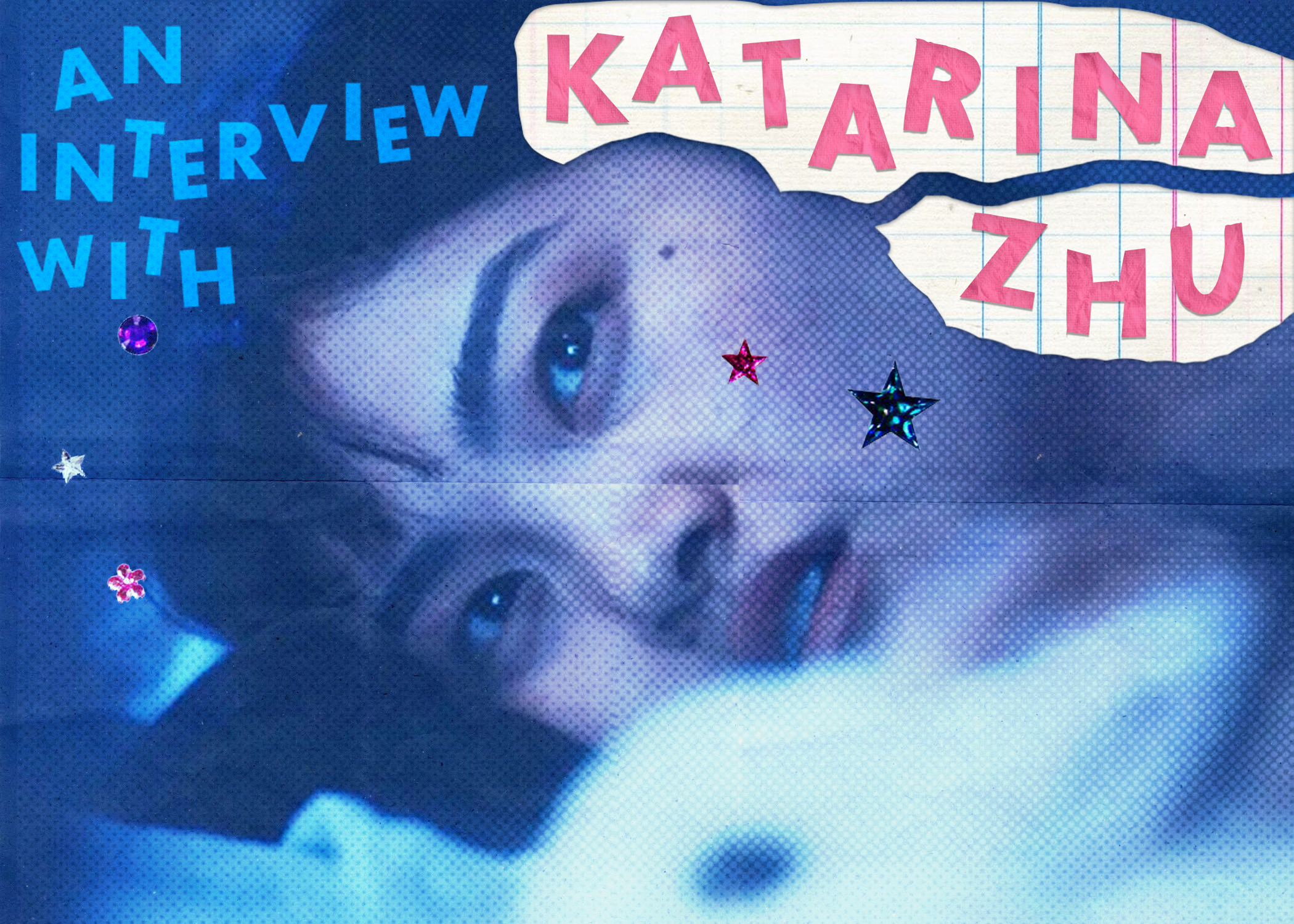
Katarina Zhu is a director, actor, and an alum of NYU Tisch that we are very proud to claim. Premiering at Sundance 2025, her debut feature Bunnylovr follows an often-dissociating cam girl (Rebecca, played by Zhu herself) as she struggles to rekindle the relationship with her dying father. At the same time, she embarks on a relationship with a client that becomes increasingly obsessed with her, sending her a white pet bunny to keep her company. Bunnylovr does not head in the direction of Fatal Attraction, but it builds an air of unease as the requests of Rebecca’s client become more discomforting.
Ahead of Bunnylovr’s New York premiere at Quad Cinema, Zhu answered questions about synth-filled scores, internet personas, working with her longtime friend Rachel Sennott, and—of course—bunnies.
I loved your performance in Bunnylovr. Rebecca feels so distant sometimes, but you still get a strong sense of her internal world. How was it to build her character, both on- and off-camera?
It’s so funny when people say, “Oh, she feels so distant, or inaccessible.” To me, obviously, it feels like you know her so intimately and she’s sort of an open book. But, I guess that’s not the case. It sort of makes me think about how I’m coming across. Am I actually really cold and standoffish or, like, inaccessible when I think I’m pouring my heart out to people?
In terms of building the character on- and off-camera, I took two extremes of my personality and really amplified them. I really drew on a younger version of myself and a younger version of my friends. I worked with an acting coach, Ted Sluberski, in the weeks leading up to shooting to lock in the performance.
I prepped so much that, once we got to set, I was able to live in the character pretty easily. Having the help of my DP Daisy (Zhou) was so instrumental. There are moments where she was definitely coaching me through scenes and I know I couldn’t have done those scenes without her.
When you think of Rebecca, what were these two extremes that you were tapping into?
One is an inactive state, like this sort of passiveness that she has. The other is this reckless, messy charging-ahead-like-a-bull-in-a-china-shop side to her where she makes impulsive, sometimes silly, decisions that feel out of line with the more meek part of her.
A lot of the descriptions for the film describe her as “drifting.” I don’t know if “drifting” is the right word.
Wait, I’m so curious. What word would you use?
There’s times where she’s just completely static more so than drifting.
Totally. Like, stuck, yeah.
You’ve directed shorts like Silver Lake Cleaners and Shrub before. What went into developing your visual and directorial style for a feature length film?
It’s a lot of the same, obviously. It’s basically all of the same skills. The things that really changed were that I had more resources on the feature. I had more help in terms of having actual department heads for each department to be able to take a vision board that I made and run with it, or be on-call.
Building it out, [there was] so much work with my DP Daisy Zhao. She actually also went to NYU. She was in the film program and she has a really amazing sense. She’s just the best. I think I don’t have as much technical language surrounding camera or lighting, but I feel like Daisy was able to take the way that I was able to talk about how I wanted a scene to feel and she was able to translate that into a frame.
I’m pretty particular about movement and framing and composition, but I think my blindspot is color. Daisy really filled in the gaps there and created these amazing color palettes. We worked with our colorist, Josh (Bohoskey), to create a lot before we started shooting. We shot with that LUT on the footage. Once we got into color, it was a matter of tweaking things here and there, but it made the post-process for color much easier.
The shots in this film are so close to the characters and their expressions. What was the process like deciding that camera language?
I wanted it to feel very intimate and textural. There’s this shot that some people talked about where you see the beads of sweat on the character’s nose. It was important to me to capture all of that detail. All of the detail adds to the texture of the world of the film.
I was looking at directors and cinematographers like Eliza Hittman and Hélène Louvart. The way they shoot bodies, it’s so intimate and it’s this roving, handheld style that makes it feel like you’re just a fly on the wall and you’re right there with them.
Tonally, it felt almost like Shiva Baby where it’s a thriller/horror without really having all of those elements, but it gives you the same anxiety.
Totally. It wasn’t one of my direct references, but I think it was probably somewhere in my subconscious influencing without me even realizing it.
What was it like getting to work with your friend, Rachel Sennott?
A dream come true. Total dream come true. We were doing these Three Sisters (Chekov) scenes together in acting school and these crazy, intense plays. It was fun to be able to act in something together with her because we hadn’t done that since college.
She is the most amazing collaborator and supporter. I wouldn’t have been able to do it without her. Not even the stuff that people see. It’s me calling her on the phone like every week, or every day in post, crying being like, “I don’t know how we’re gonna finish the movie.”
“Detonate” [by Charli XCX] is a big part of the trailer. It appears in the film and it feels very fitting because Charli produced it in isolation during the pandemic. Eli Keszler scored the film and he’s worked on very Internet-centric films like Peter Vack’s work and The Scary of Sixty-First. How did you go about choosing the sound for this cold online world?
I had really loved Eli’s work. He did the score for this film that was at Cannes, Harka. I remember when we were looking for composers, there was something about Harka. His work on Harka and then his work with Oneohtrix Point Never made me feel like he was just the perfect person to compose.
In terms of choosing the soundtrack, how i’m feeling now got me through the pandemic. I was just completely rinsing the album the entire time I was living alone at home with my mom. It just felt very naturally tethered to the film. I wanted the score to be mostly synths and Eli is a master with that.
What made you gravitate towards the world of camming when you first thought of Bunnylovr?
I’ve always been interested in our online personas. Everybody has one now; they’re so ubiquitous. I think what really interested me was the more mundane or day-to-day aspects of life as someone who is like a sex worker, but not full-time. That’s such a modern thing because of the rise of OnlyFans and because of the Internet. It’s allowed us to have all of these different lives online and dip in and out of them.
I keep saying this in interviews, but I’m always interested in a movie that deals with female sexuality and desire and shame. Like, any Catherine Breillat film or even Babygirl. I gravitate towards those movies. At the same time, I was really interested in exploring these digital, online personas and camming felt like the perfect intersection of those two things.
I’d never seen a cam girl, or a sex worker, depicted in such a 360 way where you see every aspect of her life and every aspect is given equal weight. You see a sex worker in a film through the lens of their work and not much else.
The final montage where it seems cut between your character and clips of her father, what made you want to combine these two images this way?
The very last scene when she’s masturbating? That one. It’s so funny because during feedback screenings there was such a clear, gendered divide in terms of reactions to that scene. A lot of the women who were in feedback screenings, it was completely clear to them what that was. A lot of the guys were sort of like, is she attracted to her dad? What is happening? What does it mean?
They were really reading into it in this funny way. It’s not that deep at all. It’s just intrusive thoughts. I was useful as a device to track back to show us her journey. It’s not that deep.
One last question, did you build a connection with your co-star, the bunny?
I did. By the end of the shoot, the animal handlers and the animal agent, they trusted me entirely with the bunny. Me and the bunny had a symbiotic relationship. I would like to think I have a calming, chill energy. I really tried to turn that all the way up and I think the bunny responded to that.
I don’t think of myself as someone who could ever own a pet, but working with the bunny for that week made me at least question getting a bunny.
I mean, the bunny seemed very calm.
It was. It was in the moments that we shot it. No, yeah. It was calm.