
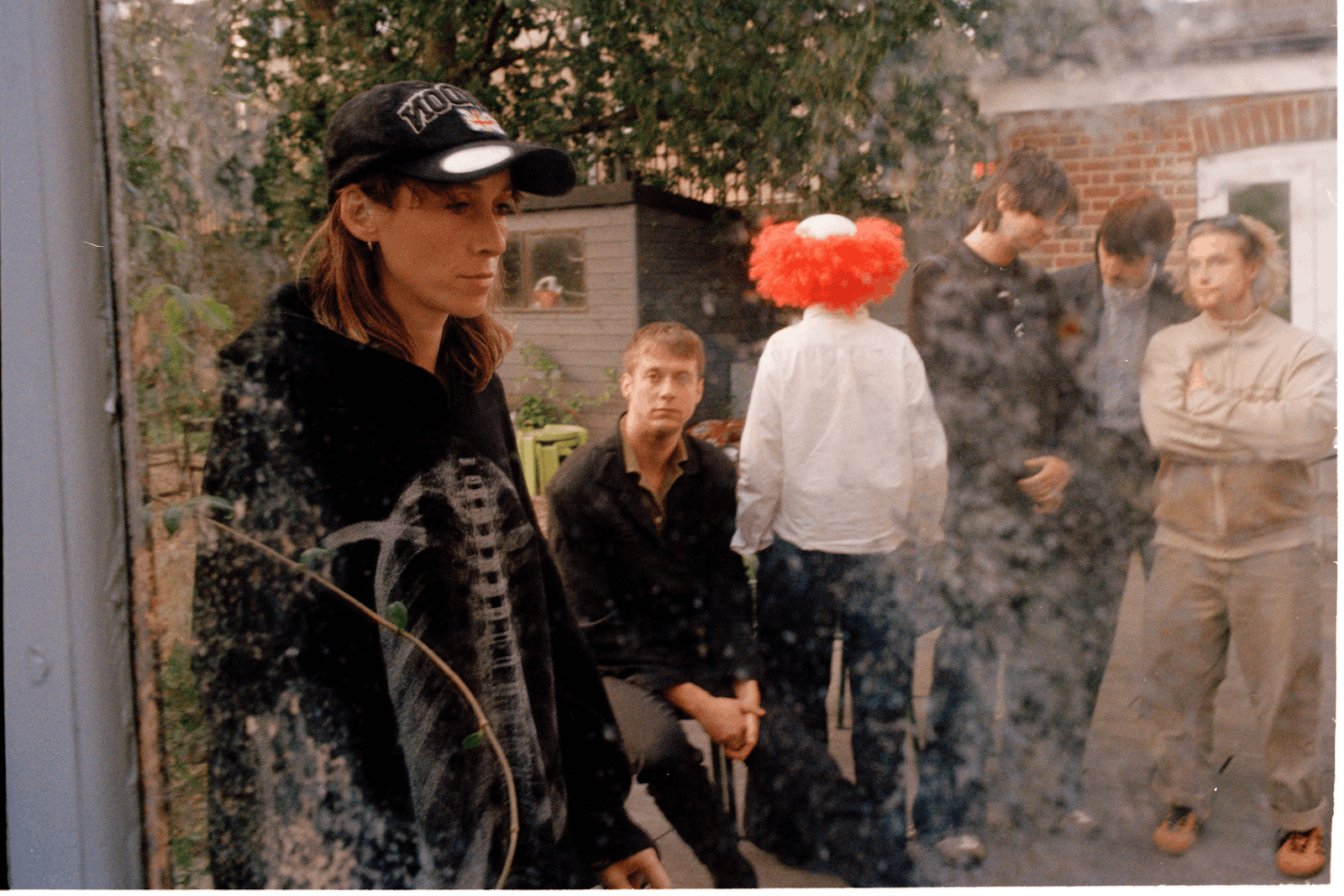
Creaking up the attic stairs, I was not sorry to hear laughter cascading down from an artist hued dressing room. It was dimly lit with clothes tossed in preparation for performance with cracked-open beer cans and chips crunching between breaths. Sorry’s warm up began within the Bowery ballroom’s attic: a cove for their resilient and boisterous friendship and a pre-game for their third U.S tour for their 2025 album COSPLAY.
Sorry, a band once known as Fish, began to release soulful, grittily produced singles in 2017 with Asha Lorenz and childhood best friend Louis O’Bryen. Their first album Home Demo/ns 1 kickstarted a fan-craze for their indie rock pop lo-fi fun with their unique collection of noise. Soon after this release, they welcomed in their friends/band members and transformed into the band Sorry. Lead singer Asha Lorenz is the lead vocalist along with Louis O’Brien backing vocals and producing, Lincoln Barrett as drums, Campbell Baum as a multi-instrumentalist, and Marco Pini with live electronic mixing and sound production. Their friendship began in North London long before the band became official; despite the average toils of growing personalities and independent nuff. O’Bryen, with Lorenz in the lead, merged to create genre clashing, see-saw music. Each album grew different wings, especially their first official album 925 in 2020 which was reminiscent of a dark dream and escapes some of the melancholy in Home De/mons 1.
Shortly preceding their first U.S tour, the band released their second album Anywhere But Here, in 2022, which foreshadowed their small break from new releases until 2025. Last year, they released COSPLAY— an album that focuses on the rejection of Adam Curtis’ hyper-normalization. Itattempts to build on Curtis’ ideas of sameness within society and the way people shape themselves on what is the perceived “norm” of identity, belief.Within COSPLAY’s unique and unstructured phonetics, they reject the common tendency to conform. Their lyrics unite pop culture references — like Elton John’s Marilyn — with unique, comedic, sad, and inspired personal stories. Their album aims to remind that pop culture doesn’t have to be copied to be remembered, but can be used as building blocks and inspirations.
COSPLAY comes out of the natural gestures of life and mostly random jams produced by the musical instinct of each member. I was lucky enough to glimpse into the way all of their brains (excluding Lincoln Barrett) winked at each other inside the intimate, boisterous dressing room above the Bowery Ballroom.
[This interview has been condensed and edited for clarity]
What was it like performing as an opener for the Maccabees?
Pini: You’re kind of just on stage and it’s harder to connect with the audience because they’re not there to see you.
Louis: Especially when you’re with a bigger band like that as well. At that point the audience is so widespread. Your music is definitely not gonna hit all of those people.
O’Bryen: Back in the day when you knew the people that were there, it was intimate.
Lorenz: We’ve never done anything like that.
Was it nerve-wracking?
Lorenz: Yeah, it’s alienating. You feel weird because you’re so far away from everyone, so it’s hard to feel engaged because you can’t really gauge the activity of the audience.
What do you want to gauge from the audience?
O’Bryen: Wailing at the tears.
Lorenz: You can feel the energy. You can feel when people are not engaged or if the vibe is dipping. When you can’t really see, like opening for a bigger band, you especially feel it. Smaller and bigger performances are both cool, they’re just different. The audience is duller when you’re on a bigger stage.
Do you feel the “vibe” difference from the audiences of Europe versus America?
Pini: It’s strange because America’s so big so each audience has its own specific vibe to it. New York crowds are pretty lit, and then dead. I remember we played in Ohio and we were surrounded with the sweetest people. [Pini turns to Baum, O’Bryan, and Lorenz] Do you remember when we were hanging out with those guys?
Baum: What city in Ohio? Columbus?
Pini: We played in this room, with stages in the corner and when we got there a witch fair.
Lorenz: What?! I wasn’t there!
Do you guys interact with the audience differently? As in, when you saw the witches, did you catch a vibe of the audience and think, “OKAY! I know how to treat this audience.”
Baum: For witches, with spells! When we’re up on stage we’re having fun. That’s what we try to do, and that’s what we want to show the audience, no matter what.
Your new album COSPLAY is largely inspired by Adam Curtis’ documentary “Hypernormalization,” a fairly heavy topic splattered in suffering. Your songs also tackle some of these topics and attempt to reject hyper normalization. How do you deal with these heavier topics in your songs while still maintaining the happy fun vibe you want?
Lorenz: I think life is ups and downs and our music is about trying to balance all the words, faces, and the vibe of the references. You want it to come from a place of rawness, and then you want to build around it while keeping that. Genius is trying to balance that with the reality of how you’re feeling. That’s a fun thing about an album; You’re making a little world of something, and everything is connected. You’re trying to balance it out, and there’s so many things to connect to understand their own reality. It’s like fiction even though it’s not.
Is music to you then like giving the listener the story? Having fun performing, but creating it with an intent to effect.
Lorenz: I think we struggle with that in our live shows, because sometimes the songs are kind of an illusion. It’s a little confusing, especially when you’re touring and you run into a bad venue, with bad sound and lighting. The effects, lighting, all make a show more electric and alive. But it means we don’t always tell the story we are trying to tell.
If you guys catch these altering vibes of the venue and so does the audience, do you try to alter your production of sounds?
O’Bryen: The energy of the audience guides you towards something, and you embody that.
Baum: Your response changes my answer.
Pini: I have a really weird job, related to what Asha is doing.
Baum: [To Lorenz] If I see you going for it, I go for it.
Pini: If the sounds that Asha is making are more aggressive, it changes my electronic mix.
How do you guys work together on stage, live? Do you learn gestures?
Baum: [To O’Bryen] We have a little thing going on. You look at each other and are connected through the zaps of music.
Pini: You guys are at the front. So you’re kind of quite connected to the crowd as well.
What’s the worst show you guys have ever experienced?
Lorenz: A single launch, three years ago at my house. Someone showed up and gave me some liquor, I was feeling sad. It was a really small show with basically just our label, and I just got way too drunk and went off crying and vomiting. Everyone was angry, I was crying.
O’Bryen: I think our manager cried.
With that close friendship, how has your music production evolved along with it? Do you guys ever just break out into dance sessions?
O’Bryen: Yeah. Last night was our first dance battle! I think we’re gonna do it tonight as well.
Lorenz: We understand each other, and can really easily build off of each other’s music because of our friendship.
How do these dance battles start, were you listening to anything?
Lorenz: No, we just start making music. Rap battles, shouting at each other. It never ends.
Baum: There’s loads I found a 10 Minute voice memo and it’s just Asha rapping into my phone.
O’Bryen: It could be ten hours! We’d be doing a thing and then we’re all “WOOWWWW! THIS IS SO SICK!”
Do you ever, do you ever use those as inspirations?
Lorenz: Pretty much every song is something like that.
O’Bryen: I remember when “Candle” was made.
Lorenz: Louis came home at 6am and I was up partying, and he came in and said, “I AM CANDLE,” and it was funny, so we wrote a song about it.
You’ve revealed that your experiences of life will shape your music. But in this album, you use a lot of references, and direct references, how does that play into your own story telling?
Lorenz: Each song is an idea that collects building ideas. Like “Candle,” which suddenly came out and then kind of referenced the Elton John song about Marilyn which feels as if she’s going to sing it. It just kind of does, and once we wanted to do more references, things started to happen and work as a whole. The sound of a song, or its resonance has something it will remind you of that inspires. Universally too, even people a bit younger than us, I think they have less grasp on pop culture. But popular culture is still being widely shared in the world and you can use them now.
Do you see sound in everyday life? How often do you feel inspired throughout the day by these references?
Pini: It’s pretty boring to not use everything as some kind of thing that’s gonna be used someday in some way. But not necessarily sound, I don’t think.
Lorenz: I like making music every day, even if I don’t use it. Practicing how you’re interpreting things makes me see way more connections in the day, and makes me feel more inspired. But, it’s something you have to be actively doing. When I’m not doing that, I’m not picking up on things. They kind of all feed into each other. So, you have to push yourself, otherwise, I don’t know what I’m listening for. It can be a bit of a fuss. Can drive me a bit mad.